
Live Updates: Trump says U.S. prepared to strike Iran “anytime we want” after carrying out “very heavy attack”
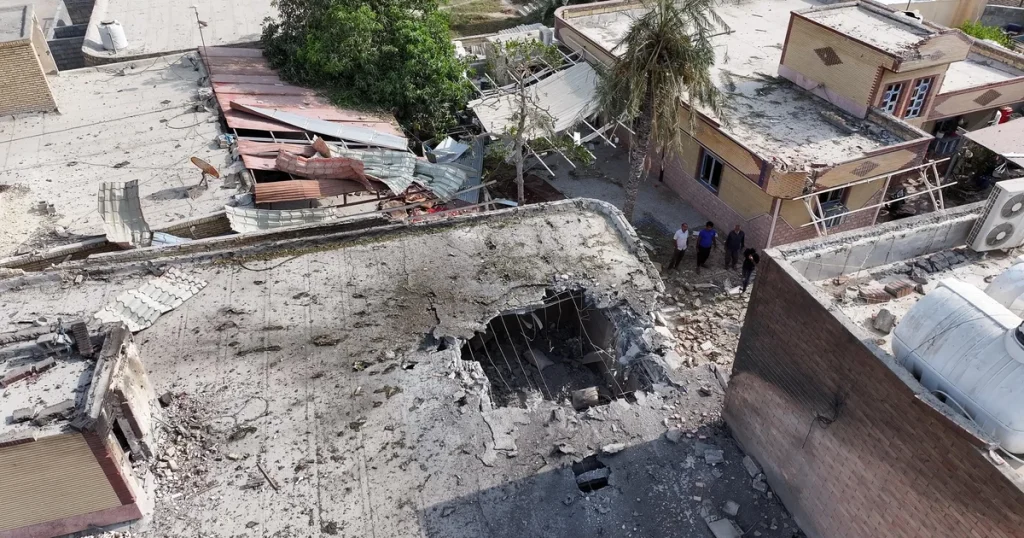
U.S. Strike Hits Iranian Wedding; Trump Vows More Strikes “Anytime We Want”
Bizeconanalysis.com – At least four people were killed and dozens more wounded when a U.S. military strike struck a wedding celebration at a private home in southern Iran, according to Iranian authorities. The attack, carried out Tuesday night, became the latest flashpoint in a conflict that has simmered for months despite official declarations that major hostilities had concluded. Footage released Wednesday morning by the Iranian Red Crescent, filmed from above after daybreak, revealed a gaping hole in the roof of the wedding venue, with shattered debris scattered across adjacent alleyways.
The father of the bride, Ali Mallahi, described the incident in a video carried by Iranian state media.
“I really don’t know what to say,” he said. “Thank God the casualties were not higher.”
He called it “a very saddening incident.” Other footage distributed by Iranian outlets showed wounded children lying in hospital beds. One man, visibly suffering from a head injury while lying in a hospital bed, recounted being en route to the wedding when he heard fighter jets overhead.
“As we arrived there, an explosion happened. It was really powerful, so powerful that even before I arrived there, pieces and debris from the building smashed into my head and face and I passed out,” the unnamed man said. “Lots of children and women were horribly injured. All the people were ordinary people.”
A spokesman for U.S. Central Command said the military was reviewing the allegations and reiterated that the United States does not target civilians.
Trump: “A Very Heavy Attack”
President Trump addressed reporters in the Oval Office on Wednesday, describing the Tuesday-night strikes as a response to what he characterized as an Iranian provocation in Jordan.
“They gave a little love tap, but we hit them very hard last night,” he said.
The president claimed the U.S. “took out all of the new equipment that they tried to build along the Strait of Hormuz,” the narrow waterway through which roughly one-fifth of global oil shipments pass. He added:
“It was a very heavy attack last night. And we’re prepared to do another one anytime we want.”
In a separate remark Wednesday, Trump floated the idea of renaming the Strait of Hormuz after himself, saying, “Now that we have it under” — a comment that drew immediate attention given the strait’s centuries-old name and its critical role in international energy logistics.
Kuwait Air Defenses Engaged
The broader regional fallout continued Wednesday as Kuwait’s air defense systems responded to incoming missile and drone attacks. The Kuwait Army confirmed in a social media statement that the projectiles were launched by Iran and that any explosions heard across the country were the result of interceptor systems neutralizing the threats. Residents were urged to follow safety instructions issued by local authorities.
The Gulf state’s involvement underscores how quickly a bilateral confrontation between Washington and Tehran can ripple across neighboring countries that host U.S. military installations or sit along shipping lanes.
Naval Blockade Tightens
U.S. Central Command reported that it had redirected 86 commercial vessels as of Wednesday, up from 84 the previous day. The Navy also disabled three vessels and boarded two others to “ensure compliance,” according to a CENTCOM social media post.
“The U.S. Navy continues to strictly enforce the U.S. blockade against Iran,” the command stated.
The blockade, which restricts Iranian maritime commerce, has been a central lever of pressure in the ongoing standoff. Shipping insurers and freight operators have been adjusting routes and premiums in response to the sustained naval presence in the Gulf and approaches to the Strait of Hormuz.
Gas Prices and the White House Energy Meeting
With crude oil markets sensitive to every development in the region, Trump said he had spoken with oil executives about price gouging the day before. A White House readout of the Tuesday meeting described a gathering of nearly a dozen small, midsize, and large refiners and distributors convened to discuss expanding domestic refining capacity.
Asked whether price gouging was on the agenda, the president confirmed it was.
“These were mostly retailers, and I want the retail prices to come down,” he said.
The economic stakes are tangible: as of Wednesday, the national average price for a gallon of regular gasoline stood at $4.12, nearly a dollar above the level recorded one year earlier, according to AAA. For American drivers, each escalation in the Gulf translates into higher pump prices within days, a dynamic that has shaped political calculations around the conflict.
The “Operation Epic Fury” Naming Dispute
Adding a layer of bureaucratic confusion to the already tangled conflict, an Air Force email from August — obtained by CBS News — revealed that the Pentagon had been instructing personnel to stop referring to ongoing U.S. military operations in Iran as “Operation Epic Fury,” roughly three months after the Trump administration publicly declared the operation concluded.
In response to questions, the Pentagon confirmed Wednesday that Operation Epic Fury officially ended on May 5. That same day, Secretary of State Marco Rubio told reporters at the White House:
“The operation is over. Epic Fury is — the president notified Congress — we’re done with that stage of it. We’re now on to this Project Freedom.”
Four days before that announcement, Trump had told Congress that the “hostilities” had “terminated.” Yet the Pentagon and Central Command had declined to disclose a formal end date for months, leaving military personnel and analysts without a clear operational boundary.
In practice, the U.S. and Iran have continued exchanging intermittent fire since May 5, punctuated by lengthy pauses in fighting, including a ceasefire that took effect in early April. The gap between the official narrative of closure and the continued exchange of strikes has fueled questions about how the administration defines the scope and duration of its military engagement.
For now, the wedding strike and Trump’s pledge of further action suggest that the pause in hostilities may be short-lived, and that the Strait of Hormuz — whether renamed or not — remains the geographic and strategic fulcrum of the confrontation.
Related Reading
Frequently Asked Questions
What is Live Updates: Trump says U.S. prepared to strike Iran "anytime we want" after carrying out "very heavy attack"?
Live Updates: Trump says U.S. prepared to strike Iran "anytime we want" after carrying out "very heavy attack" is the main topic of this guide. The article explains the context, practical details, and next steps readers should understand.
Why does Live Updates: Trump says U.S. prepared to strike Iran "anytime we want" after carrying out "very heavy attack" matter?
Live Updates: Trump says U.S. prepared to strike Iran "anytime we want" after carrying out "very heavy attack" matters because readers are looking for a useful answer, not just a short summary. Good content should match search intent and help them decide what to do next.