
“Payam Method” hits the right note with piano students, making music education fun and accessible for kids
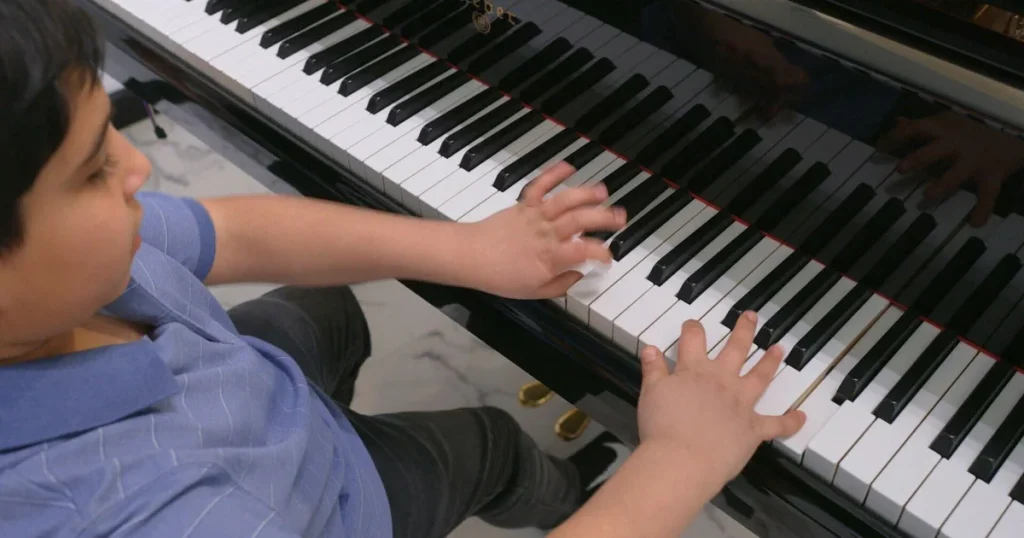
Transforming Piano Education: The Payam Method’s Innovative Approach
Payam Method hits the right note – Khastkhodaei once believed his greatest accomplishment was placing second in a local piano competition. However, his true breakthrough came when his students began dominating music events nationwide. This 32-year-old educator, whose family emigrated from Iran, has developed a revolutionary technique that not only enhances learning but also ignites a passion for piano in young learners. His method has achieved remarkable results, with students progressing faster and reaching advanced skill levels at a pace far exceeding conventional practices.
Breaking the Traditional Mold
Unlike traditional methods that focus on reading sheet music from the outset, the Payam Method starts with foundational elements like numbers and basic concepts. In a repurposed home in Bothell, Washington, Khastkhodaei and his team of young instructors demonstrate this approach, creating an environment where music education feels less like a chore and more like an engaging adventure. Lesson fees range from $75 to $100, catering to a wide spectrum of students, from preschoolers taking their first steps on the keyboard to high schoolers refining their technique.
“Our students don’t just learn piano, they love piano,” Khastkhodaei said. “And that’s one of the biggest keys to it.”
Khastkhodaei’s system emphasizes coordination and creativity, moving away from rigid memorization of notes. Instead of traditional notation, students are introduced to numbers associated with keys, fostering a more intuitive understanding. “They’re not reading notes. They’re not even sometimes looking at sheet music. We’re playing a game. And it’s fun for them,” he explained. This playful framework encourages experimentation, allowing learners to explore tempo, style, and mood as they progress through 18 structured levels.
A Different Path to Mastery
One of the method’s most striking features is its accelerated path to proficiency. Traditional piano education often requires 12 years to achieve a diploma level, a milestone likened to a black belt in music. In contrast, Khastkhodaei’s approach has seen 96% of students reach this advanced stage in just four years. “In piano we have this thing called the diploma, which is sort of like the black belt of the musical world,” he said. This transformation is attributed to the method’s focus on building muscle memory and fostering a deep emotional connection to music.
Students eventually transition to reading sheet music, but the process is designed to feel less daunting. By integrating creative composition into early lessons, the Payam Method ensures that learning remains dynamic and rewarding. Even those who aren’t aiming for concert stages find joy in creating their own music, a practice that has become a hallmark of the curriculum. Delara Rahmatian, a 12-year-old student, recently showcased her third original composition, illustrating how the method nurtures both technical skill and artistic expression.
Scaling the Success
Khastkhodaei’s innovation has gained traction thanks to Hadi Partovi, the co-founder and CEO of code.org, who is also the parent of one of his students. Partovi draws parallels between his coding platform and the Payam Method, noting that both prioritize accessibility and engagement. “We don’t teach coding with ones and zeros or angle brackets and semicolons. We teach it with blocks and dragging and dropping to make it easier,” he said. Similarly, the Payam Method introduces music through ABCs and 123s, making complex concepts more approachable for beginners.
“One is, we don’t teach coding with ones and zeros or, you know, angle brackets and semicolons. We teach it with blocks and dragging and dropping to make it easier,” Partovi said. “Similarly, Payam Music teaches music starting with ABCs and 123s before you learn the code of how music is written.”
Partovi has since taken the lead as CEO of Payam Music, aiming to expand the program nationally. His vision includes establishing schools with five to seven music rooms to accommodate around 150 students each. “It’ll take us about 100 schools to get to 10,000 students,” he noted, highlighting the ambitious goal of making high-quality music education available to a broader audience. The method’s popularity is already evident, with new locations like the Santa Monica, California, branch attracting attention from both students and educators.
Industry Recognition and Personal Connection
Industry veterans have also taken notice. Hans Zimmer, the acclaimed composer behind scores for over 150 films, has invested in the Payam Method, recognizing its potential to transform how children engage with music. Before achieving global fame, Zimmer struggled as a student, being expelled from eight music schools. “To this day, I just remember these piano lessons as being horrible,” he reflected. “And here’s a man who figured out a way of giving children this opportunity to have absolute happiness, you know? To love music and love themselves,” he added, underscoring the method’s ability to reignite enthusiasm for learning.
Zimmer’s endorsement has helped elevate the Payam Method’s profile, particularly after visiting the Santa Monica campus. There, he witnessed students performing original compositions, including one by Partovi’s son, who now writes music as part of the program. This blend of creativity and structure has not only made piano lessons more enjoyable but also more effective, with data showing significantly higher success rates compared to traditional models.
The Future of Music Education
As the Payam Method continues to grow, its impact on music education is becoming increasingly significant. By prioritizing playfulness and personalized learning, Khastkhodaei and Partovi have created a system that resonates with young minds. Their approach challenges the notion that music instruction must be dry and technical, proving that joy and mastery can coexist. With plans to expand nationwide and a foundation of support from industry leaders, the method is poised to redefine how children interact with music, offering a path that is both accessible and inspiring.
For Khastkhodaei, the success of his students is the ultimate validation. “Try it once and you’ll understand,” he said to skeptics, emphasizing the method’s ability to transform even the most reluctant learners into enthusiastic musicians. This philosophy, combined with the backing of investors like Zimmer, ensures that the Payam Method will continue to innovate, making music education not just a skill but a lifelong passion.