
The battle over Stars and Stripes
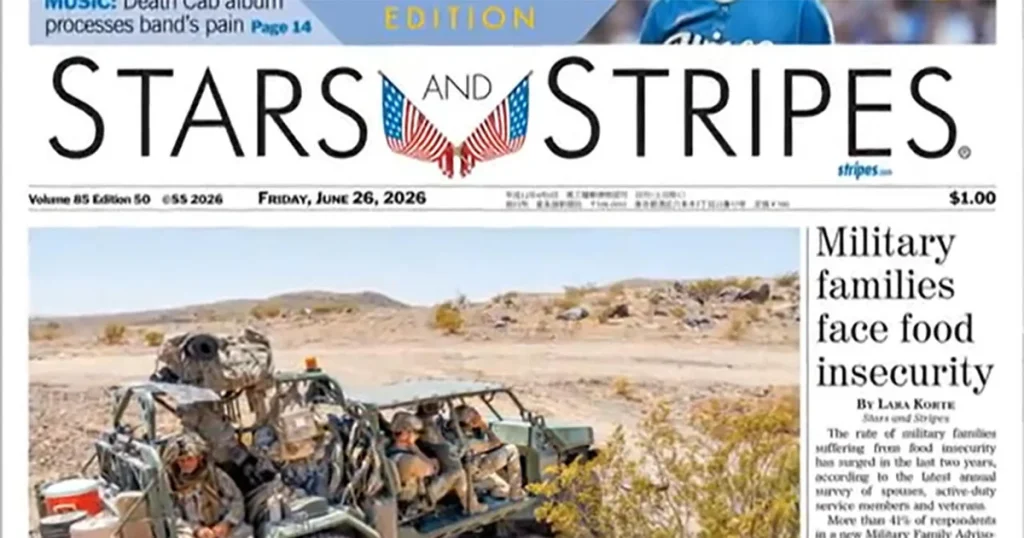
A Military Newspaper Faces Its Sharpest Editorial Fight in Decades
Bizeconanalysis.com – When the Pentagon’s top spokesman took to social media last January to announce that Stars and Stripes would be “brought into the 21st century” and its content would be “refocused away from woke distractions that syphon morale,” few outside the paper’s small newsroom expected the statement to ignite a constitutional showdown. Yet within months, the newspaper that has served American service members since the Civil War era found itself at the center of a First Amendment lawsuit, a fired ombudsman, and a fundamental question about whether a government-run publication can truly claim editorial independence.
Stars and Stripes reaches roughly 1.4 million readers daily, the vast majority through its digital platform. A print edition still ships to overseas garrisons where broadband connections remain patchy. Its reporters are employees of the Department of Defense, and the publication sits within the Pentagon’s organizational structure. Even so, the paper has long operated under a self-imposed standard of journalistic separation from chain-of-command influence.
“We’re trying to provide independent news for the military community,” editor-in-chief Erik Slavin has said.
A Century-Old Mission, Revived by a General
The newspaper’s lineage stretches back to the Civil War, but its modern incarnation traces to World War I. General John “Black Jack” Pershing, who commanded American forces in Europe, championed the idea that troops deployed abroad deserved a publication written by and for themselves. Catherine Giordano, who served as the paper’s archivist earlier this year, recounted the origin of that mission.
“It was General Pershing who said, we need a paper for American troops overseas, so they know what is going on and have a sense of why they’re fighting.”
Pershing’s own message to readers framed the enterprise in explicitly democratic terms:
“The paper, written by the men in the service, should speak the thoughts of the New American Army and American people from whom the Army has been drawn. It is your paper. Good luck to it.”
Since World War II, Stars and Stripes has been published without interruption, described in its own tradition as representing “the free thought and free expression of a free people.” That tradition, at least as the paper’s leadership understands it, is now under direct institutional pressure.
The Parnell Post and the Wire-Service Ban
The sequence of events accelerated quickly after Parnell’s January social-media post. Asked what he understood “woke distractions” to mean, Slavin offered a blunt answer:
“I really don’t know what they were referring to, because they didn’t explain it.”
In June, the paper ran a feature on upcoming European concert dates for rapper Bad Bunny, whose Super Bowl halftime performance had drawn sharp criticism from President Trump, who called it “one of the worst ever.” Lara Korte, the reporter assigned to the piece, covers the Middle East beat and is based in Germany. She defended the story on straightforward community-service grounds:
“We have a lot of people who are newly stationed here overseas. They want to find interesting trips to take. They want to have fun.”
“I’m working for Stars and Stripes,” she added, “not for the Pentagon, not for any administration, not for any policymaker. I’m here to cover the military community.”
Simultaneously with Parnell’s post, the Pentagon rescinded a federal regulation that had directed Stars and Stripes to operate “without news management or censorship.” A March 2026 memo signed by the deputy secretary of defense, titled “Modernization of Stars and Stripes Operations,” then introduced new operational constraints. According to Slavin, the memo simultaneously affirmed the paper’s independence while imposing practical limits: comics were barred, and the paper could no longer carry stories from paid wire services.
The wire-service restriction effectively cut off Associated Press dispatches. The AP had been temporarily excluded from the Oval Office after declining to adopt a proposed renaming of the Gulf of Mexico to the Gulf of America. For a military newspaper whose readership spans multiple continents, the loss of a major wire feed meant a narrower window on breaking international news.
“It’s more difficult for us to cover breaking news,” Slavin said.
The Ombudsman Column and Its Aftermath
Jacqueline Smith, who previously served as the paper’s ombudsman — a role functioning as an internal editorial watchdog — wrote a column in April that opened with a pointed jab at Secretary of Defense Pete Hegseth:
“Pete Hegseth doesn’t want you to see cartoons in this newspaper anymore.”
Smith acknowledged the tone was deliberate. “Poking the bear, in a way, but I had not at all expected that retaliation,” she said. Two weeks after the column ran, she was dismissed from her position.
Two members of the paper’s advisory board have since filed suit against the Department of Defense, alleging a violation of First Amendment protections. The Pentagon declined to comment for interview, citing the ongoing litigation.
“By having a government agency say, ‘You cannot print this,’ it’s the beginning of saying more – ‘You cannot print that,’ or ‘You must print this.’ It’s editorial control,” Smith said.
Why It Matters Beyond the Newsroom
The dispute is not merely an internal personnel matter. Stars and Stripes occupies a singular position in American media: a daily publication funded by the federal government, staffed by government employees, yet historically expected to report on that same government with the same scrutiny applied to independent outlets. If the memo’s restrictions represent a durable shift rather than a transitional adjustment, the precedent extends well beyond one newspaper. It touches the question of whether any government entity can condition continued publication on editorial choices — from which wire services may be carried to whether a comic strip appears on page six.
For the 1.4 million service members, families, and retirees who open the paper each morning, the stakes are practical as well as principled. They rely on Stars and Stripes for coverage of benefits, deployments, local events at overseas bases, and the broader national news that shapes the environment in which they serve. Narrowing that coverage, even incrementally, alters the relationship between the institution that employs them and the institution that informs them.
The lawsuit will determine whether the restrictions survive judicial review. Until then, the newspaper continues to publish, its reporters continue to file, and the question Pershing posed a century ago — whether the paper truly belongs to the people it serves — remains, for now, unanswered.
Related Reading
Frequently Asked Questions
What is The battle over Stars and Stripes?
The battle over Stars and Stripes is the main topic of this guide. The article explains the context, practical details, and next steps readers should understand.
Why does The battle over Stars and Stripes matter?
The battle over Stars and Stripes matters because readers are looking for a useful answer, not just a short summary. Good content should match search intent and help them decide what to do next.