
Frustration mounts for thousands still without power after deadly Indiana storms
Days After Deadly Storms, Thousands in Northwest Indiana Still Sit in Darkness
Bizeconanalysis.com – For Shatiya Hardin and her neighbors in Gary, Indiana, the clock ticking toward a restored electrical connection has become an agonizing daily ritual. What began as a single evening of anxiety has stretched into a prolonged ordeal, with families enduring sweltering nights, unreliable refrigeration, and the constant worry of keeping vulnerable household members safe without basic utilities.
“It’s been absolutely horrible,” Hardin said. “At night we’re sweating, we’re irritable, we have children to look out for, elderly people who need electricity for oxygen tanks.”
The crisis traces back to a series of violent storm systems that struck northwest Indiana beginning August 11. Over several consecutive days, the weather events delivered record-setting rainfall to the region, flooding residential neighborhoods and commercial corridors. At least seven people lost their lives in the storms’ aftermath, and roughly 1,000 residents were displaced from their homes. In Gary specifically, the electrical grid collapsed for more than half the city’s population, compounding an already fragile quality-of-life situation in a community where approximately one in three residents lives below the federal poverty line, per U.S. Census Bureau figures.
Scale of the Outage
Northern Indiana Public Service Company (NIPSCO), the utility that serves the affected region, reported that at the peak of the storm damage, 374,500 customers were left without electricity. By Saturday following the worst of the weather, just over 30,100 customers remained in the dark — a figure that, while reduced, still represents tens of thousands of households and businesses operating without lighting, heating or cooling, refrigeration, or the ability to charge medical devices.
The prolonged nature of the outage has pushed many Gary residents into a state of sustained emergency preparedness. Local community centers have opened their doors to provide hot meals, air-conditioned shelter, and phone-charging stations. For families with elderly members dependent on powered oxygen concentrators or other medical equipment, these centers have become lifelines rather than conveniences.
“It’s not OK for us to continually be in survival mode,” Hardin said. “We don’t have service in this area at all whatsoever. At night, the streets, the roads, everything is pitch black besides the lights from the cars.”
State Response and Federal Aid Request
On Thursday, Indiana Governor Mike Braun formally requested an expedited major disaster declaration from the Federal Emergency Management Agency covering 54 counties across the state. Braun has estimated that total losses from the storms and their cascading consequences could exceed $5 billion. A FEMA major disaster declaration unlocks federal funding streams for debris removal, temporary housing assistance, public-infrastructure repair, and individual disaster assistance programs that state and local budgets alone cannot absorb.
“If granted, this declaration will mean significantly more resources to accelerate Indiana’s recovery from the recent severe weather,” Braun wrote on social media.
The request underscores the scale of damage that extended well beyond residential power lines — encompassing road washouts, bridge damage, agricultural losses, and commercial property destruction across the affected counties.
Lawsuit Targets Utility’s Vegetation Management
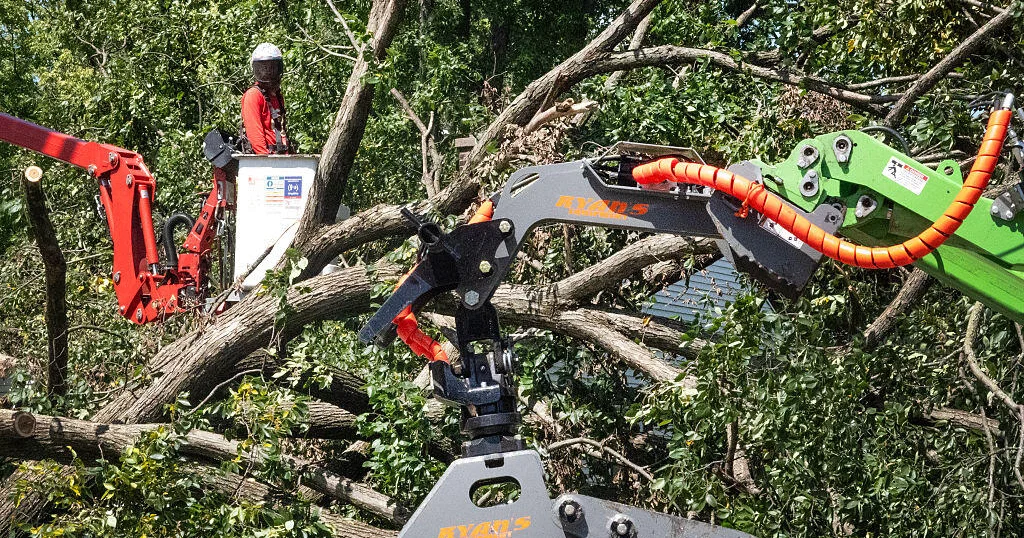
This week, a class-action lawsuit was filed against NIPSCO, asserting that the utility failed to proactively trim vegetation near its overhead power lines. Plaintiffs allege that downed trees and overgrown branches were the primary mechanism behind the widespread outages, effectively converting a weather event into a prolonged infrastructure failure. NIPSCO has publicly disputed the characterization, stating that its vegetation management spending has more than doubled since 2016.
“We strongly disagree with the characterization of NIPSCO’s vegetation management practices,” the utility said in a statement.
The dispute highlights a recurring tension in utility regulation: how aggressively must a company manage the interface between its infrastructure and the surrounding landscape, particularly in regions where dense woodland borders residential corridors? Critics argue that cost-saving decisions on trimming frequency translate directly into outage duration when storms arrive, while utilities contend that weather of unprecedented intensity overwhelms any maintenance schedule.
Mayor Calls for Greater Accountability
Gary Mayor Eddie Milton acknowledged the city’s own role in emergency coordination while pressing for structural change on the utility side. He said the city would review its internal emergency-management protocols to identify gaps exposed by the storms.
“We’re going to revisit what should we do better from an emergency management standpoint,” Milton said. “But going back to the utility side, what I’m going to encourage and demand is that we start having more accountability.”
That call for accountability lands in a community already strained by economic hardship. When a city where poverty rates hover near a third of the population loses its electrical grid for days, the consequences compound rapidly: food spoils, medications lose efficacy, children lose study conditions, and elderly residents face genuine health risks. The frustration voiced by residents like Hardin is not merely about inconvenience — it is about a safety net that failed precisely where it was needed most, and about the question of who bears responsibility when the lights stay off long after the storm has passed.
Related Reading
Frequently Asked Questions
What is Frustration mounts for thousands still without?
Frustration mounts for thousands still without is the main topic of this guide. The article explains the context, practical details, and next steps readers should understand.
Why does Frustration mounts for thousands still without matter?
Frustration mounts for thousands still without matters because readers are looking for a useful answer, not just a short summary. Good content should match search intent and help them decide what to do next.