
How long will Lindsay Clancy trial jury take to reach a verdict? Legal expert weighs in on deliberations.
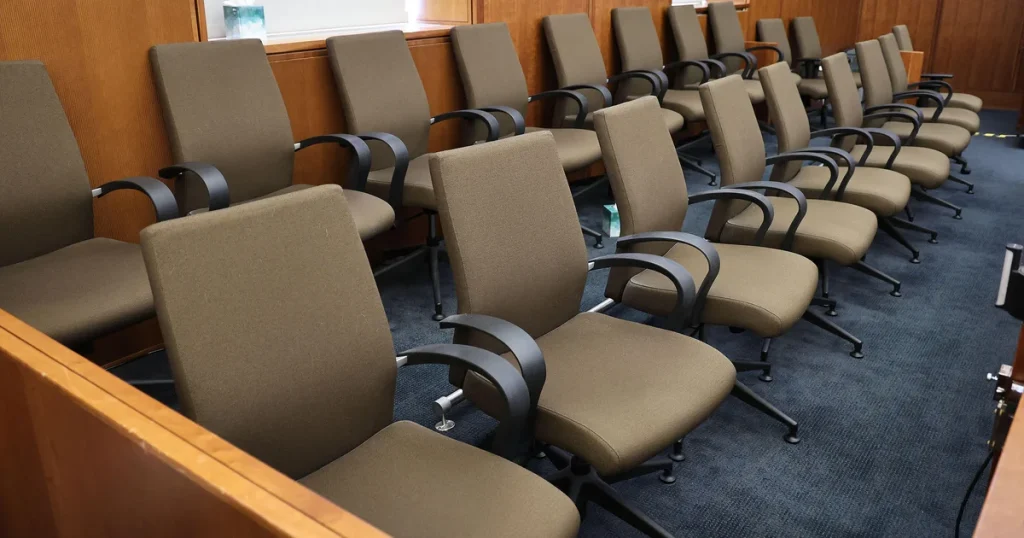
Jury in Lindsay Clancy Murder Case Enters Extended Deliberation, With Verdict Likely Days Away
Bizeconanalysis.com – The twelve jurors tasked with deciding whether Lindsay Clancy bears criminal responsibility for the deaths of her three young children in Massachusetts spent three and a half hours in closed deliberation Thursday following closing arguments at Plymouth Superior Court, and a second day of deliberation followed Friday. A verdict, however, is not expected to emerge before at least Monday or Tuesday of the following week, according to legal analysis of the proceedings.
Clancy faces charges connected to the killings of her children — 5-year-old Cora, 3-year-old Dawson, and 8-month-old Callan — in a case that has drawn sustained public attention across the state. The two sides presented sharply different narratives to the jury: prosecutors contended that Clancy orchestrated the murders deliberately and understood the difference between right and wrong at the time, while the defense maintained that she was overmedicated and experiencing postpartum psychosis, rendering her unable to conform her behavior to legal requirements.
What the Deliberation Timeline Signals
WBZ-TV legal analyst Jennifer Roman offered a reading of the jury’s Thursday session that underscored the complexity of the task ahead. Roman noted that jurors typically conduct an informal “straw poll” at the outset of deliberations — a practice not technically sanctioned by court rules but nearly universal — to gauge where each member is leaning.
“Just by the sheer fact that they didn’t come back [Thursday] at 4:20 means they are not unanimous,” Roman said. “Even if it’s not guilty by reason of insanity, it has to be unanimous.”
The requirement of unanimity across all twelve members, combined with the volume of evidence, makes a swift resolution unlikely. Roman emphasized that the jury must weigh testimony from 85 witnesses, a figure that alone demands considerable time.
“It’s not like Karen Read where there’s a lot of physical evidence they had to go through,” Roman said. “They have a lot of medical reports and notes and her journals. Although there’s not much of it, it’s going to take a while for them to get through it, and then they’re going to have to parse that out with the actual testimony.”
The distinction Roman drew is instructive. In high-profile Massachusetts murder trials built around forensic artifacts — bloodstains, ballistic trajectories, digital footprints — jurors can often anchor their reasoning to tangible objects. Here, the evidentiary landscape is dominated by clinical documentation, personal journals, and expert psychiatric testimony, materials that require careful contextual interpretation rather than straightforward physical inspection.
Composition of the Jury and Its Potential Influence
After alternates were randomly drawn Thursday, the panel was reduced from eighteen members to twelve: nine women and three men. Judge William Sullivan selected an older woman to serve as foreperson, a role that shapes the pace and organization of deliberation.
Roman observed that the gender composition of the panel cuts in multiple directions. On one hand, a majority-female jury might apply a stricter standard to a female defendant.
“Sometimes I think that women can be harsher on other women and hold them to a higher standard,” Roman said.
On the other hand, the presence of multiple women — many of whom are likely mothers or grandmothers — introduces the possibility that jurors bring personal familiarity with postpartum experiences to their evaluation of the defense’s psychiatric narrative.
“Presumably some of them are mothers or are grandmothers,” Roman said. “They may have had somebody in their life, including themselves, who may have suffered postpartum depression following a pregnancy or known someone who has and that could also color their perspective too.”
The Five Verdict Paths and Their Consequences
The jury’s verdict slips offer five possible outcomes, a structure designed to accommodate the full range of legal conclusions available under Massachusetts law. Roman characterized a straightforward “not guilty” finding as the least probable result, though it remains a legally mandated option.
“She’s acknowledged she did this,” Roman said. “It’s just a question of was she able to conform her conduct to the law at the time of the killings.”
If the jury returns a verdict of not guilty by reason of insanity, Clancy would remain committed to Tewksbury Hospital, the state psychiatric facility where she has resided for several years. Under that arrangement, hospital authorities and state officials would review her condition approximately every six months to determine whether release is safe. Roman was blunt about the practical implication:
“Even if she’s found not guilty by reason of insanity, she’s not walking.”
By contrast, a conviction on any of the three homicide counts — first-degree murder, second-degree murder, or manslaughter — would send Clancy to a correctional facility. Roman suggested that this very uncertainty about the post-conviction destination may have been a factor in the case reaching trial rather than being resolved through a plea.
“I think that’s really why this case ended up going to trial was because nobody could guarantee her that she would be in the state hospital as opposed to a population in a prison if she pleaded guilty,” Roman said.
Manslaughter as a Potential Middle Ground
For a jury struggling to reconcile the prosecution’s premeditation theory with the defense’s psychiatric account, the manslaughter count functions as what Roman termed a “compromise position.” It allows jurors to find that Clancy was impaired, struggling, and perhaps not fully calculating her actions, while still concluding she retained enough capacity to conform her conduct to the law.
“Maybe they don’t find that it was premeditated. Maybe they find that she was off, she was struggling, but she could still conform her conduct to the law,” Roman said. “That’s your manslaughter charge. I think it does give the jury a little bit more breathing room.”
That breathing room may prove decisive in a case where the line between criminal intent and psychiatric incapacity is contested by expert witnesses on both sides, and where the jury’s task is less about identifying what happened — Clancy has acknowledged the killings — and more about determining what state of mind accompanied them.
Related Reading
Frequently Asked Questions
What is How long will Lindsay Clancy trial?
How long will Lindsay Clancy trial is the main topic of this guide. The article explains the context, practical details, and next steps readers should understand.
Why does How long will Lindsay Clancy trial matter?
How long will Lindsay Clancy trial matters because readers are looking for a useful answer, not just a short summary. Good content should match search intent and help them decide what to do next.