
Nepal flood rescue efforts intensify as death toll rises, with more than 2,000 people still missing
Nepal Flood Rescue Efforts Intensify as Toll Rises
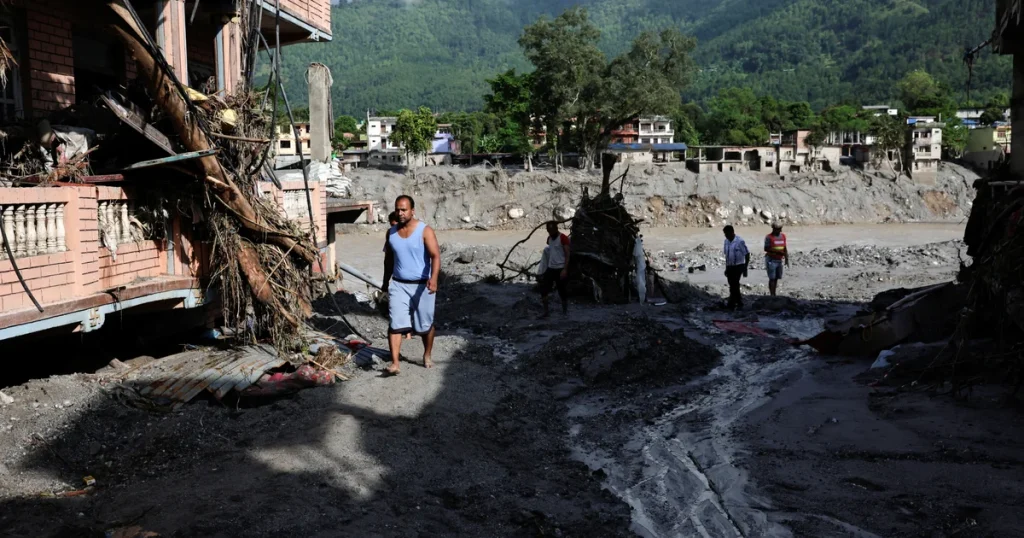
Bizeconanalysis.com – Helicopters shuttled survivors out of collapsed structures on Friday while swollen rivers continued to swallow entire settlements across Nepal and the adjoining Tibetan borderlands. The disaster, set off by a sudden geological failure high in the Himalayas on Wednesday, has killed nearly 600 people and left roughly 2,500 unaccounted for. As the death count climbs, Nepal flood rescue efforts intensify under conditions of sustained high alert, with thousands still buried beneath meters of dark-brown silt.
Nepal’s National Disaster Risk Reduction and Management Authority verified 579 fatalities as of Friday. Chinese state media reported five deaths on their side of the range, though reporting from remote villages remained thin. More than 3,000 people had already been airlifted to Kathmandu and other staging points, and cumulative rescue figures in Nepal exceeded 3,700. Still, 1,924 Nepalese citizens had no confirmed status, and Beijing separately listed 558 missing on the Tibetan side.
A Toll That Crosses Borders
Hundreds of foreign nationals—trekkers, laborers, and pilgrims bound for a sacred peak on the Tibetan flank—remain among the missing. Local Nepalese outlets floated a figure as high as 12,000 unaccounted for, but no government official has validated that number. The International Red Cross placed the total number of people directly impacted at approximately 90,000, encompassing the displaced, the injured, and those cut off from essential services.
What Triggered the Catastrophe
Satellite imagery showed that bedrock beneath a high-altitude glacier had sheared away, dragging a substantial portion of ice with it. The rockfall registered as a magnitude 5.2 seismic event. The resulting cascade of debris and meltwater swelled valley rivers almost instantaneously, sending walls of mud and water downstream through Tibet and Nepal, sweeping away structures, bridges, and entire stretches of terrain.
Jakob Steiner, a geoscientist affiliated with the University of Graz in Austria and based in Bangladesh, described the orbital evidence in blunt terms:
“A lower part of a glacier has really come off… it looks like someone cut with a huge knife through the whole lower part” of the rock and ice.
Researchers continued cross-referencing orbital and ground-level data to pin down the precise mechanics, but the broad picture was clear: structural weakness combined with rapid warming had produced a failure mode the region’s mountain communities had little time to anticipate.
A Secondary Threat: The Barrier Lake
Compounding the immediate crisis, authorities on both sides warned of a secondary flooding risk from a barrier lake that had formed upstream behind a dam of debris deposited by the initial flood. Nepal Police issued a fresh alert Friday after receiving intelligence that a structure on the Tibetan side was running over. Security personnel and relief workers were ordered to maintain high alert and relocate to safe ground at the first sign of danger.
Chinese state broadcaster CCTV noted the lake sat at roughly 9,680 feet—about 3,280 feet above Gyirong Port, the border crossing obliterated by a wall of mud and water on Wednesday morning. Though the water body lay more than six miles from the port, the broadcaster initially characterized the flood risk as high before later describing it as “manageable.” Nepal Police spokesperson Abi Narayan Kafle stressed that the rescue operation “hasn’t stopped” and was proceeding under sustained high-alert conditions.
Trapped in a Hydropower Tunnel
Among the most harrowing scenes, Nepali Army teams worked to extract workers sealed inside a hydropower tunnel at Rasuwa, part of the Upper Trishuli-1 project. Footage showed rescuers half-pulling, half-pushing a man encrusted in dark mud out of the tunnel—one of dozens believed trapped within. Army spokesperson Brig. Gen. Raja Ram Basnet explained the difficulty:
“It is complicated to find the entry and exit points of the tunnel because everything has been covered by mud. Our first priority is rescuing the stranded people.”
Frequently Asked Questions
How many people have died in the Nepal flood?
Nepal’s disaster authority verified 579 deaths as of Friday. Chinese state media reported five fatalities on the Tibetan side, bringing the combined toll to nearly 600. Figures continue to rise as rescue teams reach previously inaccessible areas.
How many people are still missing?
Approximately 1,924 people in Nepal and 558 on the Chinese side had no confirmed status as of the latest tallies—roughly 2,500 in total. Local media have cited higher numbers, but no government has validated those figures.
What caused the flood?
A sudden detachment of bedrock and ice from a high-altitude glacier triggered a magnitude 5.2 seismic event. The resulting debris and meltwater cascade swelled valley rivers almost instantly, sending walls of mud and water downstream through both Nepal and Tibet.
Is there a risk of a second flood?
Yes. A barrier lake formed upstream behind debris deposited by the initial flood. Nepal Police issued a fresh alert after reports that a structure on the Tibetan side was running over. Authorities on both sides of the border have ordered personnel to maintain high alert and relocate at the first sign of danger.
How many people have been rescued so far?
More than 3,000 individuals were airlifted to Kathmandu and other staging points, and cumulative rescue figures in Nepal surpassed 3,700. The International Red Cross estimated roughly 90,000 people were directly impacted by the inundation.