
American tourist killed by lightning strike on Italy’s Mount Etna, reports say
American Tourist Killed by Lightning on Mount Etna
Bizeconanalysis.com – An American tourist killed by lightning while hiking up one of Europe’s tallest active volcanoes died after rescue crews airlifted him to a Catania hospital on Sunday evening. The 30-year-old man, whose name had not been publicly confirmed by Italian authorities at the time of reporting, was located in cardiac arrest on the upper slopes of Mount Etna in Sicily and could not be revived despite immediate medical intervention.
What Happened on the Mountain
According to initial emergency reports, the hiker had entered a section of trail that authorities had closed to the public, apparently trying to shorten his route toward the summit. A fast-moving thunderstorm then rolled across the exposed ridgeline. Firefighters and paramedics reached him by helicopter at roughly 8 p.m. local time (2 p.m. Eastern), by which point his heart had already stopped.
He was flown to Cannizzaro Hospital in Catania, where doctors attempted resuscitation for nearly an hour. The hospital confirmed his death at 9:30 p.m. local time, a detail carried by the regional daily Catania Today.
Etna’s Unusually Violent Eruptive Phase
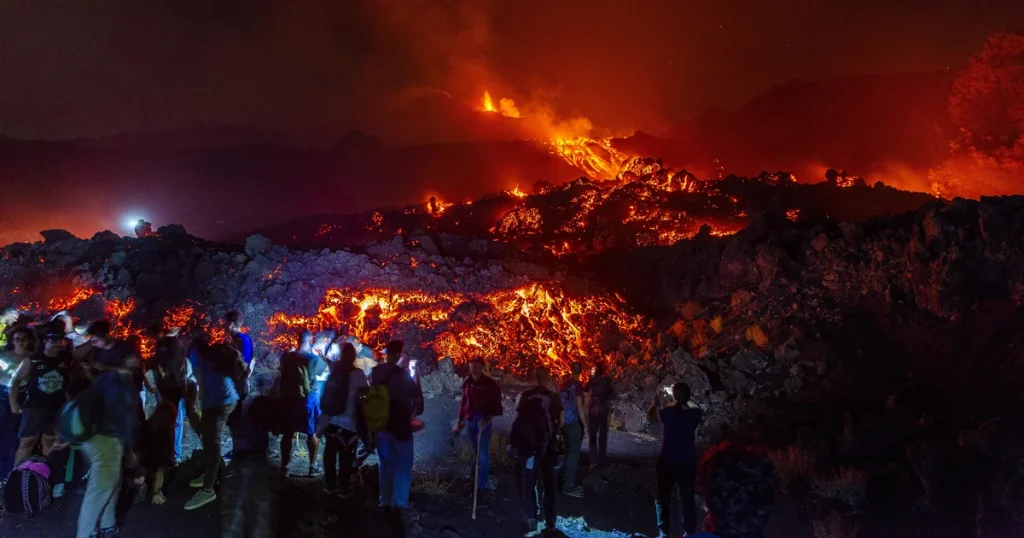
The fatal strike came during a stretch of heightened volcanic output. In the weeks before the incident, Mount Etna—standing at approximately 3,350 meters and ranking as the tallest volcano on the European continent—produced repeated lava flows and ash emissions that blanketed eastern Sicily and forced multiple closures at Catania International Airport, the island’s main air gateway.
Italian authorities responded by tightening access restrictions above the tree line, where natural shelter is virtually absent and a hiker is fully exposed to open sky. Those closures, officials stressed, are firm boundaries meant to keep visitors out of zones where volcanic gases, sudden temperature drops, and lightning can converge without warning.
Why the Weather Turns So Quickly
Italy’s Civil Protection agency has long cautioned that Etna’s geography manufactures abrupt storms. Because the volcano climbs from near sea level to high-altitude terrain within only a few kilometers, warm Mediterranean moisture collides with cold air aloft, spawning convective cells that can appear with little advance notice.
“The passage from sea level to high mountain within a few kilometers causes sudden changes in weather due to currents of humid air coming from the sea meeting masses of cold air,” the agency warns.
For a walker who spent the morning in mild coastal conditions, stepping onto an exposed ridgeline above 2,500 meters can mean entering a lightning corridor within a single hour. The restricted zone the victim entered was precisely the kind of open, elevated terrain where such strikes are most probable.
A Second Fatal Strike the Same Day
The Etna death was not an isolated weather fatality in Italy that weekend. Authorities confirmed a second fatal lightning strike on Sunday in the Alps of South Tyrol province, where an Italian hiker was killed on a mountain trail. Two lightning deaths in a single day underscored how widespread and sudden summer thunderstorms can be across the country’s varied topography, from volcanic peaks to alpine ridges.
FAQ: Practical Questions for Hikers
How many people visit Mount Etna each year? An estimated 1.5 million visitors hike or tour the volcano annually, making it one of the most heavily trafficked active volcanoes on the planet.
What should hikers check before setting out? Guides and Sicilian safety officials advise checking the current volcanic alert level, carrying layered clothing for rapid temperature swings, and turning back the moment clouds begin building over the summit. Above the tree line there is no shelter; once a storm arrives, exposure is total.
Are upper-slope trails currently open? Portions of the upper slopes have been closed in response to the ongoing eruptive cycle. Treat posted closures as firm boundaries, not suggestions, and verify conditions with local rangers before departure.
Was the victim’s identity released? At the time of initial reporting, Italian authorities had not publicly confirmed the man’s name. Family notifications were underway through standard consular channels.