
Canada’s tariffs target certain U.S. states. See which regions are most vulnerable.
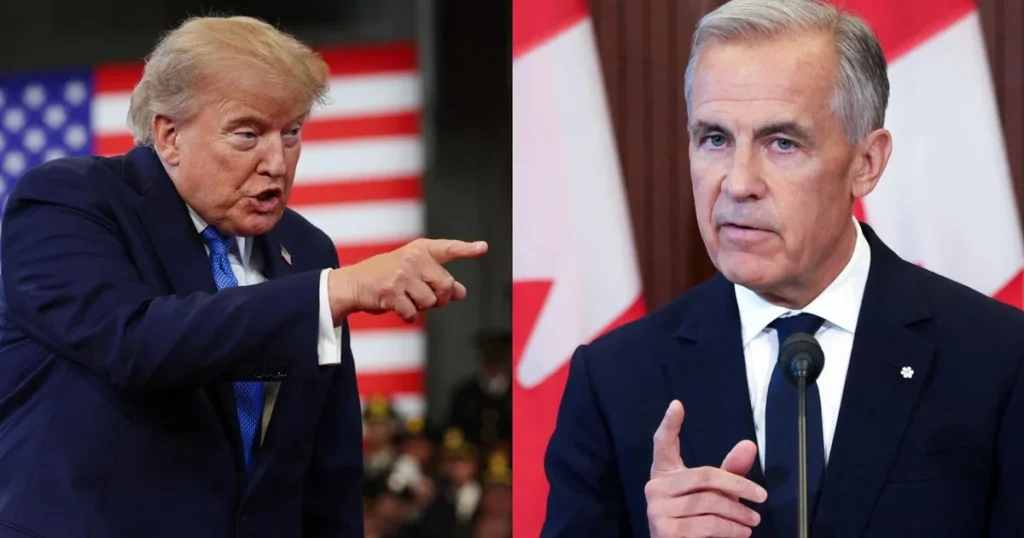
Canada’s Tariffs Target Certain U.S. States
Bizeconanalysis.com – With fewer than two months separating the rollout of new Canadian import duties from the U.S. general election, Ottawa has unveiled a retaliatory strategy that maps almost perfectly onto American electoral geography. Canada’s tariffs target certain states where contests are most competitive, imposing rates up to 50 percent on roughly $20 billion in American merchandise. Economists who cross-referenced the duty schedule against state-level export data confirm the measures are calibrated to land hardest in swing districts.
The three-tier structure — 15, 25, and 50 percent — covers more than 800 product categories beginning September 8. The scope spans Wisconsin cheddar, Vermont dairy, Michigan steel beams, and Indiana aluminum extrusions. Canadian government records show Ottawa is the top export destination for 27 American states, making the geographic reach unusually wide.
A Deliberate Political Calculus
Industry Minister Melanie Joly made the intent explicit at Tuesday’s announcement.
“We are picking products that will target states in the U.S.,” Joly said. “We’re being wise and strategic to put political pressure, and that’s why we think it’s the right thing to do right now.”
The timing reinforces the point. September 8 lands inside the final stretch before voters head to the polls. Ed Gresser, director for trade and global markets at the Progressive Policy Institute, noted that Canada absorbs roughly one-tenth of all U.S. exports and maintains consulates in cities nationwide, giving it an intimate read on both the American economy and its electoral landscape.
“That timing is not lost on the Canadians,” Gresser observed.
Which States Face the Steepest Exposure
Manufacturing-heavy regions in the Midwest and parts of the Northeast absorb the sharpest blow. Michigan and Indiana, which ship large volumes of appliances, tools, steel, and aluminum southward, will see export margins compressed by charges reaching half the shipment’s value. Dairy producers in Wisconsin and Vermont, whose cheese and milk products fall into the 25 percent bracket, face a parallel squeeze on a sector already navigating thin margins.
Agricultural states such as North Dakota — the most trade-dependent state with Canada when fuel products are excluded — are largely insulated. The bulk of North Dakota’s Canadian-bound exports consists of soybeans, wheat, and other grains, all outside the new schedule. The result is a sharply uneven geographic footprint: economies leaning on processed goods and industrial inputs absorb the impact, while those exporting raw commodities weather it with minimal disruption.
Mary Lovely, a U.S. trade expert and senior fellow at the Peterson Institute for International Economics, emphasized that because the Canadian measures roughly mirror the structure of American levies imposed on Canadian goods, the fallout will ripple across both Republican- and Democratic-leaning districts.
“By nature of what we export to Canada, you’re going to have a differential impact on states, and the tariffs are going to hit a mix of red, blue and purple states,” Lovely said.
The Broader Trade War Context
The Canadian measures represent the latest escalation in a confrontation between two longtime allies that exchanged approximately $872 billion in goods and services in 2025. The sequence began when the Trump administration declared 50 percent duties on Canadian products after bilateral negotiations collapsed. The following Monday, President Trump added a separate 50 percent charge on Canadian automotive and steel imports, set to take effect January 1, 2027, absent a negotiated settlement.
Canada’s ample oil exports, flowing southward into Midwest refineries for conversion into gasoline, diesel, and jet fuel, remain a critical economic artery linking the two economies. Disrupting that pipeline would compound the damage already inflicted by the trade wall on manufactured goods.
Washington’s Response
The White House framed the Canadian retaliation as confirmation of long-standing grievances in the industrial Midwest. Spokesman Kush Desai issued a statement asserting that heartland states had been disproportionately harmed by what he characterized as one-sided market access, singling out Michigan and Indiana as emblematic of the damage.
Frequently Asked Questions