
Why Dubai may be vital to the Trump administration’s economic war on Iran
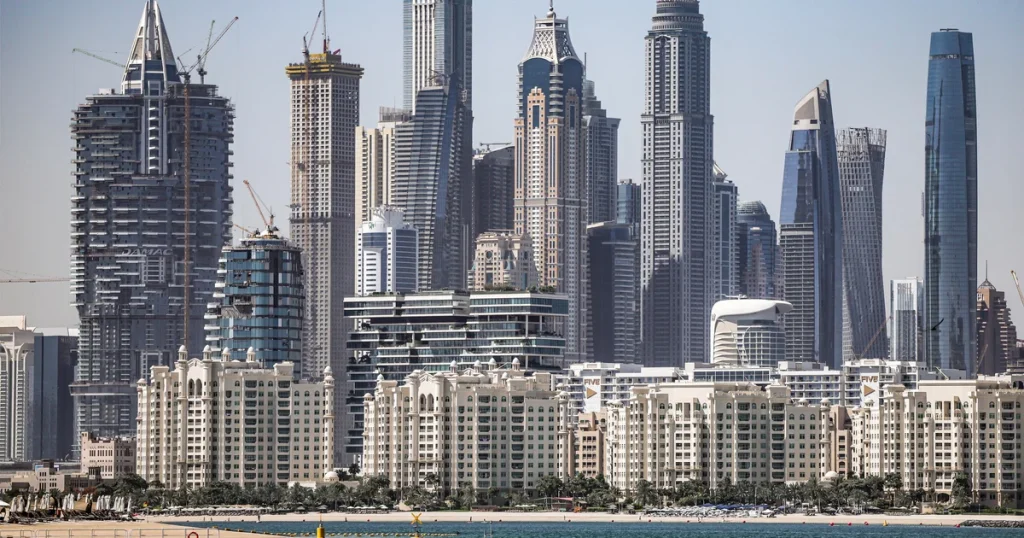
Dubai’s Financial Infrastructure at the Center of America’s Economic Pressure Campaign on Tehran
Bizeconanalysis.com – The Trump administration has escalated its economic confrontation with Iran to a level it describes as historically unmatched, pairing what Treasury Secretary Scott Bessent calls the “toughest sanctions in history” with a naval blockade designed to strangle the Islamic Republic’s trade lifelines. Yet the success of that campaign hinges on a factor that extends well beyond Washington’s own policy levers: the role played by the United Arab Emirates, and specifically its city of Dubai, as the financial plumbing through which Tehran has long moved oil revenue and foreign currency.
Dubai has built its reputation over decades as the Middle East’s dominant financial crossroads. For Iran, that reputation has carried a darker dimension. The city has functioned as a corridor for routing oil proceeds, converting currencies, and keeping funds accessible even under layers of international sanctions. The scale of that dependency is striking. Miad Maleki, a former official at the U.S. Treasury Department, put the figure plainly: roughly 80 percent of Iran’s foreign-currency exchange activity transits through Dubai.
“About 80% of Iran’s foreign currency exchange is done in Dubai. So Dubai has served as a major source for Iran’s foreign currency,” Maleki explained. “Iran’s economy today runs based on this kind of scheme of selling oil to China and then either using the funds that are generated from sales of oil to China to pay for imports from China, but also moving some of those funds outside China to jurisdictions like UAE through exchange houses.”
In practical terms, the mechanism works as follows. Iran sells crude to Chinese buyers. The resulting yuan-denominated proceeds are then funneled through exchange houses and intermediary firms based in the UAE, where they are converted into hard currencies or parked in accounts at various banks. Those funds subsequently finance Iran’s imports, service its debt obligations, and sustain the liquidity the regime needs to keep its economy afloat. Disrupt that pipeline, and the pressure on Tehran multiplies dramatically.
Washington Targets the Shell-Company Network
The Treasury Department has moved to strike at that pipeline directly. Over recent weeks it has identified and sanctioned a cluster of shell companies registered in the UAE that, in the administration’s characterization, operate as a shadow banking apparatus for the Iranian state. Among those named is HMS Trading FZE, a Dubai-registered entity that the Treasury described in an August 7 statement as playing “a critical role in helping the Iranian regime retrieve revenue from its oil sales overseas, aiding some of Iran’s most prominent exporters of petroleum.”
The same statement singled out Shahr Bank, an Iranian institution closely tied to the Islamic Revolutionary Guard Corps, accusing it of relying heavily on two Dubai-based currency-exchange firms to launder money. The Treasury further announced that American nationals are prohibited from conducting business with every Dubai-based company listed in that August 7 filing, and that secondary sanctions would be imposed on any foreign bank found to be knowingly transacting with those shell entities. The secondary-sanctions threat is particularly significant because it reaches beyond U.S. borders, compelling banks in Europe, Asia, and elsewhere to weigh whether continued dealings with the named firms are worth the risk of losing access to the American financial system.
A senior Trump administration official characterized the cumulative effect of the sanctions package and the naval blockade as having left Iran’s economy “completely broke,” adding that “there are many levers the president can crank harder in the weeks and months ahead.” The implication is that the current round of measures is intended as a foundation, not a ceiling, and that further targeting of intermediary firms, exchange houses, and banking channels remains on the table.
Abu Dhabi Cuts Economic Ties with Tehran
The UAE itself has moved to formalize its distance from Iran’s economy. Afra Al Hameli, spokesperson for the UAE Ministry of Foreign Affairs, announced via social media this week that “all trade, commercial exchanges, and financial transactions with Iran have been halted until further notice.” She added that “the UAE remains firmly committed to safeguarding the integrity of the international financial system,” a formulation that signals the Gulf state’s desire to present its actions as aligned with broader international norms rather than as a unilateral political gesture.
The timing of that announcement appears connected to a recent escalation in hostilities. Emirati authorities disclosed that Iran had fired two ballistic missiles toward the UAE, triggering the country’s air-defense systems for the first time in weeks, though officials said both projectiles fell into the sea. Separately, UAE officials stated that an Abu Dhabi National Oil Company vessel was attacked while transiting the Strait of Hormuz on a Saturday, according to reporting by the state Emirates News Agency. Those incidents, layered on top of weeks of Iranian disruption of shipping through the strait, appear to have shifted the calculus in Abu Dhabi from cautious observation to active economic disengagement.
Why the Gulf’s Posture Matters
Maleki framed the shift in Emirati behavior as a recognition that passive neutrality is no longer tenable. He observed that the UAE and other Gulf states had been absorbing economic fallout from Iran’s escalation and its closure of the Strait of Hormuz while watching to see whether Washington might broker a deal that would end the hostility.
“I think the Emiratis are now realizing they can’t just sit on the side, the economy can’t continue to take this current situation,” Maleki said.
That recognition carries implications well beyond the bilateral relationship between Abu Dhabi and Tehran. If the UAE enforces its transaction freeze rigorously, it removes one of the most important venues through which Iranian oil revenue is converted, stored, and redistributed. Combined with the Treasury’s secondary-sanctions threat against foreign banks, the effect could be to compress the already-narrow channels through which Tehran accesses hard currency. For an economy that depends on oil exports to fund imports of food, medicine, and industrial inputs, that compression translates quickly into domestic price pressure, currency depreciation, and reduced capacity to service external obligations.
The broader strategic picture is one in which economic warfare is no longer conducted solely from Washington. It is increasingly executed through the financial infrastructure of allied states, and the willingness of those allies to close their doors determines whether the pressure campaign achieves its intended effect or leaks around the edges. Dubai, with its dense network of exchange houses, free-zone entities, and correspondent-banking relationships, sits at the exact point where that determination is made. For now, at least, the doors are closing.
Related Reading
Frequently Asked Questions
What is Why Dubai may be vital?
Why Dubai may be vital is the main topic of this guide. The article explains the context, practical details, and next steps readers should understand.
Why does Why Dubai may be vital matter?
Why Dubai may be vital matters because readers are looking for a useful answer, not just a short summary. Good content should match search intent and help them decide what to do next.