
Tupac Shakur murder suspect recounts moments before 1996 shooting in audio played to jury
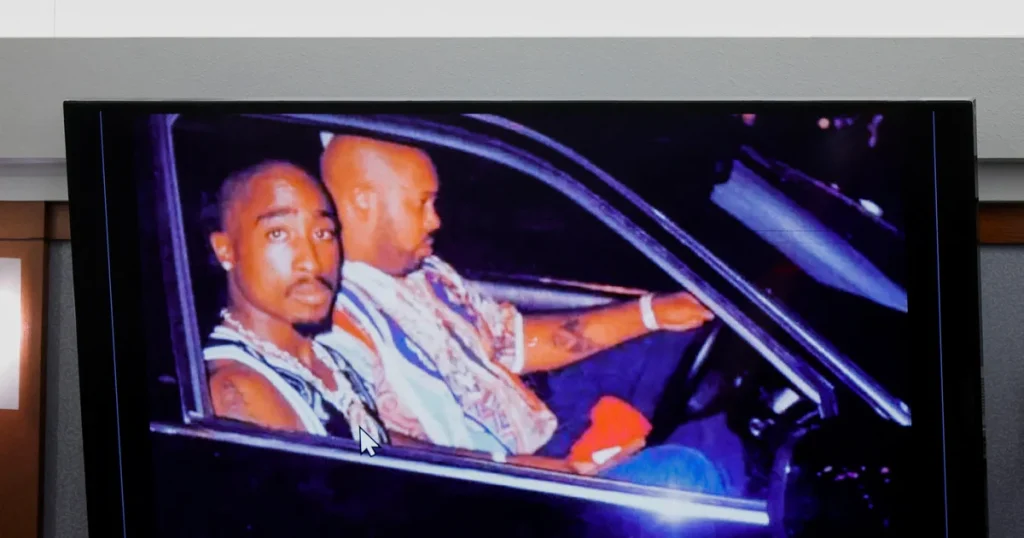
Courtroom Silence as Jurors Hear the Voice That May Have Ended Tupac Shakur’s Life
Bizeconanalysis.com – The Los Angeles courtroom fell quiet on Thursday as jurors listened to a 2008 audio recording in which Duane “Keffe D” Davis, now 63, told detectives that his nephew Orlando “Baby Lane” Anderson pulled the trigger that killed 25-year-old Tupac Shakur in Las Vegas in 1996. The transcript of the interview scrolled across a screen while Davis’s words played aloud, and some jurors paused to jot down notes. Shakur’s family members sat motionless, their eyes flicking between the display and the floor beneath their feet.
This was the first occasion on which Davis spoke directly to authorities about his role in the rapper’s death. Prosecutors have signaled that they intend to build their case heavily on his own recorded admissions — from police interviews, podcast appearances, and the 2019 memoir he co-wrote, Compton Street Legend. The interview at the center of Thursday’s proceedings is, in their view, the linchpin of the state’s theory of the case.
What Davis Told Detectives in 2008
In the recording, Davis described riding in the back of a white Cadillac alongside Anderson and two other men. The vehicle pulled up beside a black BMW in which Shakur sat next to hip-hop mogul and Death Row Records chairman Marion “Suge” Knight. Davis recounted that Knight’s car occupied the opposite side of the road from his own, which altered the dynamics of the moment.
“If we would have been on my side, I would have blasted,” Davis told the detectives.
Because Knight was on the far side, Davis passed his handgun back to Deandre “Big Dre” Smith. Smith declined it, Davis said. Anderson, also seated in the rear, then took the weapon and began firing.
After the shots, Davis believed Knight had been killed. In reality, the Death Row head sustained only a graze wound.
Why the Interview Was Really Taking Place
The detectives who conducted the 2008 session had not brought Davis in to discuss Shakur’s murder. They were investigating the 1997 killing of Shakur’s archrival, Christopher Wallace — known as the Notorious B.I.G. or Biggie Smalls — a case that remains unsolved. Davis had briefly been among the suspects in that shooting before investigators moved past him.
Daryn Dupree, one of the two detectives present, testified Thursday that he was assigned to a task force examining Wallace’s death. His partner, Greg Kading, told Davis at the outset that the conversation was confidential.
“Nothing you say today can be used against you,” Kading said, according to the recording.
Dupree added a cautionary aside:
“If you don’t say nothing, it’s cool, but if you go out there and start talking …”
Members of the gallery shook their heads when that line surfaced in the audio. Prosecutors seized on the moment, arguing that Davis did exactly what Dupree warned against — going public with stories about the shooting roughly a decade later through interviews, podcast segments, and his memoir. In their framing, that public storytelling voided any confidentiality agreement he had with law enforcement.
The Defense Pushes Back
Davis has pleaded not guilty. His attorney characterized the prosecution’s narrative as “fiction” and told the court that Davis was “full of crap” when he recounted tales of his involvement, and that investigators knew as much at the time. The defense contended that authorities never corroborated the client’s statements with physical or documentary evidence.
The defense also highlighted a contradiction: Davis had previously told the FBI that his nephew was not connected to the 1996 shooting and had speculated that Knight or Sean “Diddy” Combs might have been behind it. Before trial, investigative reporting by KLAS-TV revealed that Vanessa Murphy conducted multiple jailhouse interviews with Davis after his arrest, including one in which he claimed he was not even in Las Vegas on the night Shakur was shot.
The Night of September 7, 1996
Prosecutors allege the killing was retaliation. Hours before the shooting, Shakur’s entourage had attacked Anderson outside the MGM Grand following a boxing event featuring Mike Tyson. Davis attended the Tyson fight but was not present at the brawl, they say. Later that evening, the men in the Cadillac spotted Shakur leaning out of a black BMW while onlookers shouted his name.
“Tupac!”
Those calls, prosecutors argue, identified the target and set the sequence in motion.
A Legacy That Outlived the Man
Earlier in the trial, prosecutors displayed photographs from Shakur’s autopsy. Some members of his family left the courtroom before those images appeared; others stayed to confront what had been done to his body. The split underscored how, more than two decades after his death, the rapper’s image still commands a gravitational pull in any room.
Shakur died at the apex of his commercial popularity and just as his acting career was gaining momentum. His influence on hip-hop — as a lyricist, performer, and cultural figure — has only deepened in the years since. The trial now unfolding in Los Angeles is, in a sense, an attempt to pin down the final hours of a life whose cultural weight continues to grow long after the music stopped.
Related Reading
Frequently Asked Questions
What is Tupac Shakur murder suspect recounts moments?
Tupac Shakur murder suspect recounts moments is the main topic of this guide. The article explains the context, practical details, and next steps readers should understand.
Why does Tupac Shakur murder suspect recounts moments matter?
Tupac Shakur murder suspect recounts moments matters because readers are looking for a useful answer, not just a short summary. Good content should match search intent and help them decide what to do next.