
Live Updates: Trump says U.S. has “total control” over Strait of Hormuz and might “keep it”
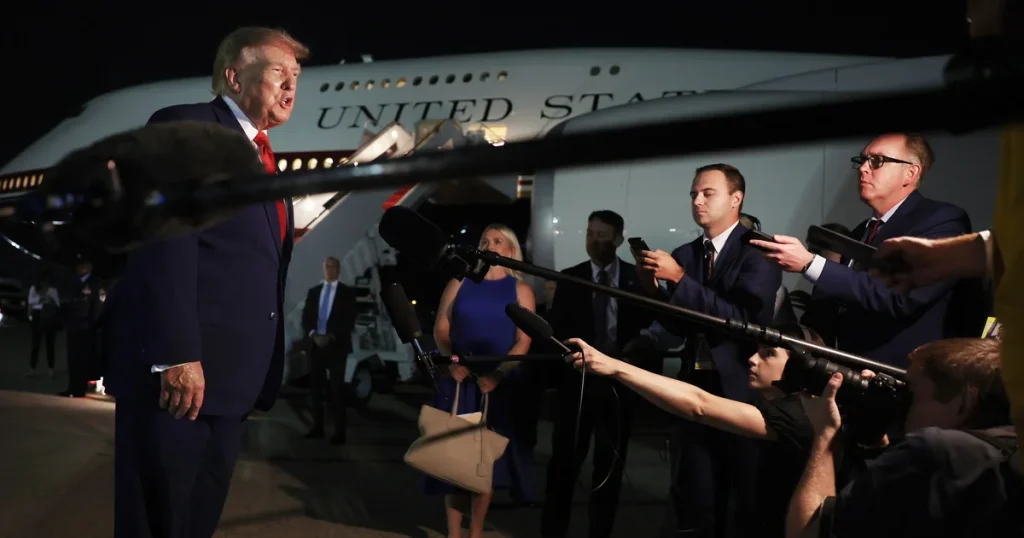
Strait of Hormuz Under U.S. Command as Iran Threatens Presidential Jet
Bizeconanalysis.com – The geopolitical landscape shifted dramatically this week as President Trump asserted American dominance over one of the world’s most critical maritime chokepoints. Speaking on Truth Social, the president declared that the United States maintains “total control over the Strait of Hormuz” and suggested Washington might retain that position indefinitely. His message emphasized the strength of the naval blockade, which he described as a “WALL OF STEEL” that Iran cannot penetrate.
Meanwhile, Tehran pushed back against these assertions. The Persian Gulf Strait Authority, the regulatory body established to oversee passage through the waterway following the outbreak of hostilities, issued a firm rebuttal. The organization stated that despite official claims from Washington, the strait remains effectively blocked and will not reopen until Iranian demands are met. Commercial traffic has consequently slowed to a near standstill, with Tuesday’s count of eight vessels falling below the ten-day average of twelve ships. This represents the lowest daily tally recorded since August 5.
Presidential Security Concerns in Turkey
Compounding the regional tensions, new details have emerged regarding a covert security operation involving the American president during his visit to Ankara. According to CBS News, Trump’s secret transfer from Air Force One to an alternate aircraft via a catering truck occurred within twenty-four hours of intelligence agencies detecting an Iranian scheme to launch a missile at the presidential jet.
The maneuver took place while leaders gathered for the annual NATO summit. Trump had arrived in the Turkish capital aboard a recently upgraded Boeing 747 provided by Qatar’s government. However, an older white-and-blue aircraft that has functioned as Air Force One since the 1990s remained on the ground as backup. Before the president departed the summit on July 8, three major intelligence organizations—the National Security Agency, the Central Intelligence Agency, and Turkey’s MIT service—identified credible information suggesting Iran planned to fire a surface-to-air missile at the presidential aircraft.
Initial reports indicated a Turkish team was positioned to execute the attack, but subsequent surveillance failed to locate any such group. Despite this, officials confirm that Iran continues to pose a substantial threat to Trump’s life as the conflict approaches its sixth month.
U.S. Forces Preparing to Leave Iraq
In a related development, American military leadership announced plans to withdraw all personnel from Iraq by the end of September. This departure would conclude a nearly two-decade presence that began with the 2003 invasion targeting Saddam Hussein’s regime. Washington and Baghdad reached an agreement in 2024 to gradually reduce the smaller U.S.-led operations focused on combating the Islamic State group.
While troops withdrew from most Iraqi bases last year, they maintained positions in the semi-autonomous northern Kurdish territory. These installations have faced regular attacks since the United States and Israel initiated military action against Iran on February 28. Iraqi Prime Minister Ali al-Zaidi met with Admiral Brad Cooper, commander of U.S. Central Command, on Wednesday. Following their discussion, al-Zaidi confirmed that September 30 represents the definitive deadline for concluding the Global Coalition’s military mission in Iraq and ensuring complete force departure.
A U.S. official verified that the withdrawal timeline remains on track but declined to specify current troop numbers or their future deployment locations. The ongoing conflict has already claimed American lives, including one soldier killed during a controlled detonation of an Iranian drone in Iraq last month. Additionally, six U.S. service members died in March when a refueling aircraft crashed.
Geneva Conventions Violations Alleged
Iran has further escalated diplomatic tensions by accusing the United States of committing war crimes. The allegations came as Tehran marked the seventy-seventh anniversary of the Geneva Conventions signing on Wednesday. Esmaeil Baqaei, spokesperson for Iran’s Foreign Ministry, addressed the international community through social media, emphasizing that states party to the conventions and Switzerland as their depositary cannot ignore what he characterized as unprecedented violations.
Baqaei specifically highlighted American actions targeting civilian infrastructure as breaches of the agreements signed on August 12, 1949. These foundational documents established engagement rules for all signatory nations during wartime. The accusations add another layer of complexity to an already volatile situation as both sides navigate military operations and diplomatic channels simultaneously.
The combination of maritime disputes, presidential security concerns, troop withdrawals, and legal allegations paints a picture of a region in significant flux. As September approaches, all eyes will remain on Iraq, the Strait of Hormuz, and the broader trajectory of U.S.-Iran relations.
Related Reading
Frequently Asked Questions
What is Live Updates: Trump says U.S. has "total control" over Strait of Hormuz and might "keep it"?
Live Updates: Trump says U.S. has "total control" over Strait of Hormuz and might "keep it" is the main topic of this guide. The article explains the context, practical details, and next steps readers should understand.
Why does Live Updates: Trump says U.S. has "total control" over Strait of Hormuz and might "keep it" matter?
Live Updates: Trump says U.S. has "total control" over Strait of Hormuz and might "keep it" matters because readers are looking for a useful answer, not just a short summary. Good content should match search intent and help them decide what to do next.