
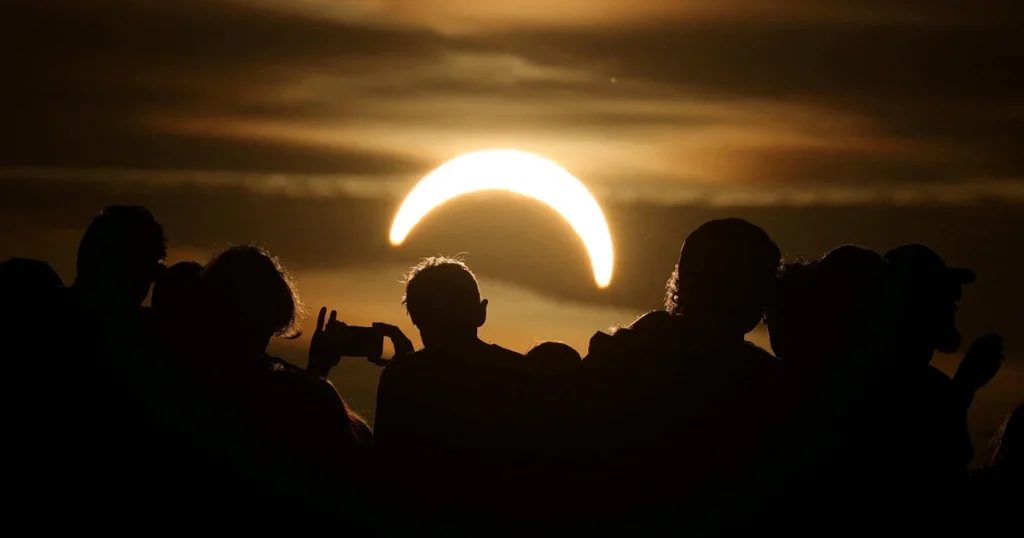
2026’s only total solar eclipse darkens skies across Northern Hemisphere. See photos, video from the best viewing locations.
2026’s Only Total Solar Eclipse: Best Viewing Locations
Bizeconanalysis.com – On Wednesday, August 12, 2026, the sky transformed as 2026’s only total solar eclipse swept across the Northern Hemisphere. This rare celestial event brought daylight to twilight for millions of observers, from the Arctic regions of Russia to the historic cities of Spain. The moon’s shadow traveled a precise path, offering viewers a chance to witness one of nature’s most dramatic astronomical displays.
A total solar eclipse happens when the moon passes directly between Earth and the sun, casting its shadow on our planet. While these events occur somewhere on Earth roughly every eighteen months, any single location may wait centuries for totality. Northern Spain had not seen such an eclipse since 1905, making this year’s event particularly special for local astronomy enthusiasts and visitors alike.
The Path of Darkness
The eclipse path began in extreme northern Russia, crossed the Arctic, and moved through northeast Greenland before reaching western Iceland. From Iceland, the shadow continued across the northern Atlantic, giving the United Kingdom excellent viewing conditions. London experienced ninety-one percent coverage at two-thirteen p.m. Eastern time, while northern Spain enjoyed full totality around two-thirty p.m. ET.
The entire phenomenon lasted about one hour and forty-five minutes from start to finish. By two-forty-five p.m. ET, the eclipse had completely ended. During totality in the narrow path, daylight turned to darkness for approximately two minutes, creating an unforgettable atmosphere that many described as magical.
Who Could See It?
While the path of totality covered a narrow band, the partial eclipse stretched much farther. According to Columbia University’s Center for International Earth Science Information Network, approximately two hundred thirty million people lived in areas with at least ninety percent coverage. Major cities like Madrid, London, and Paris all fell within this extensive viewing zone.
Not every location along the route was densely populated. Northern Greenland, largely uninhabited, still provided a pristine viewing spot for dedicated eclipse chasers willing to endure Arctic conditions. These remote areas offered clear skies and minimal light pollution for optimal viewing.
North America’s Partial View
North America did not experience totality, but residents across the continent enjoyed partial eclipse coverage. Fairbanks, Alaska, offered the most impressive American experience with thirty-seven percent coverage. Boston recorded approximately sixteen percent, while New York City reached nine percent. Toronto experienced about eight percent, and Philadelphia saw roughly seven percent.
For North American observers, the eclipse peaked at different times depending on location. Toronto viewers saw maximum coverage at one-forty p.m. local time, while New York City reached its zenith at one-fifty-four p.m. local time. In Fairbanks, the fullest point arrived at eight-twenty-seven a.m. local time.
Essential Viewing Tips
Astronomers stress that proper eye protection remains critical throughout the entire event. Solar eclipse glasses must stay on during partial eclipse phases to prevent retinal damage. Only during the brief totality period, when the sun is completely obscured, can viewers safely remove their protective eyewear. This distinction proves particularly important for those experiencing partial eclipses, where the sun remains partially visible throughout the entire event.
What’s Next for Eclipse Chasers?
For American eclipse enthusiasts, the European spectacle offers a preview of what lies ahead. The next total solar eclipse visible across the United States arrives in twenty-forty-four, though this event will only cover three states: Montana, North Dakota, and South Dakota.
Twenty-forty-five brings a more comprehensive coast-to-coast experience, beginning in Northern California and tracing an arc eastward to Florida. This trajectory mirrors the famous twenty-seventeen eclipse that captivated millions of Americans. Cities along this route include Reno, Nevada; Colorado Springs; Tulsa, Oklahoma; Little Rock, Arkansas; Jackson, Mississippi; and Orlando, Florida.
A twenty-fifty-two eclipse will cross the Southeastern United States, covering Florida, Georgia, and South Carolina. Those residing in the northeastern states must wait until May first, twenty-seventy-nine, for their next opportunity to witness totality.
Frequently Asked Questions
When does the 2026 eclipse occur? The total solar eclipse takes place on Wednesday, August 12, 2026, with totality beginning in northern Russia and ending in Spain.
Can I see the eclipse from the United States? Yes, but only as a partial eclipse. Alaska offers the best U.S. viewing with thirty-seven percent coverage, while eastern cities see seven to sixteen percent.
Do I need special glasses to watch? Yes, solar eclipse glasses are essential throughout the entire event. You may only remove them during the brief totality period when the sun is completely covered.
When is the next U.S. total solar eclipse? The next total solar eclipse visible in the United States occurs in 2044, followed by a more extensive coast-to-coast eclipse in 2045.
As astronomy enthusiasts worldwide celebrate this remarkable celestial event, many are already planning their journeys to witness future eclipses. Whether viewing from a crowded city or a remote Arctic landscape, 2026’s only total solar eclipse promises to be an unforgettable experience for all who witness it.