
Iran Live Updates: U.S. might return to negotiations “at some point,” Trump says
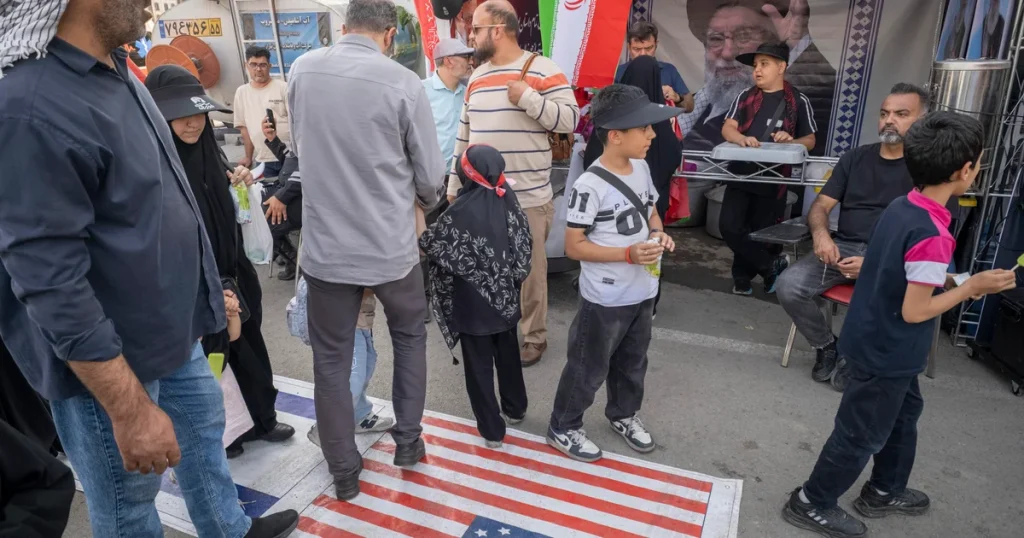
Strait of Hormuz Tensions Persist as Trump Floats Return to Talks, Regional Events Cancelled
Bizeconanalysis.com – The fragile pause in hostilities between the United States and Iran continues to unravel along multiple fronts. With oil tankers still threading cautiously through the Strait of Hormuz under what Washington describes as naval escort, President Donald Trump suggested on Wednesday that American negotiators could eventually sit back down across the table from Tehran — though he offered no timeline and struck a tone of indifference toward the stalled diplomatic track.
The president’s remarks came during a brief stop outside the White House, where he was touring a helipad under construction. Asked directly whether Washington planned to resume formal negotiations with Iran, Trump waved the question aside with a shrug.
“Maybe at some point,” the president said. “But right now, I think the situation is so good. Maybe at some point.”
He then pivoted to what has remained his non-negotiable condition since the conflict began: Iran must abandon any nuclear weapons program entirely.
“Look, it’s very simple,” Trump said. “They have to get rid of completely — no nuclear weapons. Iran cannot have a nuclear weapon. Do you know why? Because they’d use it. And we’re not gonna let them use it. So Iran cannot have a nuclear weapon, and they won’t.”
Oil Flow Through the Strait Remains Constrained
Trump drew attention to the maritime situation by noting that American vessels were transiting the Strait of Hormuz in meaningful numbers. He framed the flow as evidence of U.S. dominance over the waterway, while acknowledging intermittent disruptions.
“Last night, we had a lot of boats come through,” he said. “We have possession, complete control of the strait, I mean, outside of nuisance value. And there has been nuisance value when they shoot a drone every once in a while.”
He added that not every vessel would pass through, but that a substantial volume of crude had been moving over the preceding weeks.
“And not everybody is going to go through but they come through and over the last couple of weeks we’ve had a lot of oil coming in. It’s not going to be perfect, but it’s a lot of oil coming in.”
The White House has not formally confirmed that the U.S. Navy is escorting a limited number of oil tankers out of the strait. However, The New York Times reported on Wednesday that roughly five million barrels per day were clearing the waterway — a figure well below the approximately fifteen million barrels that moved through before the war disrupted normal shipping patterns. The gap between those two numbers underscores how much of the global energy supply chain remains under wartime constraint even as a nominal ceasefire holds in most theaters.
Trump attributed the relative stability of pump prices to American production capacity.
“One of the reasons that oil hasn’t gone to the proverbial $300 a barrel — it’s at $83, $84, $85 — and it’ll be a lot lower when this is over because we have plenty of oil,” he said. “One of the reasons that it never went to $300, $350 numbers is because we do have a lot coming in.”
Market data told a somewhat different story on Wednesday. Brent crude, the benchmark most of the world uses to price oil, traded near $92 per barrel and had held above $90 throughout the week. That level represents a steady climb from a wartime trough of roughly $71 recorded during a brief lull in fighting in late June and early July. The spread between Trump’s cited figures and actual exchange prices highlights the gap between political framing and market reality.
The president also claimed that unnamed foreign buyers were traveling to American producing regions to secure supply.
“They’re coming to Texas, Alaska, Louisiana to get oil,” he said.
He did not identify which nations or companies were making the trips.
Emirati Events Cancelled Amid Renewed Hostilities
On the ground in the Gulf, the human cost of the conflict has begun reshaping daily life. Organizers in Abu Dhabi announced the cancellation of two major entertainment events: a September 25 concert by pop star Christina Aguilera and the Offlimits music festival, originally slated for November with Colombian singer Shakira as headline act. Ticketmaster confirmed the Aguilera cancellation without offering a replacement date, while the Offlimits organizers pledged full refunds.
“We look forward to bringing the OFFLIMITS community together again in 2027,” the festival’s website stated, without specifying the reason for the cancellation.
The cancellations land against a backdrop of renewed pressure on Emirati shipping. Iran has pressed attacks on vessels flying the UAE flag in recent weeks after last month’s ceasefire collapsed. On Tuesday, the United Arab Emirates endured its first missile strike in several months; both projectiles fell harmlessly into the sea, but the episode underscored how quickly the security environment can deteriorate even when a formal truce nominally exists.
Canada Condemns Israeli Occupation of Lebanese Territory
Farther north, the spillover effects of the broader regional war continued to draw diplomatic friction. Randeep Sarai, Canada’s secretary of state for international development, visited Beirut to announce a new package of humanitarian assistance and used the occasion to criticize Israel’s military presence in Lebanon.
Sarai described the Israeli incursion as an “unlawful invasion” and argued that Beirut must retain full sovereignty over its own territory. His remarks came as the United Nations reported that approximately 360,000 Lebanese residents remained displaced by the latest round of fighting between Israeli forces and the Iranian-backed militant group Hezbollah.
“We have been working actively, I think, through diplomatic channels to do whatever possible to stop that and to allow Lebanese communities that are from those areas to be able to move back,” Sarai told The Associated Press in an interview late Tuesday.
Lebanon’s health ministry has tallied more than 4,000 deaths from the current war, with widespread destruction concentrated in the country’s south. Israel maintains what it terms a “security zone” stretching across portions of that territory, a foothold that has become one of the most contentious unresolved issues in the post-ceasefire landscape.
For readers tracking the broader picture, the convergence of these threads — constrained oil flows through the Gulf, cancelled cultural events in the Emirates, stalled diplomacy between Washington and Tehran, and a frozen conflict in Lebanon — illustrates how a single regional war can ripple across energy markets, diplomatic channels, and civilian life across at least four countries simultaneously. The question now is whether Trump’s vague promise of eventual negotiations will translate into a concrete framework, or whether the strait will remain a chokepoint of both barrels and bullets for months yet to come.
Related Reading
Frequently Asked Questions
What is Iran Live Updates?
Iran Live Updates is the main topic of this guide. The article explains the context, practical details, and next steps readers should understand.
Why does Iran Live Updates matter?
Iran Live Updates matters because readers are looking for a useful answer, not just a short summary. Good content should match search intent and help them decide what to do next.