
U.S. Navy sailor on USS Lincoln says dad was arrested by immigration officials
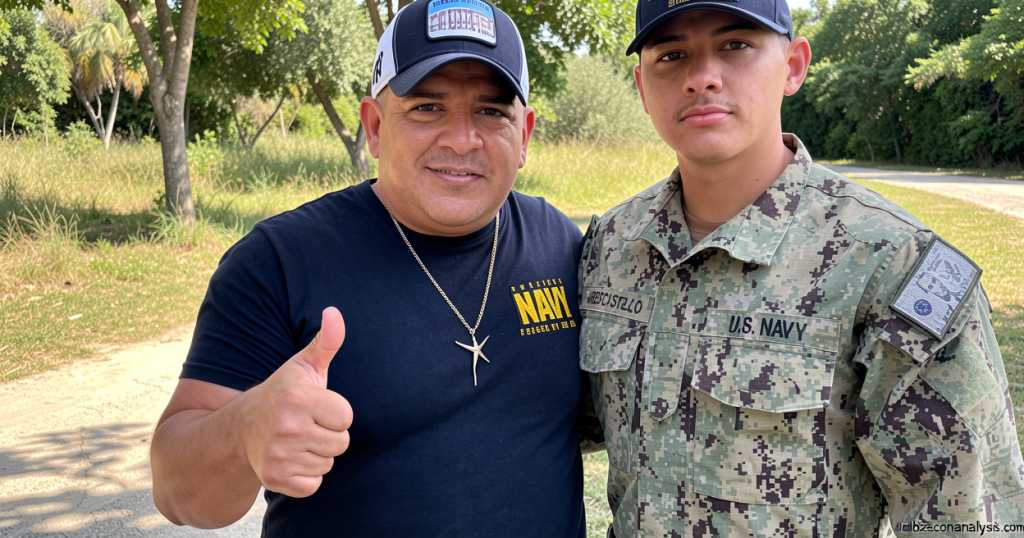
Navy Sailor’s Father Detained by Border Patrol in Key West as USS Lincoln Returns Home
Bizeconanalysis.com – A U.S. Navy sailor serving aboard the aircraft carrier USS Abraham Lincoln learned this weekend that his father had been seized by federal immigration agents during a routine traffic stop in Key West, Florida. The arrest of Luis Manuel Aviles Roa, a Nicaraguan-born man who has resided in the United States for approximately two decades, lands amid a broader wave of immigration enforcement actions that have increasingly touched military households over the past eighteen months.
Joshua Aviles, who has spent more than nine months deployed in the Middle East aboard the carrier, shared his reaction in a Facebook post over the weekend. His words captured the disorientation of a service member separated from family by thousands of miles while learning that a parent faces possible deportation.
“I just got a call that my dad was taken by ICE. If you know my dad, you know he is a hardworking, humble man who is always willing to help anyone if he can.”
“This is heartbreaking for me. I don’t know how I can mentally continue working 12+ hour days knowing that my dad is somewhere, possibly being treated like a criminal.”
The Arrest and What DHS Confirmed
The Department of Homeland Security verified that Border Patrol officers detained Aviles Roa during a traffic stop in Key West on Saturday. According to the department, the man entered the country without legal authorization. He remained in the custody of Immigration and Customs Enforcement as of Sunday, with deportation proceedings pending.
DHS did not contest the family’s assertion that Aviles Roa carries no criminal record. However, the department pushed back on any implication that military affiliation should shield him from enforcement. In a statement issued Sunday, the agency framed the action as straightforward statutory compliance.
“Having a family member in the military is not a free pass to violate our nation’s laws.”
“We are simply enforcing the laws passed by Congress. This Administration does not pick and choose which laws to enforce.”
Family Accounts and the Human Toll
Katty Delgado, Joshua Aviles’ half-sister, described the circumstances surrounding the detention. Her stepfather had been driving to a mechanic when Border Patrol officers pulled him over. She noted that he has maintained a pending immigration application seeking lawful status and that his roughly twenty years of continuous residence in the United States represent a life built here, not a brief visit.
Because Joshua remains deployed overseas, Delgado said communication between the siblings has been intermittent. What he has managed to convey, though, is that the news has disrupted his basic routines. He has told her he is struggling to sleep and to eat.
“His mind is focused now on ‘Where is my dad? And how is he doing?'”
A Pattern Under the Current Administration
The Aviles Roa case is not an isolated incident. Over the past year and a half, immigration arrests involving spouses, parents, and other relatives of active-duty service members have grown noticeably more frequent. Historically, such detentions were uncommon; agencies maintained informal guidelines that discouraged ICE and Border Patrol from acting against family members of military personnel. Those prior limits were rescinded early in the second Trump administration as part of a sweeping mass-deportation campaign.
DHS officials have repeatedly emphasized that anyone present in the country without legal status remains subject to arrest and removal, regardless of family ties to the armed forces. The department’s public messaging treats military affiliation as irrelevant to the question of whether a person entered lawfully.
For service members stationed far from home, the practical effect is compounded. A parent or spouse detained while the soldier is at sea or in a combat zone faces a legal process that unfolds without the family member’s ability to attend hearings, consult attorneys in person, or simply be present. The psychological strain on the deployed service member, already managing long deployments and demanding operational schedules, adds a layer of helplessness that commanders and chaplains have begun noting more frequently.
The USS Lincoln’s Extended Deployment
The timing of the arrest intersects with the carrier’s own operational timeline. Aviles noted in his post that he had been at sea in the Middle East for over nine months, describing his service as fighting “for a country that has given me everything.” The USS Abraham Lincoln and its complement of roughly 5,000 sailors departed the Middle East region last week, beginning a transit back to U.S. shores that could span several weeks.
The carrier has also been at the center of recent reporting on mental-health pressures and substandard living conditions experienced by crew members during prolonged deployments. For a sailor already navigating those stresses, the sudden detention of a parent introduces a personal crisis that no shipboard counseling program is designed to absorb.
As the Lincoln works its way home, Joshua Aviles will eventually be able to stand in a courtroom, speak with an immigration attorney, or simply sit beside his father. Until then, the distance between a carrier in transit and a detention facility in Florida defines the shape of his next several weeks.
Related Reading
Frequently Asked Questions
What is U S Navy sailor on USS Lincoln?
U S Navy sailor on USS Lincoln is the main topic of this guide. The article explains the context, practical details, and next steps readers should understand.
Why does U S Navy sailor on USS Lincoln matter?
U S Navy sailor on USS Lincoln matters because readers are looking for a useful answer, not just a short summary. Good content should match search intent and help them decide what to do next.