
Fast-growing Hawk Fire near Reno, Nevada forces thousands to evacuate
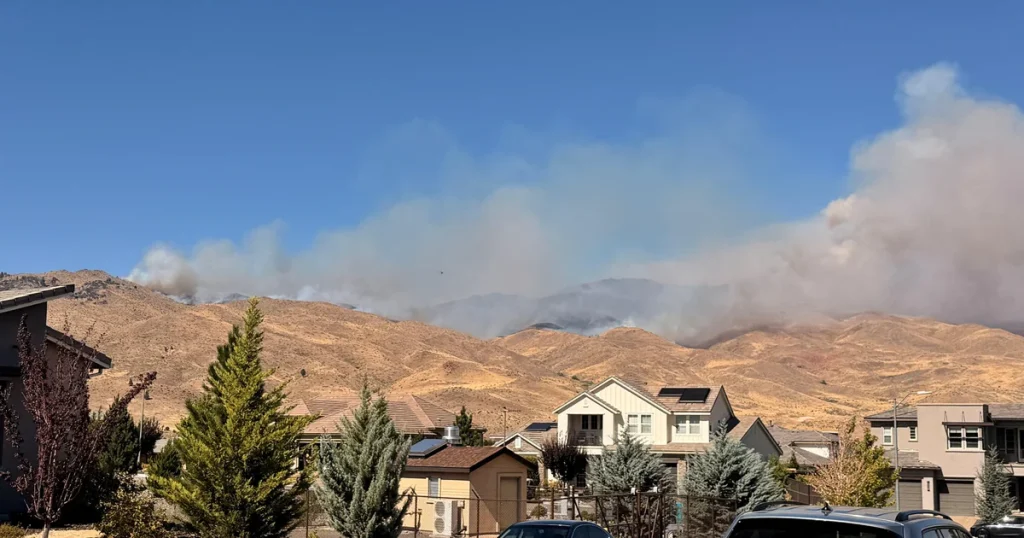
Hawk Fire Forces Mass Evacuation Across Reno, Nevada as Flames Race Through Sierra Foothills
Bizeconanalysis.com – By early Sunday morning, roughly 90,000 people living in and around Reno had been told to leave their homes as a fast-moving wildfire pushed from the rugged terrain of the Sierra foothills toward the city’s core. The blaze, now called the Hawk Fire, had already consumed more than 13,000 acres of the Humboldt–Toiyabe National Forest and was advancing in multiple directions as shifting winds fed its spread. At the time of reporting, containment stood at zero percent.
The fire’s origin is believed to be human-caused, though authorities confirmed the investigation was still underway. It apparently ignited on Saturday and expanded dramatically over the course of that day, driven by gusty winds, extremely low humidity, and parched vegetation left over from a prolonged dry spell. Those conditions are not unusual for the region in late summer, but their combination this weekend produced a fire behavior that overwhelmed initial suppression efforts.
A Fire at the Edge of the City
The Hawk Fire burned through a section of forest where Peavine Mountain rises on the Nevada side of the California state line. That ridge is ringed by residential neighborhoods and small commercial properties, and several of those structures were lost to the flames before crews could reach them. Six people sustained injuries in the incident, including three members of the firefighting and emergency-response teams.
The evacuation order split into two tiers. A “GO NOW” zone encompassing approximately 42,000 residents extended as far as the perimeter of the University of Nevada, Reno campus. An additional 45,000 people fell within a warning zone where officials urged them to depart immediately and be prepared to remain displaced for several days, clearing major thoroughfares so that fire engines, water tenders, and support vehicles could move without obstruction.
State and Local Response
Nevada Governor Joe Lombardo declared a state of emergency for Washoe County and activated the Nevada National Guard. Two helicopter crews were assigned to aerial firefighting support, while roughly 60 troops were tasked with assisting local police in securing evacuated neighborhoods and maintaining order along evacuation corridors.
“This is an active and rapidly evolving situation, and I urge everyone in the affected areas to remain vigilant and follow the direction of local officials. The state is fully engaged, and we are working alongside local authorities and first responders to deploy every available resource to protect lives, safeguard communities, and keep Nevadans out of harm’s way.”
Richard Edwards, chief of Truckee Meadows Fire & Rescue in Washoe County, described the operational challenge in a video posted to social media. He emphasized that wind-driven fires of this scale move with a speed that makes home-defense nearly impossible once the front arrives.
“The Hawk Fire is a very dynamic incident for us as it’s being driven by the winds. The wind-driven fires move very rapidly into our residential areas, creating a lot of challenges for our firefighters to save homes and protect lives.”
Disruption Across the Region
Nearly 10,000 homes and businesses in Washoe County lost electrical service on Sunday as utility crews worked around the fire perimeter. Segments of U.S. Route 395, the principal north-south highway threading through the region, were closed to through traffic. Reno itself, a city of more than 280,000 residents, felt the effects immediately.
The Washoe County School District announced that classes would be canceled Monday at every school except one, citing evacuation impacts, strain on regional public-safety resources, and the need to keep roads clear for emergency vehicles. The Reno-Sparks Convention Center was opened as a temporary shelter for evacuees, though pets were not permitted inside; small and large animals were directed to two separate holding locations. Local casinos offered discounted hotel rooms to displaced residents.
Reno Mayor Hillary Schieve issued a pointed appeal late Saturday night:
“If you have been told to evacuate, please don’t wait! Structures have already been burned in this fire and your life is more important than a building. Evacuating before the fire arrives also allows our firefighters to focus their efforts on battling the blaze.”
Airports and Hospitals
The Reno-Tahoe International Airport sat outside the evacuation perimeter, and commercial flights continued on schedule through Sunday. The smaller Reno-Stead Airport, by contrast, was closed to general-aviation traffic but remained accessible to firefighting aircraft operating out of the field. Northwest Specialty Hospital in Washoe County evacuated all patients as a precautionary measure. The Northern Nevada Health System stated that patient and staff safety remained its top priority.
A Pattern of Fire in Northern Nevada
The Hawk Fire did not arrive in isolation. Earlier in the same month, three separate wildfires fueled by hot, dry, and windy conditions north of Reno displaced more than 13,000 residents, according to the Nevada National Guard. The Humboldt–Toiyabe National Forest, which straddles the California–Nevada border and feeds the Truckee River watershed, has become increasingly prone to large, wind-driven ignitions as summer droughts lengthen and the urban-wildland interface expands around Reno’s growth corridors. For residents of Washoe County, the weekend’s events underscored a recurring seasonal reality: the mountains that define the region’s landscape can, in the wrong conditions, close over the city in a matter of hours.
Related Reading
Frequently Asked Questions
What is Fast growing Hawk Fire near Reno?
Fast growing Hawk Fire near Reno is the main topic of this guide. The article explains the context, practical details, and next steps readers should understand.
Why does Fast growing Hawk Fire near Reno matter?
Fast growing Hawk Fire near Reno matters because readers are looking for a useful answer, not just a short summary. Good content should match search intent and help them decide what to do next.