
China postpones Chang’e-7 moon launch as mission fails to meet launch conditions, officials say
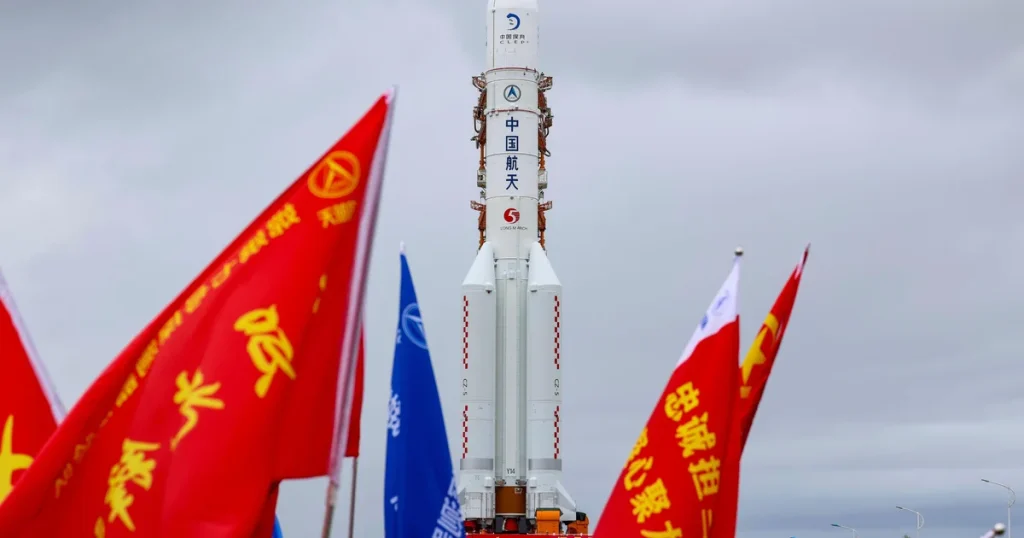
China Postpones Chang e 7 Moon Launch
Bizeconanalysis.com – Beijing confirmed on Sunday that China postpones Chang e 7 moon operations for the remainder of the year after the spacecraft could not clear its final technical checks at the Wenchang Space Launch Site on Hainan Island. The probe, which had been in end-stage readiness for departure within days, will not fly during the originally allocated window. The China Manned Space Agency framed the decision as a matter of mission integrity rather than schedule preference.
The stand-down arrives amid intensifying great-power competition over sustained lunar presence. Both China and the United States are targeting crewed landings within the next several years, so any slip in the robotic precursor timeline compresses the window available for testing surface infrastructure, power systems, and life-support logistics.
Scientific and Strategic Objectives of the Probe
The seventh vehicle in China’s lunar exploration program was built to investigate permanently shadowed craters near the south pole, searching for water-ice deposits and conducting environmental surveys of that terrain. Confirmed ice in usable quantities would supply drinking water, oxygen, and propellant feedstock for future crewed sorties. Beyond science, the flight was positioned as a proving ground for in-situ resource utilization and sustained surface operations — capabilities the agency has flagged as prerequisites for its longer-term ambitions.
The agency’s brief public statement offered no granular detail on which parameters fell outside acceptable thresholds. It stated that the spacecraft
“does not meet the launch conditions”
and that the flight
“cannot take place during the 2025 window.”
The call, it added, followed a “comprehensive assessment” guided by the principles of
“prudence, reliability and absolute mission success.”
Where the Delay Sits in the Broader Lunar Race
The timing sharpens the contrast between the two programs. In June, NASA Administrator Jared Isaacman told reporters the United States was
“very much in a space race”
against China. The American side advanced in April when four astronauts aboard Artemis II completed a free-return trajectory around the Moon — the first crewed flight beyond low Earth orbit in more than fifty years. That ten-day voyage, which carried the crew past the far side and back to Earth, earned the astronauts a Congressional Space Medal of Honor.
China’s equivalent crewed step remains in development. Its roadmap envisions robotic precursors clearing the path for eventual south-pole landings. A slip in the robotic phase narrows the already-tight timeline for validating the systems a human mission would depend on.
The postponement also lands against the backdrop of a landmark achieved just months earlier: in 2024, the Chang’e-6 probe completed a world first by returning rock and soil samples from the far side of the Moon. The current mission was meant to build directly on that momentum, shifting the program’s focus from sample collection to resource prospecting in the region both nations regard as the Moon’s most strategically valuable real estate.
No new launch date was announced. In practice, the spacecraft is expected to remain at Wenchang until the next favorable launch geometry aligns with a refreshed readiness review.
Frequently Asked Questions
Why was the launch delayed? The China Manned Space Agency stated the spacecraft did not satisfy the required launch conditions after a comprehensive assessment. No specific subsystem or parameter was named publicly.
When might the mission fly next? The agency closed the current-year window without specifying a replacement date. The spacecraft will be held at Wenchang pending the next viable launch geometry and a renewed go/no-go evaluation.
What will the probe do once it reaches the Moon? It will target permanently shadowed craters near the south pole to search for water ice and conduct environmental and resource surveys, data that would inform future crewed operations.
How does this delay affect China’s crewed lunar timeline? Robotic missions like this one are designed to validate surface infrastructure, power, and life-support logistics before humans arrive. A postponement compresses the testing window and pushes back the earliest feasible crewed landing date.