
Trump threatens defamation suit against left-leaning think tank
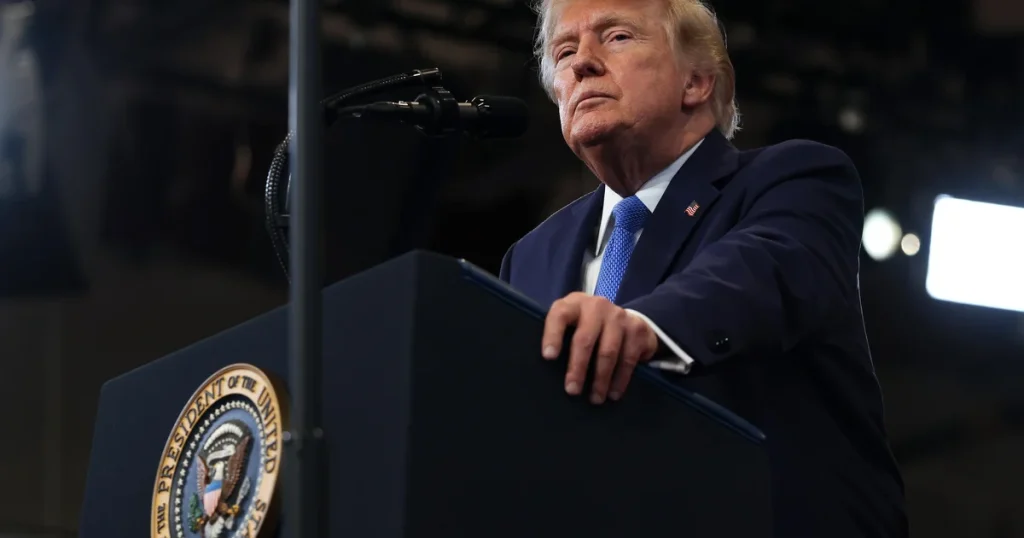
White House Lawyer Demands $5 Billion From Think Tank Over Crime-Data Report
Bizeconanalysis.com – A legal letter sent on August 17 by President Trump’s counsel, Alejandro Brito, puts the Center for American Progress on notice: retract a July report examining National Guard deployments, issue a formal apology, and compensate the president — or face a lawsuit seeking no fewer than five billion dollars in damages. The deadline for compliance was set at 5 p.m. on Friday, giving the organization roughly one business week to capitulate to what Brito characterized as materially false statements designed to harm the president’s reputation.
The report at issue, published by the left-leaning policy organization in July, reviewed multiple analyses of citywide crime data from several major metropolitan areas where Guard troops had been stationed. Its central finding was straightforward: the deployments “had no measurable effect on violent crime, homicides, or gun victimizations.” Brito’s letter argued that this conclusion was fabricated and intended to wound the president politically.
CAP Pushes Back: “Truth Is Not and Cannot Be Defamation”
Kevin Metz, an attorney representing the Center for American Progress, answered the demand letter with what amounted to a pointed rebuke.
“This is utterly absurd: truth is not and cannot be defamation. … The right to disagree with the government, debate policies, and express dissent over policy choices is central to a functioning American democracy.”
CAP President and CEO Neera Tanden went further in a public statement, framing the threatened litigation as an assault on a core constitutional guarantee.
“This threatened lawsuit’s attack on facts and evidence is baseless. A fundamental protection of the First Amendment is to allow for the publication of facts and analysis that are contrary to the arguments and claims of any administration. A lawsuit is a transparent attempt to silence us. We will neither cower nor bend in the face of it.”
Tanden added that independent data and analysis are indispensable to democratic self-governance, and that attempts to suppress unwelcome research findings “should alarm every American.”
The Deployments Behind the Dispute
To understand why the report drew such a fierce reaction, it helps to trace the sequence of events it examined. In June 2025, the administration sent National Guard troops into Los Angeles, assigning them to protect federal immigration officials and other law-enforcement personnel amid heated street protests over immigration raids. Two months later, Trump announced that Guard units would also move into Washington, D.C., declaring the mission was “to rescue our nation’s capital from crime, bloodshed, bedlam and squalor and worse.” Deployments to Memphis and New Orleans followed in subsequent weeks, extending the footprint of military personnel in civilian policing roles across several major cities.
Against that backdrop, the CAP report’s conclusion — that the Guard presence produced no detectable drop in violent crime, homicides, or gun victimizations — ran directly counter to the administration’s stated rationale for the deployments. The report drew on multiple independent analyses of citywide crime statistics rather than a single dataset, a methodological choice that strengthens its credibility while making it harder to dismiss as an outlier.
Nationally, the picture was already trending in a direction that complicated the administration’s narrative. The FBI reported the previous week that overall violent crime rates had declined across the country in 2025, a statistic that further undercut the premise that Guard deployments were necessary to stem a crime wave.
Legal Experts Question Whether a Defamation Case Could Survive
Even if Brito files suit, the legal hurdles are substantial. Jessica Levinson, a professor at Loyola Law School in Los Angeles who contributes legal analysis to CBS News, noted that public figures face an exceptionally high bar in defamation litigation.
“The official has to show that the defendant made the statement at issue with actual malice, which means they knew the statement was false, or they acted in reckless disregard of its falsity.”
Levinson added that a statistical disagreement over crime trends is an unlikely foundation for such a claim.
“It’s very unlikely that a dispute about statistics would give rise to a defamation claim.”
She also pointed out an additional threshold problem: the president would need to demonstrate that the report’s statements were reasonably understood as being directed at him personally, rather than as general criticism of his administration’s policies. A report analyzing municipal crime data in several cities sits uncomfortably close to the latter category.
A Pattern of Litigation as Political Tool
The threatened suit fits a broader pattern in which Trump has used the courts to pressure institutions and individuals he views as political adversaries. Critics argue that the combination of a multi-billion-dollar damages demand, a short compliance window, and a public letter functions less as a genuine legal strategy and more as a coercive instrument — designed to chill independent research before a single brief is filed.
For the Center for American Progress, the stakes extend beyond one report. If a think tank can be compelled to retract a data-driven finding simply because an administration dislikes the conclusion, the practical effect is to narrow the range of analysis that will be published at all. Tanden’s closing point captures that concern: in a functioning democracy, “profound disagreements over public policy are resolved through robust public debate, not through threats or intimidation.”
As of publication, Brito had not responded to requests for comment. Whether the matter proceeds to actual litigation, or whether the deadline lapses without action, will determine whether this episode remains a letter in a file or becomes a test case for the boundaries of political speech in American courts.
Related Reading
Frequently Asked Questions
What is Trump threatens defamation suit against left?
Trump threatens defamation suit against left is the main topic of this guide. The article explains the context, practical details, and next steps readers should understand.
Why does Trump threatens defamation suit against left matter?
Trump threatens defamation suit against left matters because readers are looking for a useful answer, not just a short summary. Good content should match search intent and help them decide what to do next.