
Supreme Court temporarily allows White House ballroom construction to continue
Supreme Court Temporarily Allows White House Ballroom Work
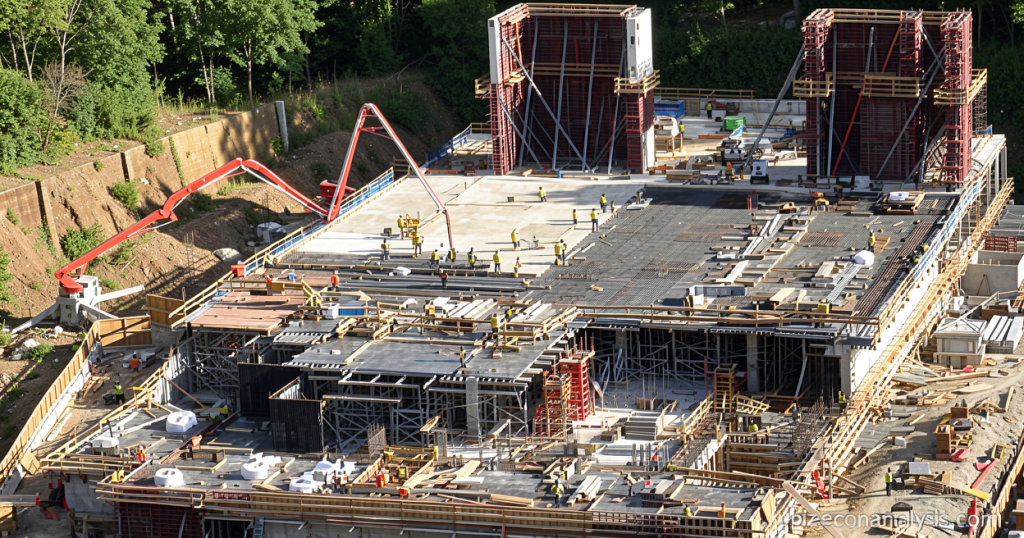
Bizeconanalysis.com – Supreme Court temporarily allows White House ballroom construction to proceed, at least for the time being. Chief Justice John Roberts granted a temporary stay on Friday, blocking a district-court injunction that would have halted all above-ground work on the roughly $400 million East Wing project. The stay remains in effect until the justices act on the Justice Department’s petition to pause the lower-court order, which had been set to take effect at midnight.
The intervention was requested directly by the administration. Last week the White House filed a petition asking the high court to let the 90,000-square-foot ballroom — paired with an underground presidential security bunker, medical facilities, and other integrated infrastructure — continue under construction. The project has become one of the most litigated disputes of the current administration.
How the Case Reached the High Court
A federal district court first issued an injunction stopping above-ground ballroom construction. The U.S. Court of Appeals for the D.C. Circuit, sitting in a divided panel, upheld that injunction earlier this month. The appeals court drew a constitutional line, holding that Congress retains “full constitutional control over federal property and the funding of its maintenance and development” and finding an “absence of any express or implied authorization” for the president to unilaterally erect a structure of this scale on White House grounds.
The D.C. Circuit nonetheless suspended its own ruling for 14 days — expiring Friday — to give the Justice Department a window to seek Supreme Court relief. Roberts’ stay now occupies that window, effectively extending the pause on the injunction while the justices deliberate.
The Administration’s National-Security Framing
Solicitor General D. John Sauer described the district-court order as an “extraordinary and unlawful injunction” that would stop “the ongoing construction of the integrated military complex, including a totally secure ballroom space, at the East Wing of the White House, which is vitally required by national security.” He urged the justices to hold the lower-court ruling in abeyance pending further review.
President Trump has amplified the security argument repeatedly, tying continued construction to his personal safety and to American national security, and citing recent foiled assassination plots. In a Truth Social post earlier this month he called the National Trust for Historic Preservation “TREASONISTS” and alleged, without presenting evidence, that they “revealed Top Military Secrets!”
“We are grateful for the Decision of the United States Supreme Court. The Military/Ballroom Complex being built on the hallowed grounds of the White House, which is so vital for National Security, will be THE GREATEST OF ITS KIND!”
That post, issued immediately after the stay, underscored how tightly the administration links the project’s fate to questions of presidential protection and institutional loyalty. White House official Joshua Fisher, overseeing the build, submitted a declaration warning the court that the project is too far advanced to reverse.
Above-Ground Work Only
A critical distinction runs through the litigation: judges have permitted all below-ground construction — the bunker, medical facilities, and other national-security infrastructure — to continue without interruption. Only the above-ground physical structure of the ballroom is contested. Trump has repeatedly blurred that line, stating in a Truth Social message that “the lower section does not work without the upper section and, likewise, the upper section does not work without the lower. It is all one highly integrated unit.” Critics note that conflating a security bunker with a ceremonial ballroom complicates judicial review of whether Congress’s property-and-funding authority has been exceeded.
Frequently Asked Questions
What exactly did the Supreme Court do? Chief Justice Roberts issued a temporary stay that pauses a district-court injunction halting above-ground ballroom construction. The stay lasts until the full court rules on the Justice Department’s petition.
Does the stay cover underground work? No. Below-ground construction — the presidential security bunker, medical facilities, and related infrastructure — has been permitted to continue throughout the litigation.
Who requested the intervention? The White House and the Justice Department petitioned the Supreme Court last week, arguing the project is vital to national security and presidential protection.
What happens next? The justices will consider whether to grant or deny the petition to pause the lower-court injunction. Until then, above-ground construction may proceed under the temporary stay.