
Supreme Court continues to allow construction of Trump’s White House ballroom
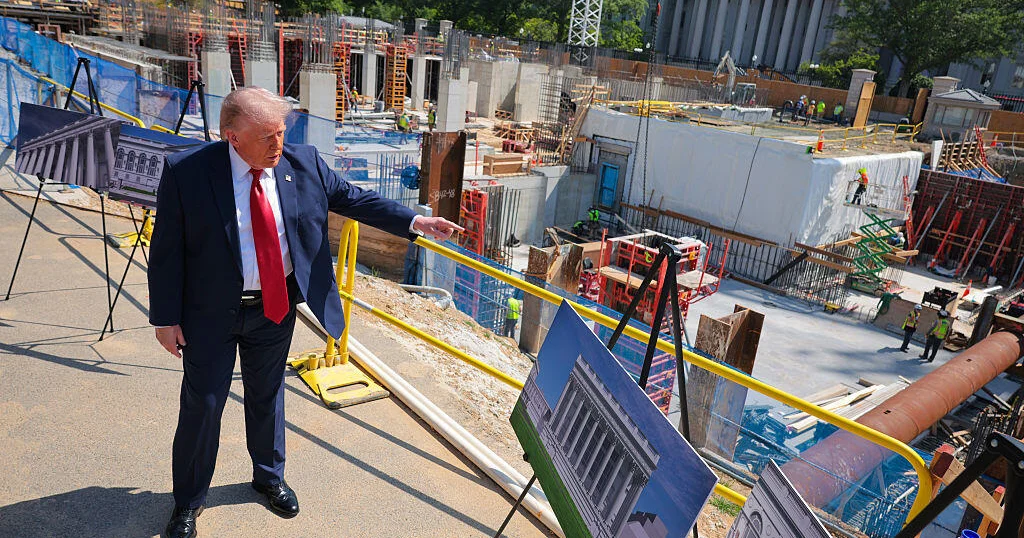
Supreme Court Continues to Allow Ballroom Build
Bizeconanalysis.com – The Supreme Court continues to allow the White House ballroom project to move forward after issuing a 5-4 ruling Monday that threw out the preservation lawsuit on procedural grounds. By finding that the challengers never possessed Article III standing, the justices dissolved the temporary injunctions lower courts had imposed and let construction crews resume work on the roughly 90,000-square-foot structure rising where the East Wing once stood.
What the majority deliberately left untouched was the far larger question of whether a sitting president may unilaterally demolish a historic wing of the executive mansion and replace it without congressional authorization. The unsigned opinion confined itself to procedural posture, sidestepping the constitutional separation-of-powers dispute that had animated the litigation from its inception.
The East Wing and Its $400 Million Replacement
Added in 1942 under President Franklin Roosevelt, the East Wing had long functioned as staff and visitor space within the White House complex. The administration’s decision to raze it and erect a ballroom plus associated military facilities — a project valued at approximately $400 million — drew immediate legal opposition. A divided panel of the U.S. Court of Appeals for the D.C. Circuit had earlier held that Congress, not the executive, exercises full constitutional control over federal property in the District of Columbia and that the administration lacked authority to proceed absent legislative approval.
That appellate ruling prompted an emergency petition to the Supreme Court. Chief Justice John Roberts, acting on his individual authority, had temporarily permitted construction to continue earlier in the month, buying the full bench time to weigh the administration’s request for nationwide relief. Monday’s opinion constituted the court’s final word on that interim question.
Standing Over Substance
The majority’s reasoning turned on the premise that the National Trust for Historic Preservation’s claimed injuries were too attenuated to satisfy constitutional requirements for a federal lawsuit. The opinion noted that lower court judges had “likely exceeded” their authority by enjoining the work, pointing to sworn declarations from senior administration officials — including the Director of National Intelligence and the heads of the Secret Service, the Army, and the State Department — who attested that the ballroom was operationally necessary and that any significant pause would harm the government because of national security facilities being installed underground.
“Today, we do not pass upon the legality of the government’s East Wing project. We conclude only that, based on the submissions before us, the government is likely to prevail in showing that the Trust lacks Article III standing to challenge the project in federal court and that the remaining stay factors favor relief.”
By anchoring its decision to standing rather than merits, the court left the underlying question of presidential authority over federal property in Washington, D.C. unresolved. That choice drew sharp criticism from the dissenting justices and from preservation advocates who had framed the case squarely as a separation-of-powers contest.
Chief Justice Roberts, joined by Justices Sonia Sotomayor, Elena Kagan, and Ketanji Brown Jackson, argued in dissent that the construction was “likely unlawful” and that Congress had never authorized the East Wing project. He contended that the injuries asserted by Alison Hoagland, a member of the National Trust, were sufficient to let the lawsuit proceed and that the majority had misconstrued the nature of her claimed harm.
“The White House is not just any building, and — when it comes to historic preservation — Hoagland is not just any person. In failing to appreciate as much, the Court misconceives the plaintiff’s injury, allowing the Executive’s likely infringement of the Legislature’s power of the purse and authority to regulate federal property in the District of Columbia to continue. Today’s decision is no victory for the separation of powers.”
Frequently Asked Questions
What exactly did the Supreme Court decide? The court ruled only on procedural standing. It held that the National Trust for Historic Preservation lacked Article III standing to challenge the ballroom project in federal court and that the stay factors favored lifting the injunctions. It did not rule on whether the demolition and replacement of the East Wing was lawful.
Can the ballroom project be challenged again? Because the merits question was never decided, a different plaintiff with a concrete, particularized injury could potentially bring a new suit. The standing ruling binds only the parties and claims before the court in this particular case.
What is the current status of construction? With the injunctions dissolved, crews have resumed work on the approximately 90,000-square-foot ballroom and associated military complex on the former East Wing site. The administration values the overall project at roughly $400 million.