
Kalshi bans ex-congressman George Santos for life after suspicious trades
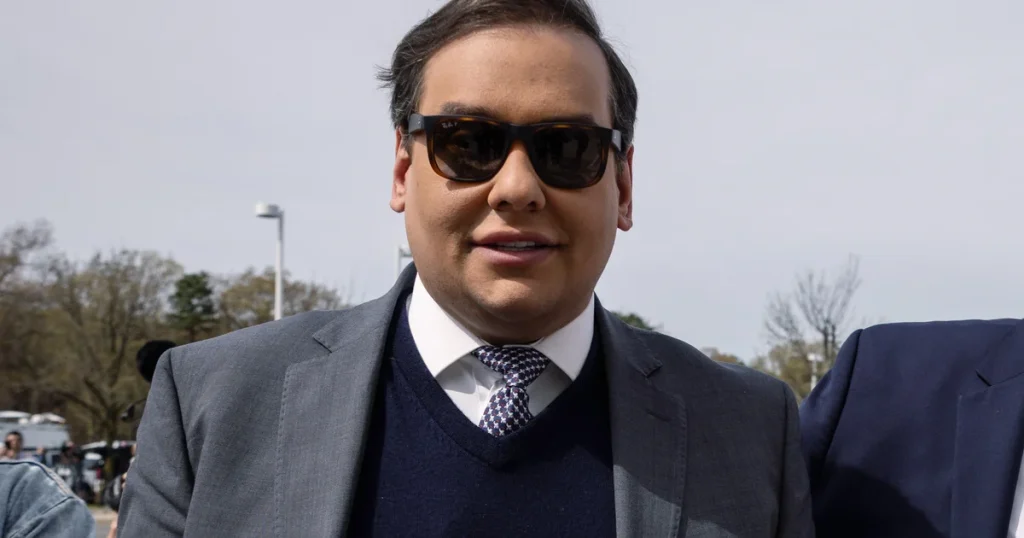
First-Ever Lifetime Ban: Kalshi Cuts Off George Santos After State of the Union Betting Scandal
Bizeconanalysis.com – The prediction-market platform Kalshi has handed out its first-ever permanent ban, and the recipient is no stranger to controversy. Former U.S. Representative George Santos, who once represented New York’s 3rd Congressional District, is now barred from trading on the platform indefinitely after the company concluded he engaged in insider trading tied to his own attendance at the 2026 State of the Union address. The ban follows a compliance review in which Santos declined to cooperate, a factor the company cited as decisive in its final determination.
Beyond the lifetime prohibition, Kalshi assessed a monetary penalty of $71,356 against Santos, a figure visible in a filing posted on the company’s own website. The enforcement action marks a watershed moment for a class of financial instruments that has grown rapidly in recent years but has yet to establish mature norms around who may and may not place wagers on events they can personally influence.
The Trades at the Center of the Case
The underlying conduct spans roughly two weeks in early February. Between February 12 and February 25, Santos placed a series of trades on a Kalshi contract framed as “Who will attend the State of the Union?” — a question on which he himself was a variable. Because his personal decision to show up or stay home could directly move the contract’s price, the platform’s rules prohibited him from wagering on that specific outcome. Nevertheless, he executed multiple positions linked to his own attendance and, in parallel, issued public statements designed to nudge the market price in a direction favorable to his holdings.
The Commodity Futures Trading Commission, which had been probing the same trades in a separate federal matter, quantified the gain at over $17,500. In a July statement, the agency explained that after Santos’s public posts, the contract’s pricing shifted in a way that enriched his positions.
“After these posts, 2026 SOTU contract prices moved in a direction favorable to Santos’ positions which allowed him to make over $17,500.”
Santos’s Reaction and Podcast Deflection
Santos did not accept the ban quietly. On Monday he took to X, the social platform formerly known as Twitter, to mock the decision.
“Hey @Kalshi thanks for the lifetime ban from your gambling platform. Let’s see how much longer you guys are around for.”
Earlier, in March, he had addressed the uproar on his own podcast, framing the episode as evidence of market fragility rather than personal misconduct.
“I guess people lost money. Some people made unexpected money. That’s to show you how fragile these markets are.”
The Federal Layer: CFTC Settlement and Trading Ban
The Kalshi action does not exist in isolation. In July, Santos agreed to pay $35,000 to resolve the CFTC’s investigation into the same suspicious trades. The agency simultaneously imposed a three-year ban on his ability to trade futures contracts, a restriction that operates independently of any single platform’s internal rules. Together, the two sanctions create a layered penalty: a federal trading prohibition plus a permanent exclusion from one major prediction-market venue.
Kalshi’s Enforcement Posture
Robert DeNault, who heads enforcement and serves as legal counsel at Kalshi, framed the Santos case as part of a broader institutional commitment. Speaking in an interview on Monday, he described the company’s compliance team as existing
“to catch bad actors, punish them, and deter other people from doing it again.”
He emphasized that while prediction markets themselves are a relatively recent phenomenon for most participants, the underlying misconduct is not.
“Prediction markets might be relatively new for people … but this type of behavior is not new.”
DeNault also underscored the cumulative nature of the penalties Santos now faces, noting that the former congressman “has been subject to punishment by the CFTC, and now he’s being subject to punishment by our exchange.”
Why This Matters for Prediction Markets
The Santos episode lands at a moment when insider-trading questions have become a defining stress test for platforms like Kalshi and Polymarket, which let participants wager on sports results, election outcomes, legislative votes, and a wide array of other real-world events. Unlike traditional securities markets, prediction markets often lack decades of settled case law and regulatory precedent. When a participant can shape the very event he is betting on, the line between legitimate trading and self-dealing becomes razor-thin, and enforcement bodies are still calibrating their responses.
The ripple effects are already visible. On the same Monday Kalshi issued its Santos ban, the platform announced three additional enforcement actions against candidates running for public office who had wagered on their own candidacies. Just the prior week, the CFTC ordered a former White House teleprompter operator to pay $172,000 after determining he had earned more than $100,000 on Kalshi bets connected to presidential speeches he had seen before they were delivered publicly. Each case tightens the implicit rule: if you can move the needle, you cannot bet on the needle.
Santos’s Political and Legal Backstory
For readers who followed his congressional career, the episode extends a long pattern of controversy. Santos served New York’s 3rd District in the House before being expelled in 2023 following charges of fraud and campaign-finance violations. In 2024 he pleaded guilty to fraud and identity-theft counts and received a seven-year prison sentence. He served only 84 days before President Trump ordered his release, describing Santos as a “rogue” while arguing he did not merit a harsh sentence and deserved credit for voting along Republican lines. The combination of a federal prison term, a presidential commutation, and now a permanent market ban gives the Santos saga an unusual arc that few financial-regulation stories have previously featured.
As prediction markets scale and attract participants ranging from casual bettors to institutional traders, the Santos ban will likely be cited in future enforcement actions as a benchmark: the first lifetime exclusion, imposed not merely for a bad trade but for a pattern of self-dealing compounded by non-cooperation with the regulator tasked with policing it. Whether that precedent holds, softens, or hardens over time will depend on how quickly the industry and its overseers codify the boundaries between information advantage and outright conflict of interest.
Related Reading
Frequently Asked Questions
What is Kalshi bans ex congressman George Santos?
Kalshi bans ex congressman George Santos is the main topic of this guide. The article explains the context, practical details, and next steps readers should understand.
Why does Kalshi bans ex congressman George Santos matter?
Kalshi bans ex congressman George Santos matters because readers are looking for a useful answer, not just a short summary. Good content should match search intent and help them decide what to do next.