
DOJ asks appeals court to let Trump’s name stay on Kennedy Center with deadline hours away
Justice Department Urges Appeals Court to Maintain Trump’s Name at Kennedy Center as Deadline Approaches
DOJ asks appeals court to let Trump – In Washington, the Trump administration has made a last-ditch effort to keep the president’s name on the Kennedy Center’s exterior signage. This request came just hours before a Friday deadline set by a lower court judge, who had previously ruled the name change unlawful. The decision by the Department of Justice to seek a temporary stay of the ruling marks a pivotal moment in the ongoing legal battle over the rebranding of the iconic performing arts venue.
The U.S. District Court Judge Christopher Cooper, in a decision from last month, concluded that the addition of President Trump’s name to the John F. Kennedy Center for the Performing Arts was done without proper authorization. His ruling not only mandated the removal of the name but also paused plans for the center to undergo a two-year renovation period. On Friday, Cooper denied the administration’s request for a temporary pause on his injunction, which would have allowed the name to remain while the case is appealed. He reasoned that the government had not sufficiently shown either the likelihood of success on appeal or the risk of irreparable harm, ensuring the deadline would proceed as planned.
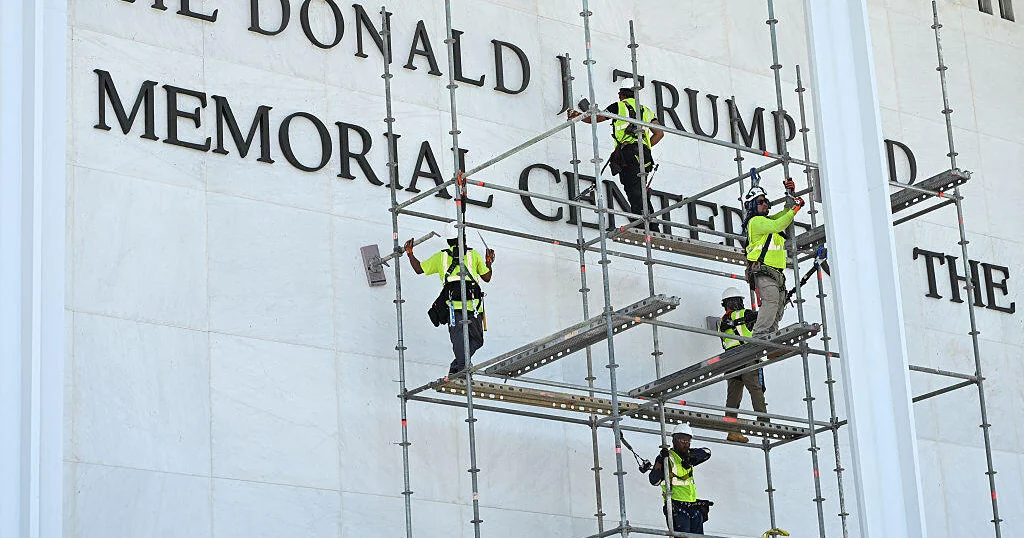
Workers were seen installing scaffolding outside the Kennedy Center under its Trump-named facade on Friday, but the building’s front entrance still bore the president’s name as of 6 p.m. The Justice Department, in an emergency motion filed late Friday, asked the Court of Appeals for the D.C. Circuit to halt Cooper’s ruling by 7 p.m. The motion argued that altering the center’s name now would create unnecessary confusion and disrupt fundraising efforts. “It does not make sense to alter the Center’s name and signage now, only to potentially revert the name again after what should be a successful appeal,” the government wrote in its filing.
The Trump administration emphasized the potential consequences of removing the name, claiming that the center’s fundraising would stall and donor contributions would need to be refunded if the name change were finalized. “Without the name, ‘Trump’ on the Building, our fundraising will not only come to a halt, but any and all monies raised or committed would be obligated to be returned, refunded, or terminated,” the motion stated. This argument was tied to the broader context of the center’s rebranding, which had been approved by a Trump-aligned board of trustees in December.
The Legal Ruling and Its Implications
Cooper’s original order also blocked plans by the administration and trustees to close the center for nearly two years for major renovations. The Kennedy Center’s website has already removed the president’s name from much of its online material, signaling a shift in the organization’s branding. However, the physical signage at the venue remains a point of contention. Trump and his allies had sought to rebrand the center shortly after his return to office last year, replacing Democratic-appointed members of the board with loyal supporters and top administration officials.
Democrat Rep. Joyce Beatty, who sits on the Kennedy Center’s board and initiated the lawsuit against the name change, criticized the administration’s late-minute maneuvering. Her legal team argued that the Justice Department’s emergency motion was a transparent attempt to delay the ruling and “game the judicial system.” “There is no reason they should not finish complying with the district court’s order — as they have been planning for the past two weeks,” Beatty’s attorneys wrote. They contended that the administration’s case for a stay was weak and that the decision to keep the name would only be temporary.
In a scathing 12-page filing, Beatty’s lawyers accused the government of “gamesmanship” and “running out the clock” by waiting weeks before appealing the decision. They called the request a “manufactured emergency,” noting that the administration had ample time to prepare for the appeal. “In the extremely unlikely event the Court grants Appellants a stay pending appeal, Appellants can easily restore Donald Trump’s name to the Kennedy Center during the appeal, should they choose,” the filing said. This assertion underlines the strategic nature of the move, as the administration hopes to delay the removal of the name while the appellate court reviews the case.
Arguments for and Against the Name Change
The motion echoed some of the arguments previously made by Mr. Trump himself regarding the state of the Kennedy Center. The filing stated that the building is in “bad shape” and “unsightly to look at,” with the administration claiming it cannot compete with other venues in the U.S. “When completed, as planned, it will be the envy of the World, something that everyone, including this court, will be proud of,” the government said. This rhetoric suggests that the name change was not just a branding decision but also part of a larger effort to enhance the center’s profile and legacy.
Beatty’s attorneys, however, dismissed these claims as self-serving. They argued that the center’s condition was not a justification for altering its name without congressional approval. Cooper’s ruling, issued in May, had already established that only Congress could authorize such a change. The deadline of June 12 was set for the administration to comply, and earlier reports indicated that the center’s general counsel had instructed staff to begin reversing the name change immediately.
The controversy highlights the political significance of the Kennedy Center, which was established by Congress as a memorial to President John F. Kennedy. The rebranding to the “Trump-Kennedy Center” has sparked debates about the institution’s independence and the influence of political figures on its identity. While the center remains the premier arts venue in the nation’s capital, the legal battle over its name underscores the broader tensions between executive action and legislative oversight.
Context of the Rebranding
The center, run by a Trump-aligned board of trustees, voted in December to add the president’s name to its title. This decision came amid efforts to reshape the institution’s image and align it with the administration’s agenda. The rebranding was part of a campaign to assert presidential influence over cultural institutions, with the argument that the name would bolster the center’s reputation and attract more attention. However, critics, including Beatty, contend that the move was politically motivated and undermined the center’s mission as a tribute to JFK.
As the deadline looms, the situation remains in flux. The administration’s emergency motion seeks to delay the removal of the name, but Cooper’s denial leaves the center’s signage under the Trump moniker at risk of being changed. The Kennedy Center’s staff is now tasked with executing the order, with the front facade potentially becoming the last visible reminder of the name change before the final ruling. The outcome of the appeal will determine whether the center retains its new identity or reverts to its original name, raising questions about the balance of power between the executive and legislative branches in shaping national landmarks.