
Powerful earthquake in southern Japan leaves people trapped in damaged mall
Devastating 7.1 Magnitude Earthquake Strikes Japan’s Kumamoto Region
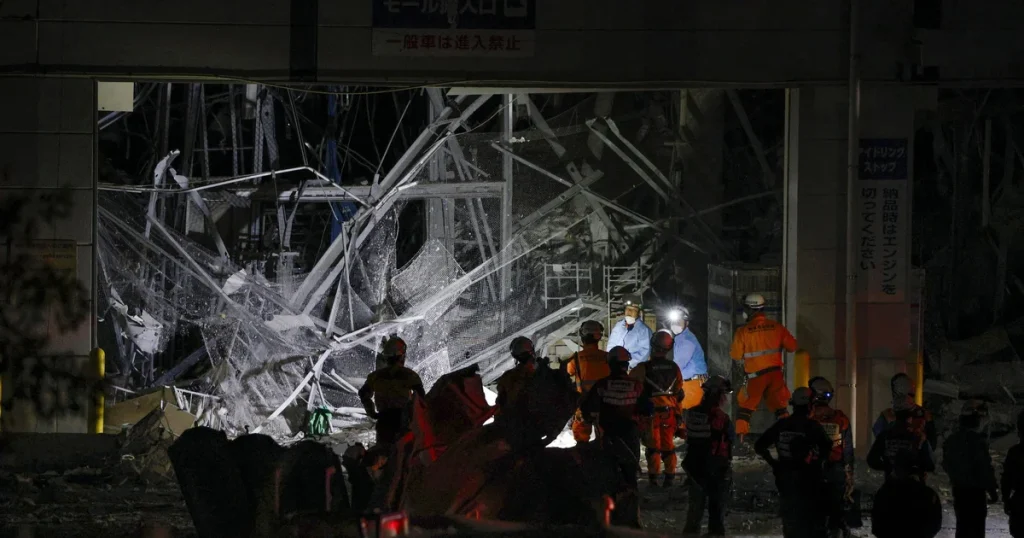
Bizeconanalysis.com – A powerful seismic event rocked southern Japan on Tuesday, causing widespread destruction across the Kumamoto prefecture on Kyushu island. Prime Minister Sanae Takaichi announced that multiple buildings collapsed and fires broke out following the temblor. Emergency responders are currently searching for at least nine individuals who remain unaccounted for inside a severely damaged shopping center in the hardest-hit area.
Immediate Aftermath and Rescue Operations
According to public broadcaster NHK, more than fifty individuals required medical attention at hospitals and emergency facilities. Japanese partner network TBS reported that the Kumamoto regional government confirmed five people had been successfully extracted from the Aeon Mall located in Kashima city. However, nine others were still listed as missing. City police initially informed TBS that numerous fatalities had occurred within the mall structure, though officials noted it would require additional time to verify precise casualty figures.
Separately, eleven workers became trapped inside the Nippon Paper Industries Yatsushiro Plant when a chimney structure collapsed during the shaking. Two of those trapped individuals were subsequently rescued but were discovered without vital signs, NHK reported. Television footage broadcast by NHK captured the extensive damage, showing multiple fires burning, bridges severely damaged, a cargo train that had derailed, and roads with significant cracking throughout the region.
Seismic Data and Official Assessments
The Japan Meteorological Agency recorded the earthquake at 4:27 p.m. local time, which corresponds to 2:27 a.m. Eastern time. The agency measured the event at magnitude 7.1, while Japan’s Shindo scale registered the highest possible level of 7 for ground shaking intensity. The United States Geological Survey independently measured the same earthquake at 6.8 magnitude. Officials noted that while hundreds of earthquakes occur in Japan annually, the vast majority produce minimal damage.
We are still assessing the extent of injuries and property damage, but I have been informed that there have already been several injuries. Power outages and fires are happening in some areas, and roads and bridges have been damaged and buildings collapsed.
The Japan Meteorological Agency initially issued a tsunami warning indicating potential waves up to three feet in height. This alert was subsequently withdrawn after approximately two hours. The Nuclear Regulation Authority confirmed that no immediate abnormalities were detected at nuclear facilities in the region. Kyushu Electric Power reported that roughly 45,000 households and facilities experienced power outages. The utility company also stated that three nuclear reactors operating in the area at the time of the earthquake were functioning normally.
Continued Shaking and Historical Context
An NHK reporter wearing a protective helmet broadcast live approximately thirty minutes after the initial quake, describing ongoing tremors. The reporter noted that the shaking was so intense that remaining standing became difficult, with the newsroom rocking violently. The correspondent advised the public to remain vigilant as aftershocks could continue.
Kumamoto experienced two catastrophic earthquakes in 2016. The first measured 6.5 in magnitude, followed two days later by a 7.3 magnitude event. Those twin disasters claimed 273 lives and injured more than 2,800 people. More recently, a 7.2 magnitude earthquake struck northern Japan on June 25 without causing fatalities or significant damage.
Japan sits atop four major tectonic plates along the western Pacific Ring of Fire, making it one of the world’s most seismically active nations. The archipelago’s population of approximately 125 million people endures hundreds of tremors annually, accounting for roughly 18 percent of global earthquakes. While most are mild, damage varies considerably based on location and depth beneath the Earth’s surface.
The nation continues to remember the devastating 9.0-magnitude undersea earthquake of 2011, which triggered a massive tsunami that killed or left missing approximately 18,500 people and severely damaged the Fukushima nuclear facility. Earlier this year on April 20, a 7.7 magnitude tremor struck northern Japan, injuring at least ten people and shaking large buildings in Tokyo. This event prompted authorities to issue a special advisory warning of increased risk for earthquakes of magnitude 8.0 or stronger, which was eventually lifted after one week.
Related Reading
Frequently Asked Questions
What is Powerful earthquake in southern Japan leaves?
Powerful earthquake in southern Japan leaves is the main topic of this guide. The article explains the context, practical details, and next steps readers should understand.
Why does Powerful earthquake in southern Japan leaves matter?
Powerful earthquake in southern Japan leaves matters because readers are looking for a useful answer, not just a short summary. Good content should match search intent and help them decide what to do next.