
Tupac Shakur’s 1996 murder was an “act of revenge,” prosecutor tells jury in trial of accused mastermind
Tupac Shakur’s 1996 Murder Trial Opens in Las Vegas
Bizeconanalysis.com – Tupac Shakur’s 1996 murder trial opened Monday in Clark County, Nevada, after nearly three decades without a single indictment. On a September evening that year, a 25-year-old rapper stepped from a black BMW in downtown Las Vegas and was struck by bullets fired from a white Cadillac. No one faced criminal charges for that killing until 2023, when Duane “Keffe D” Davis, now 63, was indicted on a count of murder with a deadly weapon intended to advance a criminal gang’s interests. Prosecutors expect the proceeding to run for weeks; a guilty verdict carries a sentence of life behind bars. Davis has maintained his innocence at every stage.
The State’s Case: Retaliation in Two and a Half Hours
Chief Deputy District Attorney Binu Palal framed the prosecution’s theory as a straightforward sequence of humiliation followed by lethal payback. He displayed a photograph from the Mike Tyson boxing match dated September 7, 1996, then played video footage showing Shakur’s entourage physically assaulting Orlando “Baby Lane” Anderson, Davis’s nephew, in the aftermath of that fight. Palal argued that Tupac Shakur’s 1996 murder was not a random drive-by but a calculated response to that beating.
“On September 7, 1996, Tupac Shakur publicly, on camera, participated in a humiliating beating of Duane Davis’ nephew, Orlando Anderson. Then, two and a half hours later … Tupac is gunned down in a drive-by shooting from a white Cadillac in an act of revenge.”
According to the state, Davis was not the triggerman. He allegedly handed a firearm to an occupant in the rear seat of his vehicle and directed that person to open fire on the BMW carrying Shakur and his manager, Marion “Suge” Knight. The white Cadillac held Davis plus three other passengers; all three have since died, leaving Davis as the sole surviving participant in the vehicle.
“Let’s be clear, Duane Davis did not pull the trigger. But he did plan the shooting in retaliation of the beating of his nephew. Remarkably, you will learn that from Duane Davis himself.”
That final remark points to a 2008 interview in which Davis spoke with investigators probing the linked deaths of Shakur and Christopher Wallace, known as Notorious B.I.G. During that session, Davis described passing a gun to men seated behind him in the Cadillac as it fired on the BMW.
The Defense Challenges the Timeline
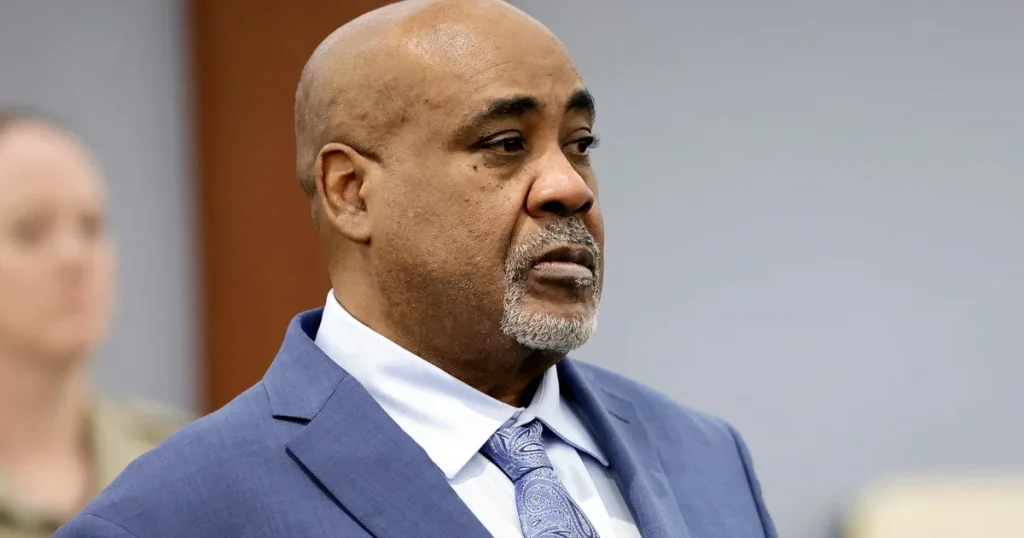
Davis entered the courtroom in a blue suit and tie, scanning the gallery before settling beside his attorney, Michael Sanft, once the jury was sworn in. Sanft spent his opening dismantling the state’s chronology, labeling the prosecution’s account “fiction” and pressing the jury to consider why the Clark County district attorney’s office waited more than two decades before bringing charges.
“No one corroborates any of this. What facts do they have after 30 years?”
The defense plans to call only a small number of witnesses, in sharp contrast to the 35 to 45 witnesses prosecutors intend to present over the course of the trial.
A Legacy and a Family in the Gallery
The unsolved nature of the 1996 shooting haunted the hip-hop world for years. Shakur’s death at 25 made him a permanent fixture in popular culture: six Grammy nominations, a 2017 induction into the Rock & Roll Hall of Fame, a posthumous star on the Hollywood Walk of Fame, a street in Oakland bearing his name, and a character inspired by him in the upcoming video game “Stranger Than Heaven.” His influence as a versatile, genre-crossing artist remains unmatched among his peers.
For the Shakur family, the trial carries a painful weight. Stepbrother Maurice “Mopreme” Shakur sat quietly in the front row behind the prosecution table. He recently told The Associated Press that watching weeks of testimony will be retraumatizing, yet the family felt compelled to be present.
“We’re gonna stand by Pac as we always have.”
Supporters formed a small line early Monday morning for a seat in the gallery. Din Malone, who traveled by bus from Denver, wore a Tupac shirt and played the rapper’s music from his phone while waiting to enter. Music industry figures also made the trip: Darryl Harper, a veteran producer who collaborated with Shakur at Death Row Records on tracks released after the shooting, booked a flight from Georgia the moment the trial date was confirmed. Shakur’s cousins Kendrick Lesane and William Lesane flew in from Atlanta the previous week.
Frequently Asked Questions
Where is the Tupac Shakur’s 1996 murder trial being held?
The trial is taking place in Clark County, Nevada, the jurisdiction where the shooting occurred in downtown Las Vegas in September 1996.
What charge does Duane “Keffe D” Davis face?
Davis is indicted on a single count of murder with a deadly weapon, with the state alleging the act was intended to advance a criminal gang’s interests. A conviction carries a sentence of life imprisonment.
Why did it take so long to bring charges?
The Clark County district attorney’s office waited more than two decades before filing the indictment. The defense has highlighted that delay as a central theme, questioning what corroborating evidence remains after roughly 30 years.
Was Davis the person who fired the gun?
According to the prosecution, no. The state’s theory is that Davis handed a firearm to a rear-seat occupant in the white Cadillac and directed that person to shoot at the BMW. Davis has denied involvement.