
Another child’s room now a silent memorial to the toll of school shootings
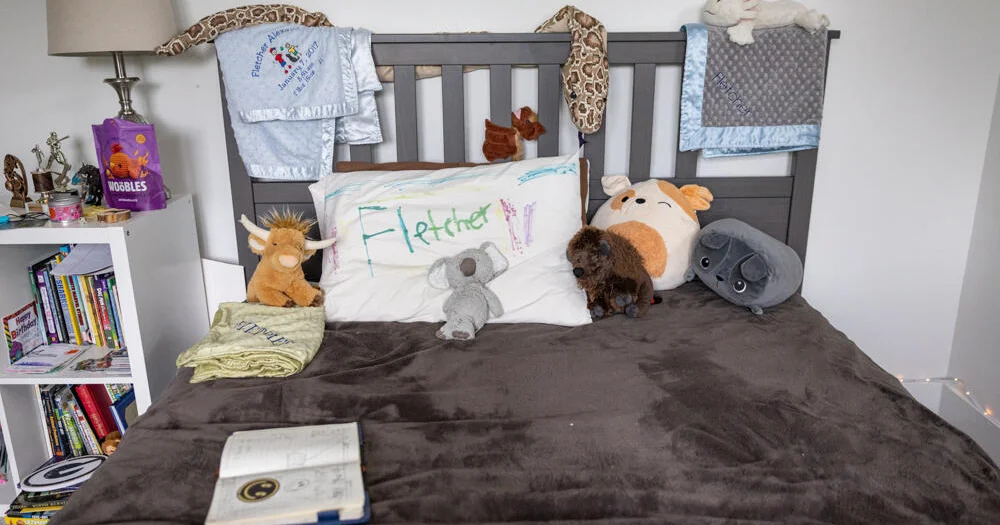
A Bedroom in South Minneapolis Holds the Weight of a Nation’s Grief
Bizeconanalysis.com – On a quiet residential street in south Minneapolis, a second-floor bedroom has been sealed off from the ordinary flow of daily life. No one rearranges the furniture. No one repaints the walls. The space belongs to a boy who will never grow into it, and his parents have chosen to leave every object exactly where it fell on the afternoon of August 27, 2025, when a gunman opened fire at the Annunciation Catholic Church and School, killing two students. For Jesse and Mollie Merkel, the room is not a place of storage or neglect. It is a shrine built from memory, and they intend to keep it that way.
Fletcher Merkel was eight years old. He liked Legos, cartoon buffaloes, and the Green Bay Packers. He maintained a small collection of houseplants he called “Fletcher’s Garden.” He wore a Cub Scout uniform with pride. These details, preserved in the room’s corners and shelves, form what his father describes as the most intimate monument imaginable to a child’s brief, unfinished life.
“He’s not with us the way we want him to be, but this is the best we have. It’s one of the most personal monuments to who he was as a person.”
Jesse Merkel spoke those words while standing in the doorway of the room, looking out at the scattered remnants of his son’s world. His wife, Mollie, added her own measure of what the space means to their family’s survival.
“If the room’s not his, I feel like that memory — like I won’t feel it the same way.”
The Documentary Lens and the Long Work Ahead
The Merkel bedroom is one of many. Over several years, photographer Lou Bopp and a documentary filmmaker traveled to eight such rooms across the country, documenting the spaces where American children were killed in school shootings. Their work became the Netflix short film All the Empty Rooms, which received an Academy Award in March of this year. The recognition brought the project a wider audience, but the couple behind the camera have been clear that the Oscar was not a finish line.
They have committed to continuing the documentation for as long as parents ask them to come, and for as long as the epidemic of school shootings in the United States continues to claim young lives. Each room they enter is treated as a sacred space. Families may keep the photographs privately, or they may choose to share them publicly so that strangers can see, briefly, what was lost.
“I want people to maybe have a tiny glimpse of, ‘What if that was me?'”
Jesse Merkel’s hope is modest but pointed: that a stranger, scrolling through an image of a child’s bedroom, might pause long enough to feel the weight of what happened. Mollie’s emphasis is different but equally urgent. She wants the world to know who Fletcher was before the shooting defined him.
“It’s really important to me that people know who he was. Like in the beginning it was bugs and animals.”
“Constant energy,”
Jesse added, describing his son’s temperament in the months before the tragedy.
Small Objects, Enormous Meaning
The photographs taken inside the room capture details that no statistic can convey. A pair of shoes sits near the door — purchased just three weeks before Fletcher died, already worn through at the soles by a child who could not stop moving. A blanket lies folded on the bed, its corner frayed to bare threads from years of comfort-seeking. A journal rests on a shelf, and one page records a childhood scheme to raid the cookie jar downstairs, capped with a triumphant annotation: “This plan was successful.”
These are not relics in any museum sense. They are the ordinary debris of a Tuesday, a Saturday, a hundred unremarkable days that now carry the full gravity of a life cut short. For the Merkel family, returning to the room is not a choice made lightly. It is an act of love that costs them something each time they open the door.
What a Room Can Ask of a Nation
When asked whether it would change anything if every American could stand in that bedroom for even a moment, both parents answered without hesitation: yes. Mollie framed it in terms of felt experience rather than intellectual argument.
“They have to feel it.”
Jesse extended the thought into a moral imperative.
“As a human, you have to say this can’t happen to anybody else.”
The plea is not new. Since the Columbine High School massacre in 1999, and through Sandy Hook, Parkland, Uvalde, and dozens of smaller incidents since, American families have been asked to absorb the shock of children dying in classrooms and church halls. The political machinery has produced gun-lobby battles, state-level legislation, and periodic national outpourings that fade within weeks. What remains, in the end, is the room. The shoes. The worn blanket. The journal entry about cookies.
In south Minneapolis, the second-floor bedroom stays exactly as it was. The plants in “Fletcher’s Garden” will need tending. The Cub Scout uniform will gather dust. The shoes will never be laced again. And the parents will keep the door closed, or open it only when they can bear the sight of what their son left behind — a small, chaotic, joyful room that now asks the rest of the country a question it has no easy answer to.
Related Reading
Frequently Asked Questions
What is Another child s room now a silent?
Another child s room now a silent is the main topic of this guide. The article explains the context, practical details, and next steps readers should understand.
Why does Another child s room now a silent matter?
Another child s room now a silent matters because readers are looking for a useful answer, not just a short summary. Good content should match search intent and help them decide what to do next.