
Evidence of bird strike found after Ryanair passenger nearly sucked out of plane’s broken window, NTSB says
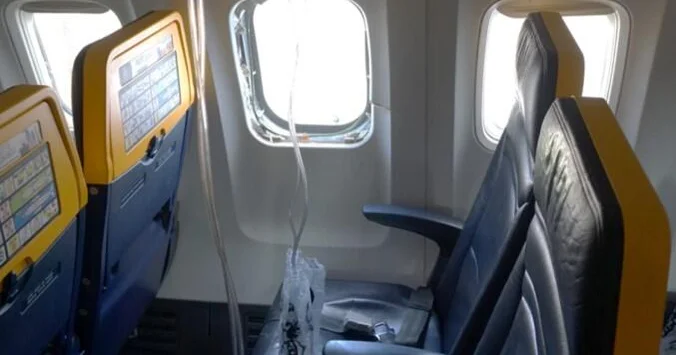
NTSB Preliminary Report Reveals Bird Strike Likely Caused Ryanair Window Incident
Engine Failure Sends Debris Through Fuselage
Bizeconanalysis.com – A preliminary investigation by the U.S. National Transportation Safety Board has identified a bird strike as the probable trigger for a dramatic incident involving a Ryanair passenger who was nearly ejected through a broken aircraft window. The report, released on Thursday, outlines how mechanical failure in one of the Boeing 737’s engines sent fragments tearing through the fuselage and cabin during a routine flight from Greece to Germany.
The sequence of events began on the morning of July 10, when Ryanair Flight 1879 departed from Thessaloniki International Airport. Within minutes of lifting off, the aircraft’s number two engine experienced a catastrophic failure. According to investigators, a fan blade snapped free from its mounting point, creating a chain reaction that sent metal fragments and debris shooting outward from the engine compartment.
The flying debris struck the aircraft’s fuselage at multiple locations, causing structural damage and ultimately shattering a passenger window located in row eleven. The force of the impact was significant enough to completely dislodge the window panel, leaving a large opening in the cabin wall. Pieces of the broken window were later discovered scattered across several rows of the aircraft, indicating the severity of the breach.
Bird Remains Point to Wildlife Collision
Perhaps the most compelling evidence in the preliminary report comes from inside the damaged engine itself. NTSB investigators discovered bird remains, including identifiable feathers, lodged deep within the engine components. While investigators cannot definitively confirm whether these remains originated from the July 10 incident or from a previous encounter, the timing and location suggest a strong connection.
Historical data reveals that the aircraft had experienced four reported bird strikes during the twelve months leading up to this incident. In two of those earlier cases, bird remains were also recovered from the engines. This pattern strengthens the theory that wildlife collision played a central role in the recent accident.
The bird remains and additional samples collected from the scene were forwarded to the Smithsonian Institution’s Feather Identification Laboratory in Washington, D.C. for detailed analysis. This prestigious facility specializes in identifying bird species through feather morphology, which could help pinpoint exactly which type of bird was involved in the strike.
Passenger Nearly Ejected from Cabin
The passenger seated in row eleven, identified as a sixty-one-year-old Serbian man, suffered serious injuries when cabin depressurization caused him to be partially sucked out through the broken window. Flight attendants reported observing the man partially lodged in the damaged window frame, with the entire window panel missing from its housing.
“I don’t remember much and my head and neck still hurt but I am still alive,” the injured passenger told The Guardian. “It could have been the seatbelt, the fact that I was still strapped in.”
Other passengers quickly responded to the emergency, pulling the injured man back into the cabin. He was then relocated to row twelve, where a fellow passenger who happened to be a doctor provided immediate medical attention. Meanwhile, another traveler ventured into the forward galley and retrieved a metal box, using it to attempt to seal the broken window opening.
Investigation Uncovers Technical Details
Technical analysis revealed several critical findings. Pilots received an engine warning before hearing a loud bang, followed by cabin depressurization. Data recorders showed that vibrations in the number two engine exceeded those in the number one engine during the final moments of takeoff. Investigators also identified signs of metal fatigue at the base of the broken fan blade, despite recent inspections that had cleared the blades for service.
Three loose fragments of the fan blade were recovered from the engine. The presence of metal fatigue suggests that the blade may have failed due to stress accumulation over time rather than an external impact alone.
Regulatory and Operational Context
The incident has highlighted certain regulatory distinctions between European and American aviation standards. Ryanair, as an Irish carrier, operates outside Federal Aviation Administration jurisdiction. NTSB investigators noted that engine updates mandated for U.S. airlines by 2028 had not yet been implemented on this particular aircraft.
Greek authorities designated the NTSB as the lead investigating agency for the incident. The preliminary findings represent only the beginning of a comprehensive investigation. Protocol dictates that the final NTSB report will likely be published within twelve to twenty-four months, allowing time for thorough analysis of all evidence, including the Smithsonian’s feather identification results.
Boeing issued a statement confirming its support for the investigation. The company emphasized that it follows NTSB requirements and International Civil Aviation Organization Annex 13 protocols, deferring to the American agency while maintaining contact with both Ryanair and Malta Air, its primary customers.
Ryanair has declined to comment until the investigation concludes. All one hundred forty-nine passengers and six crew members aboard the aircraft were accounted for, with only the Serbian man sustaining injuries. The plane returned immediately to Thessaloniki International Airport following the incident, where emergency services were waiting to assist the injured passenger.
Related Reading
Frequently Asked Questions
What is Evidence of bird strike found after?
Evidence of bird strike found after is the main topic of this guide. The article explains the context, practical details, and next steps readers should understand.
Why does Evidence of bird strike found after matter?
Evidence of bird strike found after matters because readers are looking for a useful answer, not just a short summary. Good content should match search intent and help them decide what to do next.