
Security guard rescued from Venezuela earthquake rubble 8 days after massive temblors: “Truly a miracle”
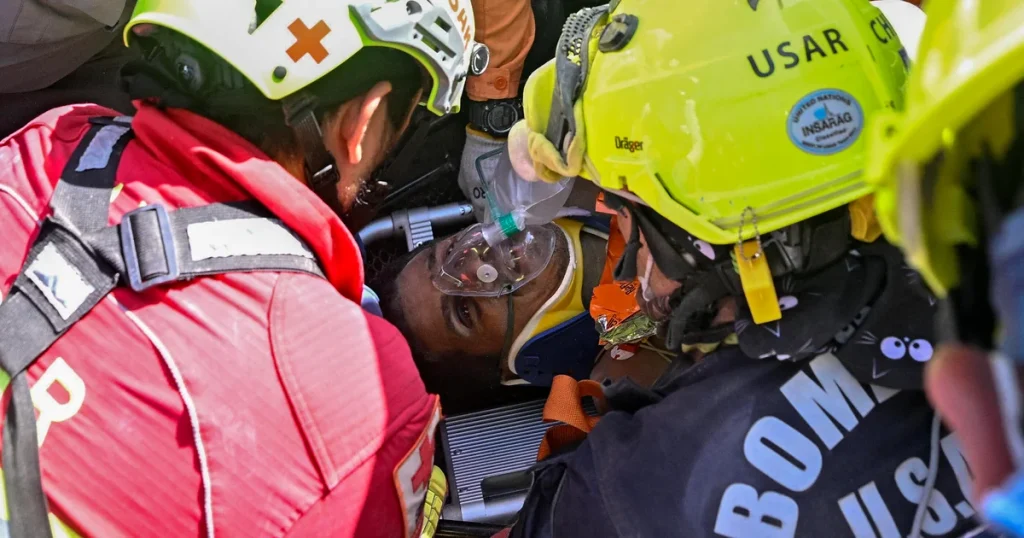
Eight-Day Miracle: Security Guard Survives Venezuela Earthquake Collapse
Security guard rescued from Venezuela earthquake – On Thursday, a crowd of hundreds gathered to celebrate as rescuers in Venezuela pulled Hernan Gil from the ruins of a collapsed building eight days after a catastrophic earthquake struck. AFP journalists were on hand to witness the emotional moment. The official death toll had climbed to nearly 2,600, with countless individuals still missing, yet Gil’s survival was hailed as a remarkable feat. He was removed from the debris of a seven-story structure that had crumbled in the June 24 disaster, leaving the coastal area of Catia La Mar nearly unrecognizable.
A Testimony of Hope
Before his extraction, Gil’s wife, Gusbimar Gonzalez, expressed her disbelief to AFP. “I’m completely amazed because it’s the first time I’ve seen so many countries come together like this to save a single person,” she said. Her words underscored the global effort that had brought international teams to the scene, working relentlessly to uncover the hidden survivor.
“This is truly a miracle,” Gusbimar Gonzalez told AFP. “I’m completely amazed because it’s the first time I’ve seen so many countries come together like this to save a single person.”
Collaborative Rescue Efforts
The operation involved collaboration from seven countries — Venezuela, Chile, the United States, Portugal, Costa Rica, El Salvador, and Mexico — who worked tirelessly over three days to locate and extract Gil. Teams from these nations combined their expertise, with some focusing on structural analysis and others on life support systems to keep Gil alive during the grueling process. The task force leader from the Los Angeles County Fire Department, Manny Sampang, described the complexity of the rescue, noting that multiple buildings nearby were leaning into the collapsed structure, heightening the risk of further collapse.
Days of Struggle and Survival
Rescuers had first established communication with Gil four days prior, reports indicated he was trapped under 140 tons of concrete. During this time, he was sustained through a syringe, a critical measure that kept him conscious and stable as teams worked to free him from the wreckage. The operation required meticulous planning, as each movement risked destabilizing the already weakened buildings surrounding him.
Leadership in the Field
El Salvador’s President Nayib Bukele shared a video on X, capturing the moment rescuers carried Gil to safety on a stretcher. The message accompanying the clip emphasized the triumph of the team, stating, “WE FINALLY MANAGED TO RESCUE HERNÁN!” This rescue was particularly challenging, as teams had to navigate the risk of further collapses from nearby damaged structures. The effort highlighted the determination of volunteers and professionals alike to defy the odds.
“It is a very complex rescue,” Manny Sampang, a task force leader from the Los Angeles County Fire Department, told CBS News before Gil was finally pulled out. “I have multiple buildings leaning into that building we are trying to rescue him from.”
Canines and Human Resilience
Dustin Reynolds, a member of Virginia Urban Search and Rescue Task Force 1, described the difficulty of the search in the days following the quakes. “After so many days, the rescues primarily involve people buried beneath feet and feet of rubble,” he explained to CBS News. The use of highly trained canines played a crucial role in locating survivors, with the success of these efforts bringing a sense of hope to those still trapped. Among the notable rescues, an 18-day-old infant was saved from a collapsed high-rise after being trapped for 32 hours alongside her mother. Similarly, a mother and her 9-month-old child were extracted from rubble with only minor injuries, demonstrating the resilience of families in the face of disaster.
Small Wonders Amid the Ruins
Virginia Urban Search and Rescue Task Force 1 reported additional heartwarming rescues, including a small dog that had been buried under the rubble for five days. These moments, though seemingly minor, reinforced the possibility of survival even in the most dire circumstances. Yet, as the days passed, the likelihood of finding more survivors began to wane.
Hope Diminished in the Search
In La Guaira, the city most severely affected, most collapsed buildings were marked with the letter “D” for deceased — a designation given when no signs of life were detected after thorough searches. Javier Rodes, leading a Spanish rescue team, noted, “Time isn’t wasted in a place where there is no expectation of recovering people alive,” underscoring the grim reality of the situation. The National Assembly President, Jorge Rodriguez, announced that the death toll had risen to 2,295, with over 11,000 injured and nearly 13,000 left homeless. Tens