
Flash flood tears through Nepal, killing scores and leaving over 400 tourists missing, including 33 Americans
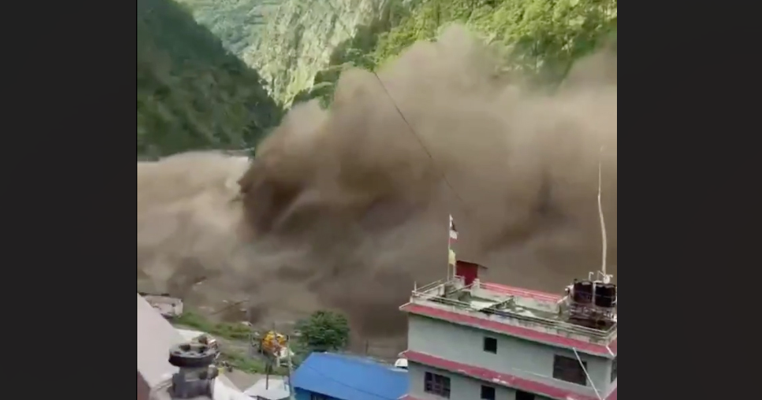
Earthquake-Triggered Landslide Unleashes Catastrophic Flash Flood Across Nepal’s Northern Valleys
Bizeconanalysis.com – A massive landslide, set off by seismic activity, dammed the Bhote Koshi River in Nepal’s Rasuwa district before the accumulated water burst through with devastating force on Wednesday morning. The resulting torrent swept through the valleys of northern Nepal, killing at least 160 people and leaving more than 400 individuals unaccounted for — the vast majority of them foreign visitors on organized trekking and sightseeing itineraries. The disaster struck the Nuwakot and Dhading districts adjacent to Rasuwa, all situated north of the capital Kathmandu, and obliterated entire settlements in its path.
Scale of Loss and Missing Persons
Nepali police confirmed the recovery of at least 157 bodies in the aftermath of what officials described as “devastating floods,” though no breakdown of victims’ nationalities had been released. Separately, Chinese state media reported significant casualties from a mudslide at a Tibet border crossing point, including three confirmed deaths.
The missing-persons tally, drawn from tour operators and compiled by Nepal’s Tourism Board, stood at 403 individuals. Of those, 341 were foreign nationals. The breakdown by country included 33 Americans, 34 Australians, 24 Canadians, 19 Malaysians, four Germans, and one Israeli. Most of the foreign travelers had been participating in commercial trekking packages arranged by licensed operators.
How the Flood Formed
Nepal’s Foreign Minister Shishir Khanal explained the mechanism: an earthquake triggered a large-scale landslide that blocked the Bhote Koshi River, creating a temporary natural dam. When the trapped water eventually breached the obstruction, a wall of floodwater surged downstream with little warning. The Bhote Koshi, one of the most powerful tributaries of the Koshi River system, flows through some of the country’s most remote and steeply incised terrain, making the speed and force of the release particularly lethal.
Nepal’s mountainous geography — characterized by deep gorges, narrow valleys, and limited road access — compounds the danger. Communities built along riverbanks in these corridors face acute vulnerability when upstream events alter water flow suddenly.
Rescue Operations Hampered by Terrain
David Fisher, head of delegation for the International Red Cross in Nepal, described the operational picture as extraordinarily difficult. Many affected zones remained unreachable by road, forcing reliance on rotary-wing aircraft for initial rescues.
“Entire villages have disappeared,” Fisher said. “Markets have disappeared, and a critical artery for commerce between China and Nepal has also now been damaged, making it very difficult for many of those families who depend on that for their living.”
Reuters noted that helicopters were unable to land at Syapru Besi and Timure, two of the hardest-hit localities, limiting the pace of ground-level recovery and evacuation.
District administrator Narendra Pariyar warned that further losses were possible.
“There could be heavy casualties or loss of property,” Pariyar was quoted as saying. He urged residents living along the banks of the Bhote Koshi River to relocate to higher ground immediately.
Government and International Response
Nepali President Ramachandra Paudel expressed that he was “extremely saddened” by the loss of lives and property caused by the sudden flood, and called on all government agencies, political parties, and the general public to intensify rescue and relief operations.
Prime Minister Balen Shah posted on social media that coordinated work had begun with medical teams, scouts, and the Red Cross to manage the humanitarian response.
In Washington, Secretary of State Marco Rubio issued a statement expressing solidarity with the Nepali people, noting that the State Department “stands ready to support the government of Nepal with needed humanitarian assistance.”
India’s central government directed authorities in states bordering Nepal to place their disaster-response machinery on high alert, given the shared river systems and the likelihood of downstream effects.
Infrastructure Damage and Economic Fallout
The Nepal Electricity Authority confirmed that six major hydropower and transmission facilities sustained damage in the flooding. Police spokesman Abi Narayan Kafle acknowledged uncertainty about the full extent of destruction.
“We do not exactly know the extent of damage, but the flood is big, and it could have damaged many settlements,” Kafle told AFP. “We have alerted people who are staying near the riverside to relocate … and deployed all our resources.”
The destruction of bridges, roads, and power infrastructure in the Rasuwa corridor threatens to sever a key trade and transit link between Nepal and the Tibet Autonomous Region of China. For communities whose livelihoods depend on cross-border commerce through these mountain passes, the economic disruption could persist well beyond the immediate emergency phase.
Context: Nepal’s Recurring Flood Vulnerability
Nepal’s narrow, densely populated river valleys have made the country acutely susceptible to flash flooding, particularly in the monsoon months of June through September. Climate change is intensifying glacial melt and rainfall variability in the Himalayan region, increasing the frequency of glacial lake outburst floods and landslide-dammed river events. The Bhote Koshi basin, fed by glaciers above 5,000 meters, sits squarely within this risk corridor. Each year, dozens of villages along the upper Koshi tributaries face the prospect of sudden inundation when upstream geology shifts — a hazard that the Wednesday disaster, with its earthquake-landslide-flood cascade, illustrated with particular brutality.
Related Reading
Frequently Asked Questions
What is Flash flood tears through Nepal killing?
Flash flood tears through Nepal killing is the main topic of this guide. The article explains the context, practical details, and next steps readers should understand.
Why does Flash flood tears through Nepal killing matter?
Flash flood tears through Nepal killing matters because readers are looking for a useful answer, not just a short summary. Good content should match search intent and help them decide what to do next.