
Could the AfD become Germany’s first far-right party to lead a state since WWII?
A Historic Threshold in Saxony-Anhalt: What Sunday’s Vote Means for Postwar German Politics
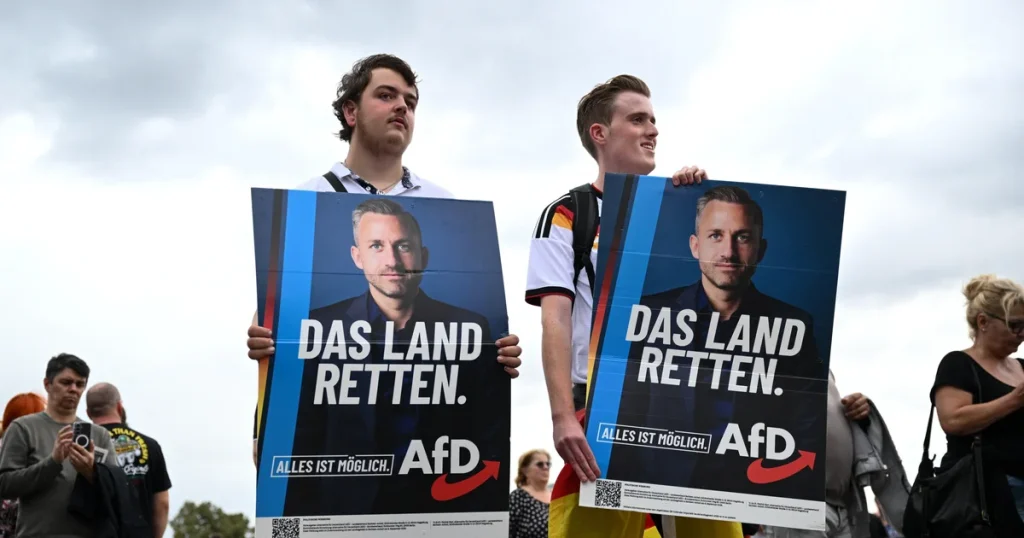
Bizeconanalysis.com – In a region of roughly 2.1 million residents situated west of Berlin, early exit-poll data from Sunday’s state election pointed to a commanding lead for the Alternative for Germany (AfD) — a result that, if confirmed, would mark the first time since 1945 that a far-right party has taken the helm of a German state government. The stakes extend well beyond the borders of Saxony-Anhalt, whose capital, Magdeburg, is a city of approximately 244,000 inhabitants. What unfolds in that modest administrative center will reshape how the rest of the country’s political establishment thinks about coalition-building, constitutional norms, and the boundaries of acceptable governance.
The Numbers on the Board
Public-television exit polls from ARD and ZDF placed the AfD near 44 percent of the vote — more than twice the share the party captured in the same region five years ago. That figure, however, fell marginally short of the absolute majority the party had sought in order to govern without partners, thereby sidestepping what German commentators call the “firewall”: the long-standing refusal of mainstream parties to enter coalition talks with the AfD.
The Christian Democratic Union, the center-right formation aligned with Chancellor Friedrich Merz and currently holding the state government, was seen finishing second at roughly 18.5 percent. The Left Party trailed in third with about nine percent. Both the Social Democrats and the Greens appeared on course to clear the five-percent threshold for legislative seats, each polling in the eight-to-nine percent range. The BSW party’s fate remained uncertain at the time of reporting.
Ulrich Siegmund, the AfD’s 35-year-old candidate for state premier, addressed ARD shortly after polls closed:
“We have written history.” Voters, he added, had sent a signal that “things cannot carry on like this.”
A Party Transformed
The AfD was founded in 2013, largely as a grassroots protest movement opposing deeper European integration and, in particular, the EU’s response to the 2015 refugee influx. Over the following decade the party drifted sharply rightward, absorbing elements of nativist rhetoric, skepticism toward multilateral institutions, and, in its eastern German chapters, a more confrontational posture toward immigrants and religious minorities. A victory in Saxony-Anhalt would represent an extraordinary leap for a formation that, less than a decade ago, was still struggling to clear parliamentary thresholds at the federal level.
For observers of European politics, the significance is structural: it would demonstrate that the postwar consensus — that no party openly espousing far-right ideology should hold executive power in a German state — has effectively collapsed in at least one Land. The ripple effects on federal coalition arithmetic, on the behavior of state-level CDU and SPD chapters, and on public confidence in democratic institutions would be considerable.
The Intelligence Question
Since 2023, the Saxony-Anhalt Office for the Protection of the Constitution — the state-level branch of Germany’s national domestic intelligence service — has formally classified the AfD’s regional chapter as a “confirmed far-right extremist” organization. In its published assessment, the office stated that the chapter’s core positions violate fundamental principles of the Basic Law and are “substantially permeated by the racist ideology of ethnopluralism.”
“Numerous anti-Muslim, racist and antisemitic statements by officials and elected representatives of the state association demonstrate that the AfD in Saxony-Anhalt seeks precisely such an ethnoculturally homogeneous national population and calls for the exclusion of people on the basis of their origin or religion.”
Siegmund has rejected the designation outright. In an August interview he accused the agency of being “politically weaponized” against his party, arguing that it “monitors the opposition” and is being deployed as “a political instrument.” Should his party take power, he said, it would consider either abolishing the state intelligence office entirely or subjecting it to a wholesale restructuring.
The Man at the Center
Siegmund projects a composed, charismatic, and approachable public persona — qualities that have made him a magnet for voters in a region long alienated by federal politics. Yet the August cover of Der Spiegel magazine branded him “Germany’s most dangerous man,” pointing to the combination of his winning demeanor, a realistic prospect of assuming state executive authority, and a radical policy platform.
The magazine noted that several of Siegmund’s closest party associates include former officials of the Heimattreuen Deutschen Jugend, a neo-Nazi youth organization that was banned in 2009. That biographical detail has fueled criticism that the party’s eastern German leadership maintains informal ties to the postwar far-right milieu.
The Remigration Question
Siegmund attended the 2023 “Potsdam meeting,” a gathering of German and international far-right figures at which Austrian anti-immigration activist Martin Sellner presented what he called a “master plan” for “remigration.” The concept envisioned the expulsion of asylum seekers, legally resident non-Germans, and German nationals of immigrant background deemed to have failed to “assimilate” — all to be sent to an unspecified African nation. A version of that plan has since become central to the AfD’s Saxony-Anhalt platform.
The state party now calls for what it terms a “deportation and remigration offensive,” backed by expanded detention infrastructure to house individuals awaiting removal, alongside new, stringent numerical caps on annual immigration. Germany currently imposes no statutory ceiling on the number of people permitted to enter the country each year; the state AfD chapter has dismissed proposed caps of around 200,000 per annum as far too generous.
For American readers, the policy architecture may evoke familiar debates over detention capacity and aggressive deportation enforcement. Yet the German context carries its own constitutional weight: any large-scale removal program would have to navigate the Basic Law’s guarantees of personal liberty, the right to asylum, and the prohibition on collective punishment — constraints that make the practical implementation of such a platform far more contested than its rhetorical framing suggests.
Whatever the final seat count in Magdeburg’s state parliament, Sunday’s vote has already altered the political landscape. The question is no longer whether the AfD can win a state government, but how quickly the rest of German politics adjusts to the reality that it has.
Related Reading
Frequently Asked Questions
What is Could the AfD become Germany s first?
Could the AfD become Germany s first is the main topic of this guide. The article explains the context, practical details, and next steps readers should understand.
Why does Could the AfD become Germany s first matter?
Could the AfD become Germany s first matters because readers are looking for a useful answer, not just a short summary. Good content should match search intent and help them decide what to do next.