
As the Danube River dries up, World War II shipwrecks and mammoth bones come into view
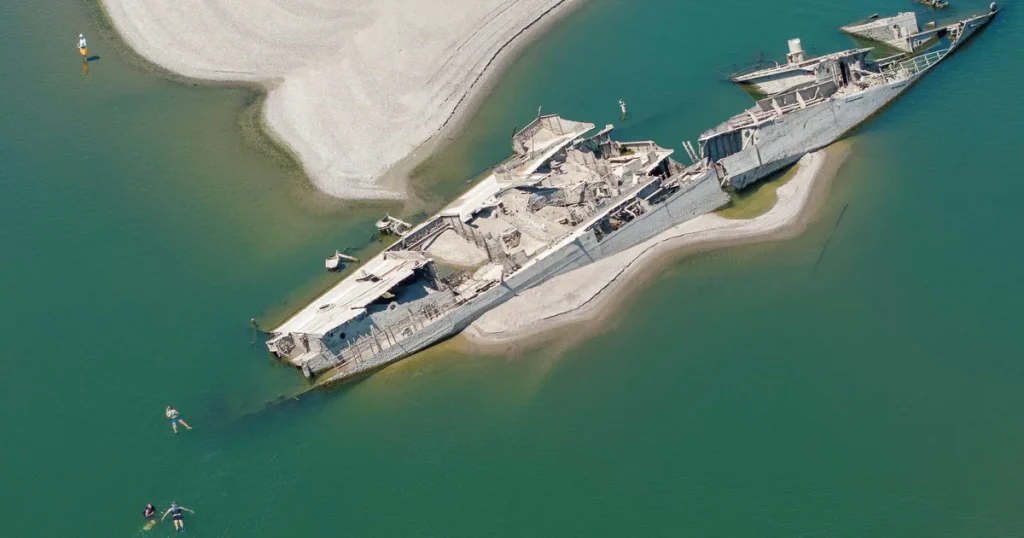
As the Danube River Dries: WWII Shipwrecks and Mammoth Bones Emerge
Bizeconanalysis.com – As the Danube River dries to historic lows, Europe’s second-longest waterway is unveiling a remarkable collection of treasures spanning centuries. Unprecedented drought conditions across Central and Eastern Europe have stripped away the water that concealed these wonders for decades. Alongside the summer heat crisis, residents and visitors are witnessing an extraordinary convergence of history and prehistory. Dozens of World War II German battleships, their rusted hulls resting on the riverbed for nearly eighty years, are now visible to the naked eye. In a remarkable coincidence, the parched riverbed in Bulgaria has also uncovered the bones of an ancient woolly mammoth, creating a dual discovery that bridges millennia.
Warships of the Black Sea Fleet Emerge
Near the Serbian port of Prahovo, where the Danube forms the natural border between Serbia and Romania, a rusty hull now breaks through the water’s surface. A broken mast stands as a silent sentinel where the Nazi flag once fluttered in the wind. These vessels belonged to Nazi Germany’s Black Sea fleet, which the Germans deliberately sank as they retreated from Romania and Soviet forces pushed deeper into European territory during the final months of the conflict.
Historians estimate that up to 200 German warships were scuttled in September 1944 near Prahovo in the Danube gorge while coming under Soviet fire. The strategic purpose was clear: by sinking these vessels, Nazi Germany hoped to create an underwater barrier that would slow the Soviet advance through the Balkans. The plan ultimately failed to achieve its goal, as Nazi Germany surrendered months later in May 1945. Today, at least twenty of these World War II wrecks of various sizes can be seen from the banks of Prahovo without any special equipment.
Local Voices on a Changing River
People still don’t know how to access the ships themselves,
said Ivica Gavrilovic, a lifelong resident of the Danube region, as he ferried a family of three across the shallow waters in his small boat. Gavrilovic noted that while public interest in the shipwrecks has surged, navigating to the vessels remains challenging for visitors.
The environmental crisis extends beyond historical artifacts. Krsta Brandic, another Prahovo resident, observed the dramatic impact on modern navigation:
As you can see, the (big) ships can’t pass anymore.
The Danube, which flows through ten nations before reaching the Black Sea, is experiencing dangerous conditions that threaten both commerce and power generation. Record-low water levels have pushed power plants to the brink of shutdown, prompting governments across the region to implement electricity conservation measures.
Ancient Bones Reveal Ice Age Secrets
While the warships tell a story of twentieth-century conflict, the mammoth bones discovered near the northeastern Bulgarian city of Ruse connect modern observers to a world that existed tens of thousands of years ago. Nikolay Nenov, director of the Regional Historical Museum, confirmed that the bone fragments found on the parched riverbed very likely belonged to a woolly mammoth that lived during the Ice Age.
Specialists have identified several key specimens from the discovery: a jawbone, fragments of tusks, part of a shoulder blade, and a femur with its articular head. Nenov noted that the animal appears to have been young, and the dark coloration of the bones suggests it spent considerable time in a marshy environment. This discovery holds particular scientific value because, unlike many previous finds scattered across different locations, these bones were concentrated in a single place, strongly indicating they all belonged to one individual animal.
Historical and Scientific Significance
Woolly mammoths coexisted with early humans who hunted these cold-resistant herbivores for sustenance and utilized their tusks and bones as tools. The species eventually disappeared approximately 4,000 years ago, though scientists have been recovering fragments of mammoth tusks, bones, teeth, and hair for decades. The recent discovery adds to this growing body of evidence about these magnificent creatures.
The Serbian government, with financial support from the European Union, has long attempted to address the shipwreck problem. While Communist Yugoslav authorities removed some vessels from the river, most remained due to the dangerous explosives they still carried. Now, with water levels dropping further, authorities are working to maintain traffic flow on the Danube while the unusual weather—linked by experts to global warming and other factors—continues to reshape the river landscape.
These emergent treasures are not entirely new phenomena. In 2024, a trove of sunken Nazi ships, still decorated with swastikas, was revealed near the Romanian port of Constanta as the Black Sea also experienced unusually low water levels. As the Danube River dries further, more secrets may yet emerge from beneath its waters.
Frequently Asked Questions
How many World War II ships are visible in the Danube? At least twenty World War II wrecks of various sizes can now be seen from the banks of Prahovo without any special equipment. Historians estimate that up to 200 German warships were originally scuttled in September 1944 in this area.
What mammoth bones were discovered? Specialists identified a jawbone, fragments of tusks, part of a shoulder blade, and a femur with its articular head. The bones were found near the Bulgarian city of Ruse and very likely belonged to a young woolly mammoth from the Ice Age.
Why is the Danube River drying up? Experts link the unusually low water levels to global warming and other climate factors. The Danube flows through ten nations before reaching the Black Sea, and record-low water levels have threatened both commerce and power generation across the region.
Can visitors access the shipwrecks? According to local resident Ivica Gavrilovic, people still don’t know how to access the ships themselves. While public interest has surged, navigating to the vessels remains challenging for visitors due to shallow waters and the ships’ locations.