
American missing in wake of Nepal floods contacted, Nepali officials tell CBS News
One American Reached After Nepal’s Catastrophic Floods: A Glimmer of Hope Amid Devastation
Bizeconanalysis.com – Nepali government officials confirmed on Tuesday that rescuers have established contact with at least one U.S. national who had been missing since the catastrophic flash floods that swept the Nepal-Tibet border region. The development, while offering a narrow ray of optimism, arrives against a backdrop of staggering loss: more than 4,600 people remain unaccounted for within Nepal’s borders, and at least 1,050 deaths have been confirmed in the country alone. Across the border in Tibet, Chinese authorities have verified 16 fatalities and listed more than 550 additional people as missing.
Approximately 85 Americans were still on the missing list as of Tuesday. Families across the globe have spent nearly a week in agonizing silence, and the confirmation that one of their number has been reached by rescue teams carries enormous emotional weight. Details about the individual contacted — identity, precise location, physical condition — had not yet been publicly verified at the time of reporting.
Scope of the Rescue Effort
An official document prepared by the Nepal Tourism Board indicated that as of Monday evening, rescue teams were “in contact” with five foreign nationals among the thousands still unaccounted for. Alongside the unidentified American, the group included three Spanish citizens and one Belgian national. The same document recorded that 315 foreign nationals had been successfully rescued in total since the disaster began.
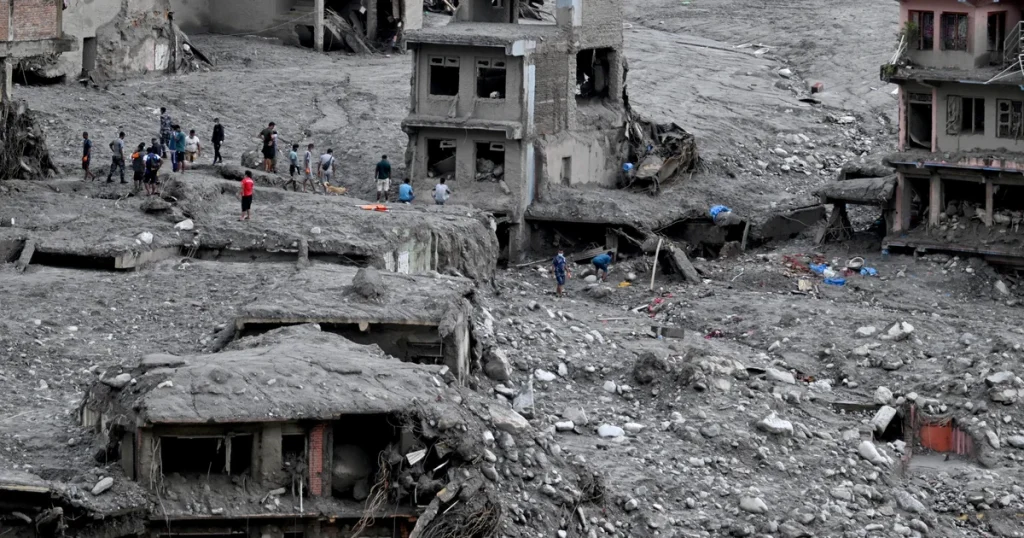
The mechanism of the catastrophe traces back to almost a week earlier, when a mountainside collapse combined with glacier failure in the Himalayan range triggered cascading avalanches across both Nepal and Tibet. Those avalanches, in turn, dammed rivers and unleashed torrential flash floods that obliterated valleys, buried infrastructure, and severed communications across vast stretches of the region. Recovery teams have since recovered bodies in riverbeds far downstream from the epicenter, underscoring the sheer distance the debris traveled.
Survivors’ Account: A “Monster Thing” Descending the Valley
Among the very few Americans confirmed rescued from the disaster zone are Anjana Raja and Pattabiraman Venkatesan, a couple from the San Francisco Bay Area who had been undertaking a pilgrimage to Tibet when the catastrophe struck. They were aboard a tour bus heading toward the Nepali border when the flood wave arrived.
“It’s like 60, 70 feet, it looked like a tsunami, but dark black,” Venkatesan recalled. “I could see this monster thing coming down. At that point I didn’t know if it was water. I thought it was fire, forest fire, honestly.”
The couple abandoned the bus and ran for higher ground. They ultimately reached a mountaintop where they spent the night sheltered in a goat shed alongside other survivors before being airlifted to safety the following morning. Their account provides one of the few first-person descriptions of what witnesses experienced as the flood wall descended the valley — a dark, opaque surge indistinguishable from fire or debris at first glance.
Hydroelectric Workers Trapped in Flooded Tunnels
Prime Minister-level officials have indicated that roughly 600 workers from hydroelectric power projects are among those missing, believed to be sealed inside tunnels and construction sites within the disaster area. Search-and-rescue teams have continued clearing mud-blocked passages in an effort to reach the trapped workers, though growing anxiety persists over whether oxygen levels inside the sealed sections can sustain life for much longer. The hydroelectric sector is a cornerstone of Nepal’s economy and energy independence, and the loss of so many workers in a single event represents both a human tragedy and a significant blow to the country’s infrastructure development.
A River Beyond Memory
No resident of the affected valleys could recall the sacred Trishuli River swelling to the levels witnessed during last week’s flood. Rohit Tamang, 22, has lived his entire life in a home perched above the river. He watched the waters surge on Wednesday with no means of intervention and has chosen to remain in place despite the devastation surrounding him.
“Because my childhood memories are here,” Tamang said, explaining his decision not to leave.
His sentiment echoes a broader pattern in rural Nepal, where displacement after natural disasters often meets deep reluctance to abandon ancestral land, even when conditions remain precarious.
Foreign Minister: Many May Be Alive but Unreachable
Nepal’s Foreign Minister Shisir Khanal offered a measured but hopeful assessment on Tuesday, suggesting that a substantial number of the missing foreigners may have been trekking in remote mountain areas when the disaster struck, leaving them stranded without communications yet potentially unharmed.
“This is one of the most popular trekking regions in Nepal, where a lot of tourists go,” Khanal stated. “We’re hoping that that’s partly a communication challenge that we’re experiencing. We’re hoping that the numbers [of missing] would be significantly less.”
The Annapurna and Langtang corridors, along with lesser-known high-altitude routes, draw tens of thousands of international trekkers each year. In the absence of cellular coverage above certain elevations, a hiker cut off from their group by a collapsed trail or buried pass can vanish from all records without having suffered injury. If that hypothesis holds for even a fraction of the missing, the eventual accounting could shift dramatically from tragedy to relief.
For now, the families waiting — in Kathmandu, in San Francisco, in Madrid, in Brussels, and in cities across the globe — hold their breath. Each confirmed contact, each rescued name, and each cleared tunnel represents a small reprieve in what remains one of the deadliest natural disasters in the Himalayan region’s recent history. The mountains, indifferent and vast, continue to yield their secrets slowly, one survivor at a time.
Related Reading
Frequently Asked Questions
What is American missing in wake of Nepal?
American missing in wake of Nepal is the main topic of this guide. The article explains the context, practical details, and next steps readers should understand.
Why does American missing in wake of Nepal matter?
American missing in wake of Nepal matters because readers are looking for a useful answer, not just a short summary. Good content should match search intent and help them decide what to do next.