
Supreme Court lets Trump strip deportation protections from Syrians and Haitians
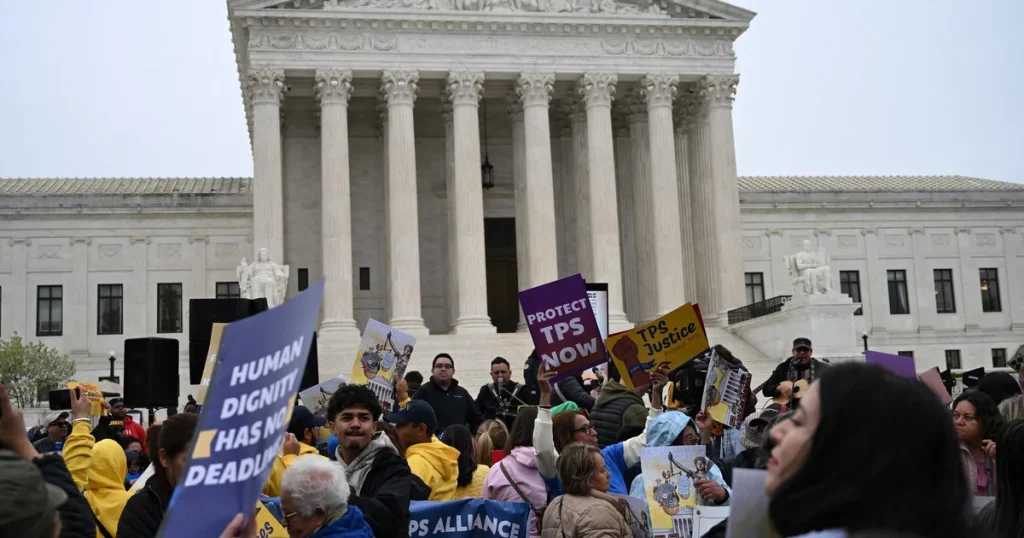
Supreme Court Grants Trump Administration Authority to Remove Temporary Protections for Syrians and Haitians
Supreme Court lets Trump strip deportation – The U.S. Supreme Court on Thursday approved the Trump administration’s move to rescind temporary protected status (TPS) for over 356,000 Syrians and Haitians, allowing their deportation to proceed without further judicial intervention. This decision marks a significant shift in the legal framework governing TPS, which has been a critical tool for granting relief to immigrants affected by war, natural disasters, or other extraordinary circumstances. The ruling was reached in two separate cases that challenged the administration’s authority to terminate the programs, with the court’s conservative majority siding with the government’s position.
TPS Termination and Judicial Review
The controversy began when the Department of Homeland Security (DHS) announced the end of TPS for Syrians and Haitians, a move that sparked lawsuits from immigrant advocates and affected individuals. Lower courts had initially paused the terminations, citing the need for further review of the administrative decisions. However, the Supreme Court overturned these rulings, stating in a 6-3 decision that the TPS statute explicitly prevents judicial challenges to claims made under federal law. This means immigrants cannot legally argue that the termination of their status violates broader constitutional principles unless they can prove specific statutory breaches.
Justice Samuel Alito, writing for the majority, emphasized that the TPS law is designed to be flexible, allowing the government to adjust protections based on current conditions. “The TPS statute plainly bars consideration of respondents’ non-constitutional claims,” he argued, highlighting the legal basis for the decision. The court also dismissed concerns about racial bias, asserting that the Trump administration’s actions were grounded in broader policy considerations rather than discriminatory intent.
Broader Implications for Immigrants
The ruling has far-reaching consequences, potentially affecting more than 1 million immigrants from 17 countries who rely on TPS for stability. The Trump administration has already targeted 13 of these nations, including Syria and Haiti, to end their programs. This move could lead to the revocation of work authorizations, increased risk of deportation, and the arrest of thousands of individuals who have called the U.S. their home. While the decision was specific to Syrians and Haitians, it sets a precedent that could apply to other TPS recipients, altering the legal landscape for future cases.
Justice Elena Kagan, in her dissent, criticized the majority for undermining a fundamental humanitarian safeguard. “True enough that TPS is a temporary program, and that it did not promise the plaintiffs never-ending humanitarian protection,” she wrote, acknowledging the program’s design. Yet she argued that the law was meant to provide a structured process for termination, including mandatory consultations with stakeholders about country conditions. Kagan contended that the absence of such evaluations left the decision vulnerable to “partisan whims” and that race-based considerations tainted the process, particularly for Haitian immigrants.
“The law prevents the program from ending as it likely did here — without the required consultations about country conditions and, as to Haiti, with impermissible race-based considerations tainting the decision,” Kagan stated.
Kagan’s dissent warned that the ruling would force hundreds of thousands of immigrants into uncertainty, with litigation continuing in lower courts. “Hundreds of thousands of lives will be uprooted” as the government moves to finalize the terminations, she said, stressing the human cost of the decision. The majority, however, defended the administration’s authority, arguing that TPS is meant to be a short-term solution rather than a long-term pathway to permanent residency.
Policy Motivations and Legal Justifications
The Supreme Court’s decision included a broader analysis of the Trump administration’s rationale. Alito noted that statements from President Trump and former Secretary of Homeland Security Kristi Noem reflected policy views that could be justified by race-neutral grounds. For example, the administration’s reasoning for ending TPS could be framed as a consistent effort to phase out programs that have been in place for years, rather than targeting specific groups based on race.
Alito also highlighted that the current administration has terminated all previous TPS designations upon their renewal, suggesting a pattern of policy reversal. “The current administration, which has terminated every TPS designation that has come up for renewal, simply opposes the TPS program, at least as it has been implemented in the past,” he wrote, implying that the decision was more about political strategy than legal necessity. This interpretation leaves the door open for future administrations to adjust TPS programs based on shifting priorities.
Reactions from Advocacy Groups and Legal Scholars
Immigrant rights advocates have expressed concern over the decision, arguing that it removes a critical safety net for vulnerable populations. Ahilan Arulanantham, a law professor at UCLA who represented Syrian immigrants in the case, called the ruling a setback for humanitarian protections. “Today the Supreme Court allowed the government to ignore a bedrock humanitarian protection that Congress, in bipartisan fashion, established three decades ago,” he said, emphasizing the long-term impact of the decision.
Arulanantham warned that without TPS, millions of individuals who have built lives in the U.S. could face displacement. “Without TPS, millions of individuals who are part of our communities are at risk of being sent back to countries in crisis,” he added, citing the potential for hardship among those who have no other legal options. The White House, on the other hand, hailed the decision as a validation of Trump’s vision for immigration policy. “The decision affirms Mr. Trump’s belief that TPS is meant to be temporary,” said Abigail Jackson, a White House spokeswoman.
“It was never intended to be a pathway to permanent status or legal residency and it is committed to the discretion of the Secretary of Homeland Security,” Jackson stated.
The administration argued that TPS has historically been a tool for emergency relief, not a long-term solution. “The Trump Administration continues to lawfully end the egregious abuses to our immigration system that have hurt Americans for years,” the statement claimed. This perspective underscores the political tension between maintaining flexibility in immigration policy and ensuring protections for those who have been granted temporary refuge.
Historical Context of TPS Designations
Syria’s TPS designation, which began in 2012, was a direct response to the country’s civil war, which displaced millions and created a humanitarian crisis. Similarly, Haiti’s protections were first granted in 2010 after the devastating earthquake that killed over 200,000 people and left the nation’s infrastructure in ruins. The TPS for Haiti was later extended due to ongoing economic and political challenges, including the assassination of its president in 2021.
These historical events highlight the role of TPS as a mechanism to address urgent needs. However, the Supreme Court’s ruling suggests that the program’s flexibility may now be used to expedite terminations, even in the absence of comprehensive country condition assessments. Critics argue this undermines the program’s original purpose, which was to provide stability during times of crisis. For Syrians and Haitians, the decision means the possibility of deportation looms larger, with their futures now dependent on the political will of the administration.