
How Trump drafted upcoming renovations for Washington Dulles, a “terrible airport”
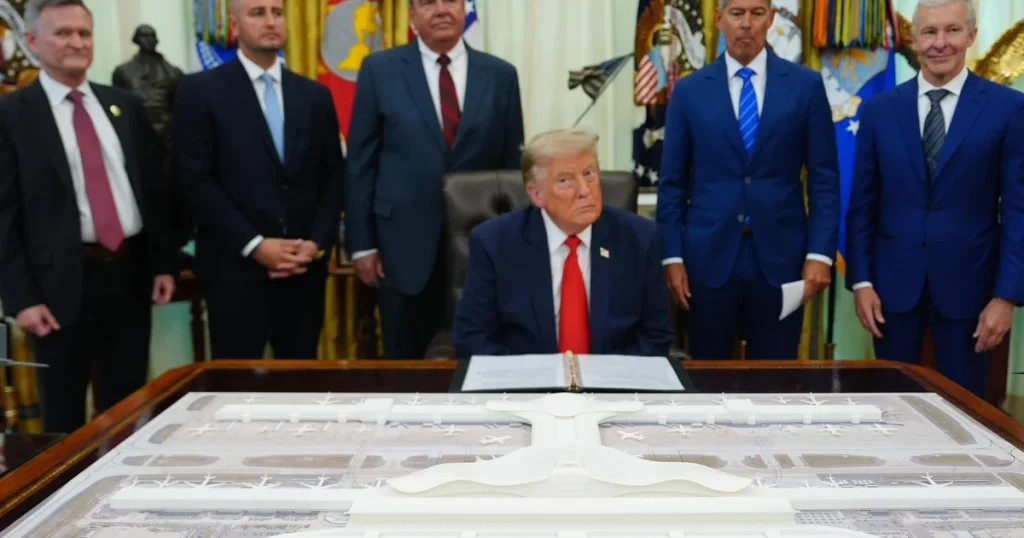
Trump’s Vision for Washington Dulles Airport Transformation
Bizeconanalysis.com – How Trump drafted upcoming renovations for Washington Dulles International Airport has become one of the most significant infrastructure initiatives of his presidency. During the early months of this year, the president engaged in extensive deliberation regarding the revitalization of the nation’s capital’s aging federally managed aviation hub. According to several sources who spoke with CBS News, Trump requested that competing design and engineering companies develop three-dimensional models to help him visualize potential renovation concepts more effectively.
Model Review Process at the White House
These substantial tabletop representations traveled repeatedly between the airport and the White House, allowing the president to examine and modify various aspects of the proposed improvements. His feedback addressed terminal transport buses, parking facility placement, baggage handling mechanisms, underground train systems, and the overall visual character of the airport. This hands-on approach reflects Trump’s broader pattern of personal involvement in infrastructure projects during his second term, following similar initiatives for the White House East Wing, a new ballroom, the Kennedy Center, and several Washington parks.
Public Announcement and Design Selection
On Wednesday, the president made a formal declaration from the Oval Office, standing beside Transportation Secretary Sean Duffy with one of the models prominently displayed. He revealed that his team had evaluated more than thirty different proposals from various firms. The companies involved included HNTB, STV Group, Jacobs, Ferrovial, and AECOM, with the latter also contributing to the presidential White House ballroom initiative.
Trump has previously characterized Dulles as a “terrible airport” that suffered from flawed initial planning. In private conversations, he expressed frustration with parking facilities located two miles from the terminal and described the existing mobile lounge transportation network as “crazy.” These criticisms ultimately shaped the direction of the renovation strategy.
Key Design Elements and Rejected Proposals
One source indicated that Trump favored maintaining Eero Saarinen’s iconic sloped-roof main terminal while updating interior spaces with an open foyer and modern airline ticket kiosks. The comprehensive $22.5 billion project will eliminate the mobile lounges, commonly known as “people movers,” which have operated at Dulles since 1962 and represent perhaps the most criticized element of the airport.
Instead, travelers will access terminals via a new U-shaped underground aerotrain combined with moving walkways. The current aerotrain only connects concourses A, B, and C, leaving the D concourse—home to United Airlines gates—without direct rail service. Additional moving sidewalks will complement the new system.
Several proposals received particular attention during the selection process. Ferrovial, which recently completed Terminal 1 at New York’s JFK Airport, suggested a wavy-roof main terminal design that Trump ultimately dismissed. Jacobs offered a pedestrian bridge elevated enough for aircraft to pass beneath, though the president found its aesthetic unappealing. HNTB presented the most ambitious concept: essentially constructing a completely new airport with an additional main terminal at the opposite end of the property, but Trump considered this approach too disruptive to ongoing flight operations.
Financial Structure and United Airlines’ Role
BlackRock submitted a comprehensive proposal that included both financing and construction responsibilities, along with airport operations management. This plan would have transferred control from the Metropolitan Washington Airports Authority and redirected revenue streams. However, sources noted several complications, particularly opposition from United Airlines, which carries approximately two-thirds of Dulles’ daily passengers.
The final design builds upon existing infrastructure while maintaining cooperation with United. Scott Kirby, the airline’s chief executive, personally discussed the project with Trump. Under the approved framework, MWAA will utilize its authority to issue tax-free bonds for funding. United will contract for construction and subsequently repay bond financing through airport operational revenues.
Mr. Trump said his team reviewed more than 30 proposals.
The renovation also includes four new linear concourses replacing the current A, B, C, and D gate structures. The C and D gates, originally constructed in 1985 as temporary facilities for United Airlines, have remained in service for over four decades. A relocated parking lot positioned closer to the main terminal will enhance passenger convenience. These changes represent one of the most significant transformations in the airport’s sixty-year history.
Frequently Asked Questions
How much will the Dulles Airport renovation cost? The comprehensive renovation project is valued at $22.5 billion, making it one of the largest airport infrastructure investments in U.S. history.
When will the renovation be completed? While exact timelines depend on construction phases, the project is expected to span several years with phased implementation to minimize disruption to daily operations.
What is the biggest change to the airport’s transportation system? The most significant change is the elimination of mobile lounges (“people movers”) that have operated since 1962, replaced by a new U-shaped underground aerotrain and moving walkways.
How does United Airlines factor into the renovation? United Airlines carries approximately two-thirds of Dulles’ daily passengers and plays a central role in the financial structure, contracting for construction and repaying bond financing through airport revenues.
Which companies submitted proposals for the renovation? More than thirty proposals were evaluated from firms including HNTB, STV Group, Jacobs, Ferrovial, AECOM, and BlackRock, each offering different approaches to the transformation.