
NASA launches its Roman Space Telescope to explore the hidden universe
A New Eye Opens on the Invisible Cosmos
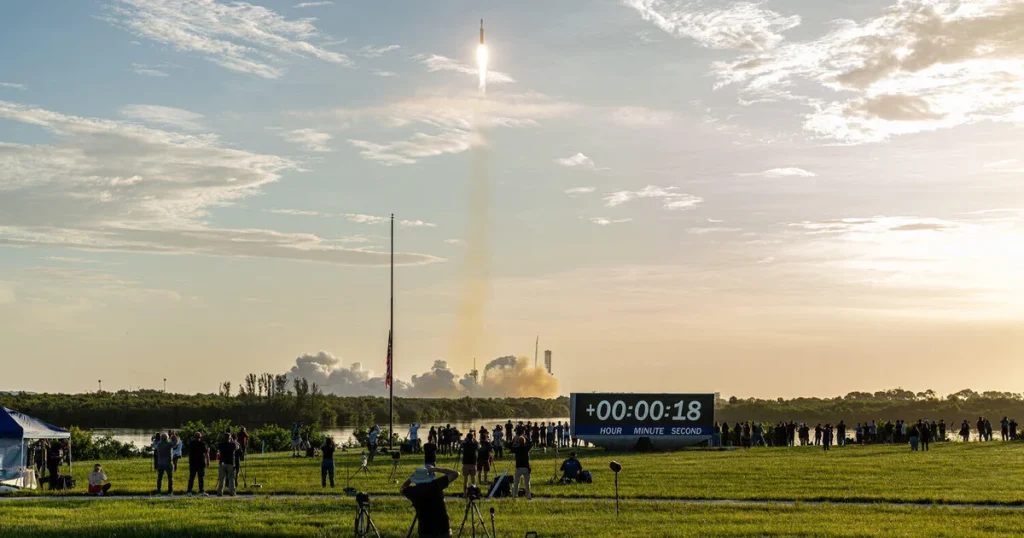
Bizeconanalysis.com – Sunday morning brought a thunderous departure from Florida’s coast as a SpaceX Falcon Heavy rocket lifted an 18,000-pound observatory into the sky, beginning a three-month transit toward a gravitational equilibrium point roughly one million miles from Earth. The payload, the Nancy Grace Roman Space Telescope, carries a $4.3 billion mandate: to chart the architecture of the universe at scales no previous instrument has attempted, using a wide-field 300-megapixel camera and an experimental coronagraph capable of suppressing starlight to reveal faint planetary companions.
The mission represents the culmination of decades of planning. Roman’s primary mirror — a Hubble-class optical element originally manufactured for a classified intelligence satellite — will peer across billions of light-years to trace how dark matter, the invisible scaffolding holding galaxies in place, threads through the cosmic web. Simultaneously, it will gather evidence about dark energy, the repulsive force driving the universe’s accelerating expansion. Together, these two unseen components constitute the overwhelming majority of all matter and energy in existence, yet neither has been directly detected.
Mapping the Invisible
Dark matter accounts for roughly 85 percent of all matter in the cosmos. It exerts gravitational pull that keeps spiral galaxies from flying apart during rotation, yet it emits no light and interacts with ordinary matter only through gravity. Dark energy, by contrast, appears to permeate space itself, pushing galaxies apart at an ever-increasing rate. Understanding the balance between these two forces — one pulling structure together, the other tearing it apart — is arguably the central question of modern cosmology.
Roman will probe that balance by measuring the large-scale distribution of galaxies and the subtle distortions in their light caused by intervening matter. The telescope’s wide-field camera will catalog an estimated 20 billion stars, at least 2 billion individual galaxies, tens of thousands of supernova explosions, and countless transient phenomena including tidal-disruption flares produced when stars are shredded by close passages near black holes.
Hunting Worlds Beyond the Solar System
A second instrument aboard Roman — a coronagraph equipped with shape-shifting deformable mirrors — will dim the glare of distant suns enough to analyze reflected light from Jupiter-mass planets orbiting them. This capability will let astronomers extract chemical signatures from exoplanet atmospheres, revealing atmospheric composition and potential habitability indicators.
In parallel, the wide-field camera will employ the transit method, detecting the periodic dimming of stars as planets cross their faces. As of the launch date, roughly 6,200 exoplanets have been confirmed. Projected mission yields suggest that figure will surpass 100,000 by the end of Roman’s operational lifetime, transforming the statistical picture of planetary systems across the Milky Way.
“Roman is going to revolutionize the way we look at our universe,” NASA science chief Nicky Fox said after launch. “It is going to measure dark matter, which is like the fabric of the universe; it’s the thing you can’t see, but we know it’s there.”
“It’s going to measure dark energy, which kind of powers the universe. [There is] sort of a cosmic struggle between dark matter that wants to pull things together and dark energy that wants to push things apart. And [Roman] will allow us to finally kind of explain our universe and understand our place in it.”
Fox added that the observatory would identify “tens of thousands of exoplanets, planets that we don’t even know are there, billions of galaxies, tens of billions of stars. It’s just a spectacular mission.”
The Launch Itself
The Falcon Heavy ignited at 7:26 a.m. EDT from historic Pad 39A at Kennedy Space Center. Its three core stages, each driven by nine kerosene-fueled Merlin engines, generated more than five million pounds of combined thrust. The vehicle was the 13th flight of SpaceX’s most powerful operational rocket and traced a rapid easterly arc over the Atlantic Ocean, offering a dramatic weekend spectacle for coastal residents, visitors, and space-center personnel.
Two strap-on side boosters — one flying for the first time, the other on its third mission — cut off and separated approximately two and a half minutes after liftoff. Both then executed flip maneuvers, reversed course, and landed on target at Cape Canaveral Space Force Station. The central core continued firing for roughly another 90 seconds before shutting down and descending into the Atlantic, its propellant fully expended. A second stage then fired twice to place the payload on its interplanetary trajectory.
The telescope separated from its upper stage 31 minutes after ignition. Shortly thereafter, its solar arrays deployed as designed, confirming the spacecraft was healthy and beginning its long cruise toward the L2 Lagrange point.
A Political Postscript
During the post-launch press briefing at the Florida spaceport, President Donald Trump placed a telephone call to NASA administrator Jared Isaacman. The president’s administration had previously sought reductions in Roman’s funding during earlier budget proposals. Isaacman held the handset to a microphone so the president could address the assembled crowd.
“I just want to thank everybody and congratulate you,” Trump said. “Boy, it looked beautiful on television. I just called Jared to find out, is there anything negative that I should know about? … He said, ‘No, it’s looking great. It couldn’t be better, and it was another great success.’ So, Jared’s doing a fantastic job, you are doing a fantastic job and I’m supplying you all that money.”
“Well, Mr. President, you’ve got a lot of smiling people in the room right now that are very happy to hear those words,” Isaacman replied. “We will put it to excellent use.”
Why the Name Matters
The observatory bears the name of Nancy Grace Roman, NASA’s first chief astronomer, who spent decades advocating for space-based telescopes at a time when ground-based optics dominated the field. Her persistent lobbying helped establish the institutional and scientific rationale for placing large-aperture instruments above Earth’s distorting atmosphere. Naming the flagship successor to the Wide Field Infrared Survey Telescope program after her underscores the generational continuity of the mission’s intellectual lineage.
Once at its operational station, Roman will begin systematic surveys that no ground-based or previous space telescope can match in depth, breadth, and infrared sensitivity. The data streams it produces over its planned mission lifetime will reshape models of galaxy formation, constrain the equation of state of dark energy, and expand the known inventory of planetary systems by an order of magnitude. For astronomers, the telescope transforms a statistical question — how common are certain types of worlds? — into a census.
Related Reading
Frequently Asked Questions
What is NASA launches its Roman Space Telescope?
NASA launches its Roman Space Telescope is the main topic of this guide. The article explains the context, practical details, and next steps readers should understand.
Why does NASA launches its Roman Space Telescope matter?
NASA launches its Roman Space Telescope matters because readers are looking for a useful answer, not just a short summary. Good content should match search intent and help them decide what to do next.