
Roman Space Telescope, NASA’s next “great observatory,” launches into space
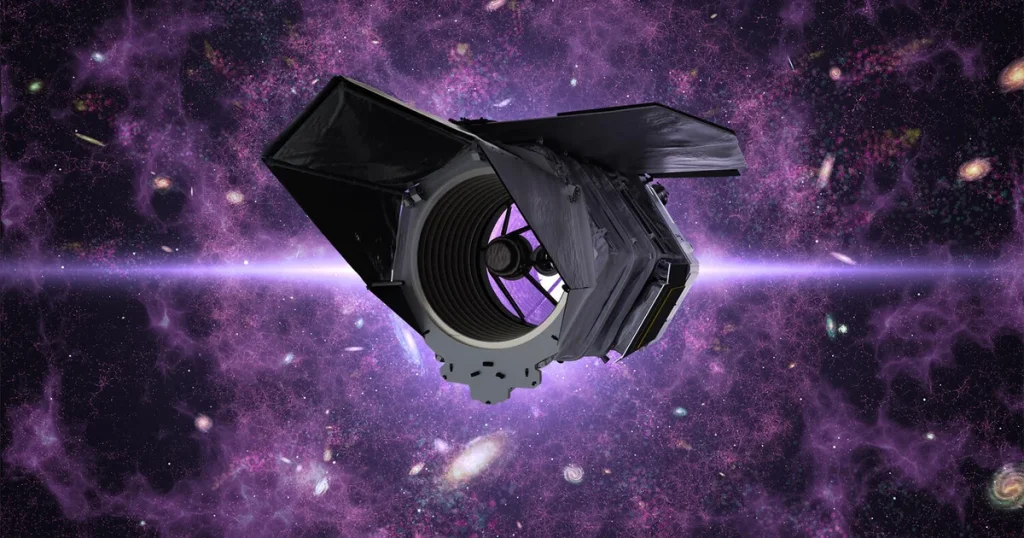
NASA’s Roman Space Telescope Begins a $4.3 Billion Mission to Map the Cosmos
Bizeconanalysis.com – Sunday morning at 7:26 a.m. EDT, a triple-core SpaceX Falcon Heavy rocket lifted off from Kennedy Space Center carrying a payload that will reshape how astronomers study the universe. Aboard the vehicle sat the Nancy Grace Roman Space Telescope — a 42-foot-long, 18,000-pound observatory built around a donated Hubble-class mirror originally manufactured for a classified intelligence satellite. The spacecraft is now en route to Lagrange Point No. 2, a gravitational equilibrium roughly one million miles beyond Earth on the side facing away from the Sun, where it will hover with minimal fuel expenditure. The James Webb Space Telescope already occupies that same region for identical orbital reasons.
The mission, valued at $4.3 billion, represents NASA’s next “great observatory” and carries a mandate to capture wide-field imagery of extraordinary resolution. A single full-frame exposure from Roman’s 300-megapixel wide-field camera would span approximately 45 city blocks — or, put in more vivid terms, the entire face of El Capitan in Yosemite National Park. Displaying that image at full fidelity would demand roughly half a million 4K televisions arranged side by side.
A Data Engine Without Precedent
The volume of information Roman will generate dwarfs anything that came before it. Over three decades of operation, the Hubble Space Telescope transmitted approximately 172 terabytes of scientific data back to Earth. Roman, by contrast, is projected to downlink around 2,500 terabytes during its five-year primary mission alone. In practical scanning terms, the new observatory will sweep broad regions of the sky roughly 1,000 times faster than Hubble ever could, accumulating in a single month what its predecessor would have required a full century to gather.
“The speed at which we’ll be scanning the sky, delivering vast amounts of data and returning results will be at an unprecedented rate, never done before,” said Niki Fox, NASA’s associate administrator for science.
Fox, who has overseen the agency’s research portfolio for years, characterized the instrument as “a sheer powerhouse” and “literally a speed machine.” Administrator Jared Isaacman framed the mission in broader civilizational terms:
“Roman will give the Earth a new atlas of the universe,” Isaacman stated. He added that the flood of data is expected to “shed new light on the nature of dark matter, dark energy and the structure of the universe itself and accelerate the … discovery of potentially habitable planets outside our solar system.”
Why the Telescope Bears Nancy Roman’s Name
The observatory honors Nancy Grace Roman, NASA’s first chief astronomer, who spent decades arguing that space-based telescopes were indispensable to modern astrophysics. Her advocacy was instrumental in pushing the Hubble Space Telescope from concept to orbit, earning her the enduring nickname “the mother of Hubble.” That legacy now extends to the very instrument that will succeed Hubble’s observational role at a scale no one previously imagined.
Dark Matter, Dark Energy, and the Hubble Tension
From its perch at L2, Roman will probe two of cosmology’s deepest mysteries simultaneously. Dark matter — the invisible substance threading through every galaxy, accounting for most of the cosmos’s mass and acting as a gravitational brake on cosmic expansion — will be studied through its gravitational fingerprints on large-scale structure. Dark energy, the repulsive force believed to have existed since the Big Bang but only becoming dynamically dominant roughly five billion years ago as the universe thinned, will be examined through its accelerating effect on galactic recession velocities.
Central to the mission is what cosmologists call the Hubble Tension. When Hubble launched in 1990, estimates of the universe’s age spanned a bewildering range from roughly 10 to 20 billion years. Hubble’s measurements of supernova distances and redshifts narrowed that figure to within one percent: 13.8 billion years. Yet independent analyses of the cosmic microwave background — the 3-degree thermal afterglow of the Big Bang — yield a subtly different value for the expansion rate. The discrepancy implies that some element of the standard cosmological model may be incomplete or incorrect.
“We’re seeing evidence that the Hubble constant, as inferred from very early times, is not consistent with the Hubble constant that we measure closer to now, which is telling us that the model that connects those two things might not be quite right,” explained Julie McEnery, the project’s lead scientist. “We have a slight tension in our expectations for how structure should grow and evolve.”
That “slight tension,” as McEnery understates it, points toward a potentially fundamental gap in how physicists describe the forces governing cosmic evolution. Roman’s unprecedented survey speed and detector sensitivity are designed precisely to close that gap — or to confirm that the gap is deeper than anyone currently suspects. Either outcome would rewrite textbooks.
The spacecraft’s trajectory toward L2 places it in a stable gravitational niche where station-keeping requires only occasional micro-corrections, freeing nearly all onboard power for science operations. Once settled, Roman will begin systematic wide-field surveys of the extragalactic sky, building the densest three-dimensional map of matter distribution ever assembled. The data stream that follows will take years to process, but the first results are expected to arrive within months of arrival, offering an early glimpse of what a thousand-fold acceleration in observational throughput can reveal about the architecture of spacetime itself.
Related Reading
Frequently Asked Questions
What is Roman Space Telescope NASA s next?
Roman Space Telescope NASA s next is the main topic of this guide. The article explains the context, practical details, and next steps readers should understand.
Why does Roman Space Telescope NASA s next matter?
Roman Space Telescope NASA s next matters because readers are looking for a useful answer, not just a short summary. Good content should match search intent and help them decide what to do next.