
Nepal on high alert for fresh flooding after river levels rise as death toll soars past 800
Nepal on High Alert for Fresh Flooding as Toll Passes 800
Bizeconanalysis.com – Nepal on high alert for fresh flooding became the defining phrase of Sunday morning as alarm signals blared across mobile phones in the hardest-hit districts, urging residents to prepare for yet another surge of floodwater. Water levels in the Bhotekoshi River climbed sharply overnight, prompting rescuers to race toward a critical highway linking Kathmandu with one of the regions devastated by Wednesday’s catastrophic inundation. The National Disaster Risk Reduction and Management Authority confirmed the death toll had reached 788, with another 2,502 people unaccounted for. Across the border, Chinese authorities tallied 16 fatalities and 546 missing persons on their side of the mountain divide.
Dharam Raj Uprety, chief executive of the disaster authority, explained that Chinese officials had relayed intelligence about surging water flow upstream, triggering the renewed advisory. For villagers already battered by the initial deluge, the repeated sirens have become a grim rhythm of daily life, each one a reminder that the danger has not passed.
“Sometimes they say a flood is coming, then we have to run again to higher ground, even at night. There is also rain,” said Govind Shreshta, a resident of a flood-struck village. “It’s really difficult for me. I have a 72-year-old father and 70-year-old mom. I must carry them and I am exhausted. It’s going on like this for those who are still alive.”
Life After the First Wave
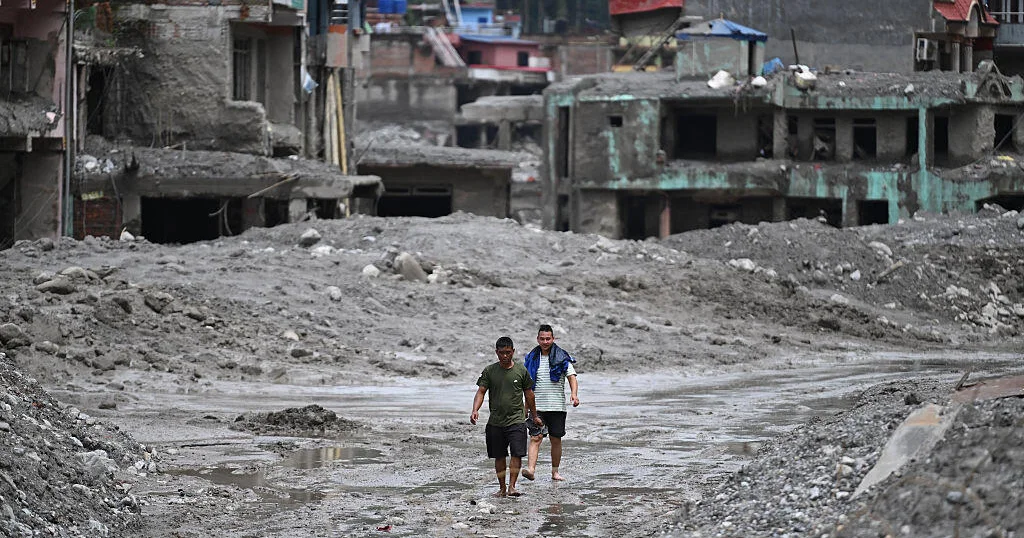
In Dhading, one of the most severely damaged districts, a fragile and tentative recovery began as residents crept back toward shattered homes. Families sat amid interiors where walls had been scoured away, using shovels to drag sludge-thick mud and shattered debris off balconies and window frames. Others crouched over the saturated ground, fishing out household items from the muck and rinsing them clean. One man tracked down his flock of chickens, found them still breathing, and loaded them into the cab of his truck.
“Everything is finished. Nothing is left. Not even our home,” Sharmila Tamang, a Dhading resident attempting to salvage what remained, told reporters.
Infrastructure damage extends well beyond residential areas. At a major hydroelectric facility badly struck by the floodwaters, crews began Sunday inspections to gauge the extent of destruction. The plant supplies electricity to more than 20,000 residents spread across four districts, meaning prolonged outages could compound the humanitarian crisis already straining local services. With Nepal on high alert for fresh surges still in effect, even tentative recovery efforts could be undone within hours if river levels climb again.
International Search and Emergency Aid
The disaster has drawn global attention to the fate of foreign nationals caught in the region. U.S. State Department spokesperson Tommy Pigott stated on Sunday that 85 Americans remained unaccounted for in Nepal, though nine had been safely evacuated. Speaking on ABC’s “This Week,” Pigott added that no confirmed deaths of U.S. citizens had been identified at that point.
“Right now we’re in communication with them directly to assess those needs. We have a disaster area response advisor actually on the ground right now, in communication to see how best we can offer assistance,” Pigott said. “The situation on the ground, as you just saw, in terms of the mud and other things, means that we have to get the right assistance in there. Nepal government, we’re coordinating with them on what they need.”
The State Department announced Saturday that it had activated $3.6 million in emergency humanitarian assistance, covering up to three months of food for as many as 10,000 households. The missing list also encompasses hundreds of individuals from more than a dozen nations who had been in the area for work, mountaineering, or pilgrimage to a sacred peak. Chinese state media reported on Sunday that 261 foreigners were missing in Tibet alone, including over a hundred Nepalis alongside nationals from around the world.
Glacial Collapse and the Climate Question
Wednesday’s flash floods were triggered by a glacial collapse high in the Himalayan range. Scientists examining satellite imagery concluded that bedrock beneath a glacier had given way, dragging a portion of the ice sheet with it. The rockfall was so violent that it registered as a magnitude 5.2 seismic event. The cascade of rock and meltwater then swelled the rivers in the valleys below, unleashing a torrent that swept away buildings, bridges, and entire stretches of earth across Tibet and Nepal. The question of whether Nepal on high alert for fresh inundation would persist into the coming weeks hinges on whether further glacial instability occurs upstream.
Nepal’s foreign minister, Shisir Khanal, used the crisis to press for a stronger global response to climate change, arguing that the Himalayan nation bears a disproportionate burden of warming despite its negligible carbon footprint.
“Despite having only 0.1% contribution to the global emissions, people of Nepal have become major victims of climate change,” Khanal said Saturday.
Frequently Asked Questions
What triggered the floods? A glacial collapse in the Himalayan range caused bedrock to give way beneath a glacier, producing a magnitude 5.2 seismic event. The resulting cascade of rock and meltwater swelled downstream rivers, generating flash floods across Nepal and Tibet.
How many people are confirmed dead or missing? Nepal’s disaster authority reported 788 deaths and 2,502 missing persons. Chinese authorities recorded 16 fatalities and 546 missing on their side. Hundreds of foreign nationals from more than a dozen countries remain unaccounted for.
What emergency aid has been deployed? The U.S. State Department activated $3.6 million in humanitarian assistance covering up to three months of food for 10,000 households. A disaster area response advisor is on the ground coordinating with the Nepali government. Nepal on high alert for fresh flooding advisories remain active across multiple districts as river levels continue to fluctuate.