
Trump signs executive order to rename Lake Ontario “Lake America”
Executive Order Renames Lake Ontario to “Lake America” as U.S.-Canada Trade Clash Intensifies
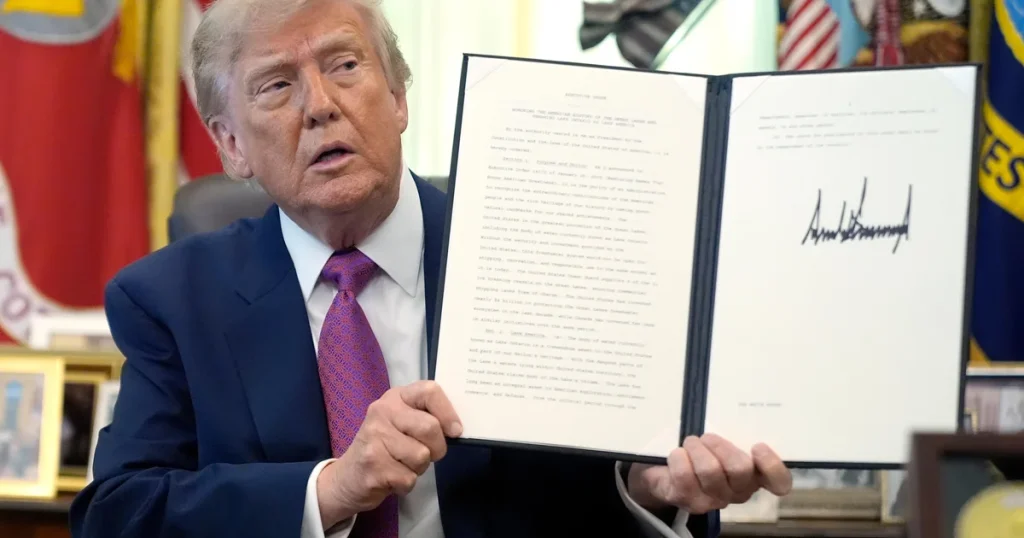
Bizeconanalysis.com – In a move that blends geographic symbolism with trade-war signaling, President Donald Trump signed an executive order on Thursday directing the federal government to replace the name “Lake Ontario” with “Lake America.” The action, carried out in the Oval Office, follows a week of escalating friction between Washington and Ottawa over tariffs, border commerce, and what the president has repeatedly characterized as decades of American economic exploitation by its northern neighbor.
The Order and Its Mechanism
The directive instructs Interior Secretary Doug Burgum to amend entries in the Geographic Names Information System, the federal database that works alongside the U.S. Board on Geographic Names to standardize how official documents reference places across the country. Once updated, the new designation will propagate through printed federal publications within days, according to a letter from the director of the U.S. Geological Survey that Trump shared on his social media platform shortly after signing.
The president made clear before putting pen to paper that the change was immediate and non-negotiable.
“We’re going to be changing the name of Lake Ontario, effective immediately, to Lake America,” the president said before he signed the order.
It is worth noting the limits of the action: the executive branch cannot compel foreign governments, international organizations, or private enterprises to adopt the new label. What it can mandate is internal federal usage — maps produced by federal agencies, official correspondence, and government-published reference materials.
A Social Media Precursor
The Oval Office announcement was not entirely spontaneous. Earlier in the week, Trump posted on Truth Social that the United States was giving “serious consideration” to altering the lake’s name, accompanied by an edited map in which the familiar “Lake Ontario” label had been struck through. In the same post, he suggested that American commercial dealings with the Canadian province of Ontario were unlikely to continue at any meaningful scale.
Canada’s Response
Prime Minister Mark Carney responded with a pointed historical argument, emphasizing that the name in question predates both nations’ modern political formations by centuries.
“The name Lake Ontario comes from the Wendat word ‘Ontario,’ which, appropriately, means, ‘the lake is beautiful, the lake is big,'” Carney said. “The name is more than 400 years old, predating both the Confederation of Canada and the Declaration of Independence of the United States of America. We know that America is changing. Their trading relationships, their foreign- policies, their national monuments, their hydronyms. Canadians also know that naming reality means calling it Lake Ontario – then, now and always.”
Carney added that the lake is “much older than the Declaration of Independence,” framing the renaming as an attempt to overwrite indigenous linguistic heritage with a nationalist slogan.
New York Pushes Back
Within the United States, the reaction was swift. New York, the sole state sharing a shoreline with the lake, saw its Democratic governor, Kathy Hochul, declare that the state would not adopt the new name in its own communications or signage.
“New York won’t be calling it that,” Hochul said.
The lake, roughly 1,885 square miles in surface area, forms part of the border between New York and Ontario, Canada, and feeds the Niagara River system. For residents of Buffalo, Rochester, and the surrounding communities, the waterway is a daily reality of commerce, recreation, and municipal water supply — a context that makes the federal renaming feel, to many locals, like a distant political gesture with little practical consequence.
Trade-War Context
The renaming lands amid a rapidly escalating tariff confrontation. On Saturday, 50 percent duties took effect on select Canadian imports including wine and dairy products. By Monday, Trump had announced that all Canadian steel and automotive imports would face the same 50 percent rate beginning in January. Ottawa retaliated by announcing matching tariffs of up to 50 percent on billions of dollars of American goods effective September 8.
Asked what message the lake renaming sends to Canada, Trump dismissed the framing.
“No message,” he said, but added, “As you know, Canada has been ripping us off for a long time on trade, very, very sadly. Even the military. You know, we defend Canada for nothing.”
A Pattern of Geographic Renaming
The Lake America order is the latest in a series of geographic rebranding moves. Trump previously sought to restore “Mount McKinley” as the official name of Denali, Alaska’s 20,310-foot summit, reversing a 2015 decision that had returned the indigenous Athabascan name. Earlier still, he directed the renaming of the Gulf of Mexico to the “Gulf of America.” In that instance, some private entities voluntarily adopted the new label, while others did not. The White House reportedly restricted Associated Press reporters’ access to presidential events after the news agency declined to use “Gulf of America” in its copy — a reminder that the administration views editorial compliance as within its purview.
On Thursday itself, Trump extended the logic one step further, suggesting the next target might be an entire ocean.
“Now all we need is an ocean,” he said. “So maybe we’ll have to change the name of the Atlantic and — or — the Pacific.”
Whether that remark signals a genuine intention or rhetorical escalation remains to be seen. What is clear is that the administration is treating geographic nomenclature as a lever of national-branding politics, deploying the federal naming apparatus to project sovereignty narratives onto shared waters and borders that, by international convention, belong to no single nation.
Related Reading
Frequently Asked Questions
What is Trump signs executive order to rename?
Trump signs executive order to rename is the main topic of this guide. The article explains the context, practical details, and next steps readers should understand.
Why does Trump signs executive order to rename matter?
Trump signs executive order to rename matters because readers are looking for a useful answer, not just a short summary. Good content should match search intent and help them decide what to do next.