
Kashkari says inflation could be extended “the longer there’s back and forth” in Canada tariff fight
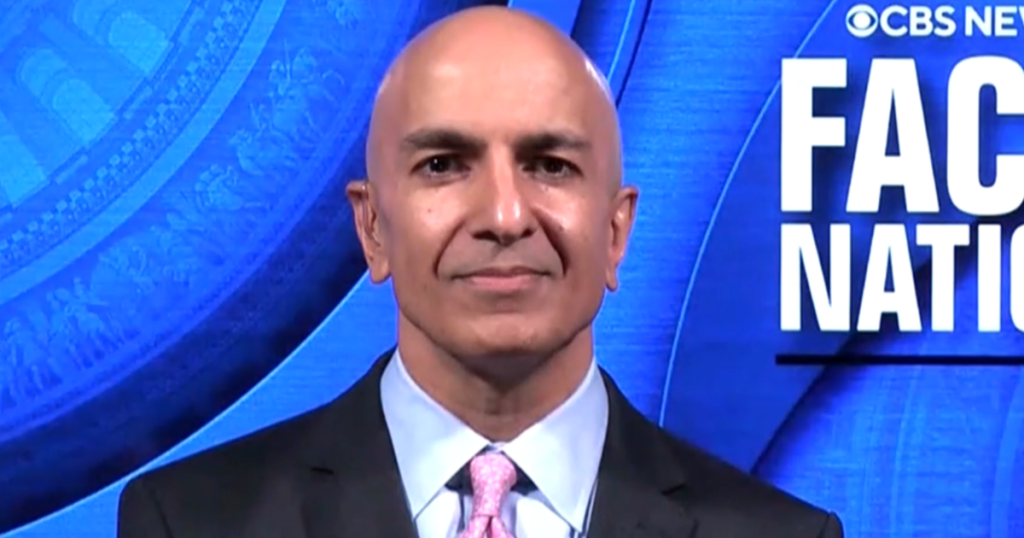
Kashkari Warns Canada Tariff Dispute Could Extend Inflation
Bizeconanalysis.com – Kashkari says inflation could be extended if the tariff standoff between Washington and Ottawa drags on, according to remarks made Sunday on PBS’s “Face the Nation with Margaret Brennan.” Neel Kashkari, president of the Federal Reserve Bank of Minneapolis, drew a direct parallel between prolonged trade uncertainty and the price distortions already visible in energy markets from the Iran conflict. In his framing, the duration of policy ambiguity — not the headline rate of any single duty — is what keeps price pressures alive well past what standard forecasts project.
“The longer there’s back and forth on the trade front, just like the longer there’s back and forth in the conflict of Iran, the imprint and inflation end up being extended and delayed.”
The 50 Percent Tariff and Ottawa’s September 8 Response
The comments came hours after Washington formally activated a 50 percent tariff across a wide range of Canadian imports, a move that followed the collapse of months of negotiations. U.S. Trade Representative Jamieson Greer confirmed that no further rounds of talks had been scheduled, effectively closing the diplomatic channel at a moment when the two economies remain deeply interlocked.
Ottawa moved quickly in reply. Prime Minister Mark Carney announced retaliatory duties on American goods, with sector-specific details slated for release that week. The countermeasures take effect on September 8 and are expected to cover steel, dairy products, household appliances, farm machinery, pulp, paper, and consumer electronics. The breadth of the Canadian package signals that neither capital treats the dispute as a narrow, sector-specific quarrel but as a structural renegotiation of terms that have governed cross-border commerce for decades.
The friction has accumulated across multiple fronts beyond trade. NATO burden-sharing disagreements, a long-running dispute over a proposed bridge project in the Detroit metropolitan area, and President Trump’s repeated public suggestions that Canada might become the fifty-first state have each eroded the institutional trust that once made rapid resolution of trade frictions routine.
How Tariff Uncertainty Feeds Headline Prices
The transmission channel from a 50 percent duty to consumer prices is straightforward but routinely underappreciated. When imported steel or dairy faces a steep tariff, domestic producers of those inputs face reduced competitive pressure. Downstream manufacturers — appliance builders, construction firms, food processors — absorb higher input costs, and a portion of that increase passes through to retail shelves. Retaliation compounds the effect: American exporters now face elevated costs abroad while domestic consumers absorb elevated costs at home, producing a two-sided margin squeeze that typically surfaces in headline inflation with a lag of several months.
Kashkari positioned the tariff episode as one element within a broader pattern of supply-side shocks that have kept inflation above target for roughly five years. He singled out the ongoing military conflict involving Iran as another major driver, noting that energy markets transmit price shocks across virtually every sector of the U.S. economy. His central argument was that once a “steady state” is established — whatever the final tariff architecture turns out to be — firms can recalibrate supply chains, renegotiate contracts, and allow the inflationary overhang to dissipate.
“And so to the extent that we can get to a new normal, a level of whatever the trade dynamic is going to be, once we can get to that steady state, then businesses can adjust, and the inflationary impact can fade into the background.”
The stakes are underscored by the sheer volume of commerce at issue. In 2025, the two countries exchanged approximately $880 billion in goods and services. Canada ranks as the United States’ second-largest trading partner, trailing only Mexico. Kashkari described Canada as “an important trading partner for America,” a characterization that understates the depth of integrated supply chains linking the two economies, particularly in automotive, aerospace, and energy sectors.
Frequently Asked Questions
When do Canada’s retaliatory tariffs take effect? Ottawa’s countermeasures are scheduled to go live on September 8, covering sectors from steel and dairy to consumer electronics and farm machinery.
What is the size of the U.S. tariff on Canadian goods? Washington activated a 50 percent duty across a broad swath of Canadian imports after negotiations collapsed without a deal.
Why does Kashkari emphasize duration over magnitude? His argument is that businesses facing ambiguous policy signals build in risk premiums, delay investment, and pass through costs more readily. Once a stable rule set is established, firms can adjust and the inflationary overhang fades.
How large is the bilateral trade relationship? The two countries exchanged roughly $880 billion in goods and services in 2025, making Canada the United States’ second-largest trading partner after Mexico.