
Dr. Oz says MMR is “not a lethal vaccine” despite Trump’s comments
Measles Vaccination Rates Slide Below Herd Immunity Line as Federal Officials Clash Over MMR Delivery
Bizeconanalysis.com – For the first time since the early 1990s, the share of American kindergarteners receiving the measles component of their childhood immunization schedule has fallen beneath the critical 95 percent threshold. New data released last week by the Centers for Disease Control and Prevention places the figure at 92.4 percent for the 2025–2026 school year, a noticeable drop from the 95.2 percent recorded during the 2019–2020 academic year. That shortfall arrives at a moment when measles cases across the United States have climbed to their highest point in three and a half decades, sharpening the urgency of every policy decision surrounding the measles, mumps, and rubella shot.
A Presidential Executive Order Splits the Combined Shot
Earlier this month, President Donald Trump signed an executive order directing that the MMR vaccine be administered as three distinct injections rather than the single combined formulation that has been standard practice in American pediatric care since the 1960s. At the signing event, the president asserted—without citing peer-reviewed evidence—that the combined formulation, if not separated into its individual components, carries a risk of being “lethal” to recipients.
“Together there could be a possibility they are quite lethal,” Trump said. “Separately it looks like they are not at all lethal, but just very effective.”
The three standalone vaccines he referenced do not currently exist on the U.S. market. No manufacturer has produced and cleared separate measles-only, mumps-only, or rubella-only products for domestic distribution, meaning the order, as written, points toward a formulation that parents and clinicians cannot yet obtain.
CMS Administrator Pushes Back on the “Lethal” Framing
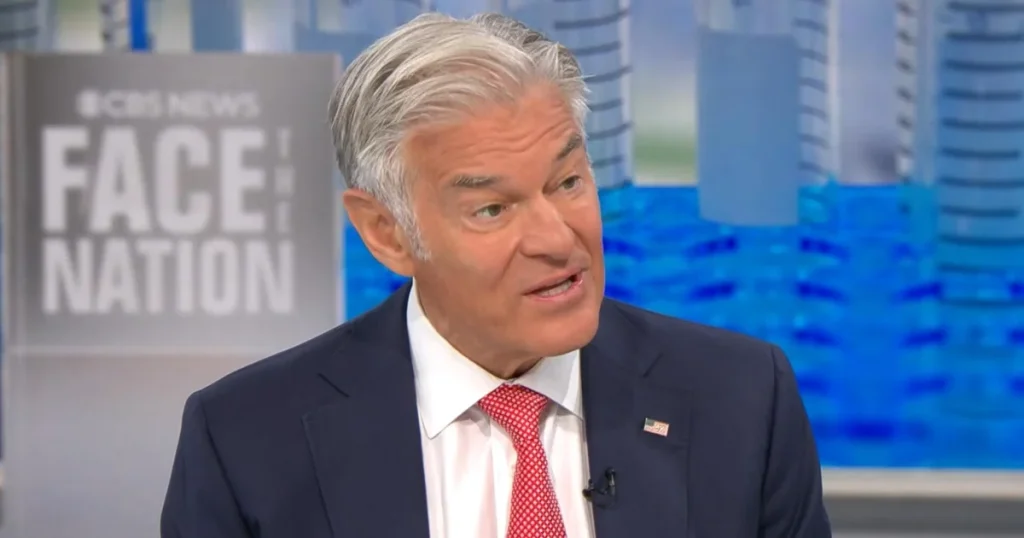
Dr. Mehmet Oz, who heads the Centers for Medicare and Medicaid Services, addressed the controversy directly on Sunday during an appearance on the radio program “Face the Nation with Margaret Brennan.” Confronted with the president’s language, Oz was unequivocal in his correction of the record.
“No, the MMR vaccine is not a lethal vaccine,” Oz stated.
He went on to emphasize that the administration’s underlying intent remains to encourage vaccination, while simultaneously preserving what he described as parental autonomy in medical decisions for children.
“We want patients to get the treatments that their doctors are recommending to them, but we also want parents to have the autonomy to decide what their kids receive,” Oz explained.
State-Level Exemption Gaps Complicate Parental Choice
Oz identified a practical obstacle that sits beneath the headline dispute: many state legislatures have not updated or clarified the rules governing religious and philosophical exemptions from mandatory childhood immunization. In his view, that regulatory ambiguity makes it harder for parents to ask informed questions about which vaccines their children should receive and under what circumstances they might opt out of a particular shot.
“The challenge we’re running into is that many states have not clarified that, and actually, it’s harder for parents to ask these difficult questions,” he said.
He noted that several other nations already distribute the measles, mumps, and rubella antigens as individually packaged products, suggesting the logistical pathway to separate administration exists internationally even if it has not yet materialized domestically.
The Herd Immunity Math Behind the Urgency
The CDC’s kindergarten data carry weight beyond a single statistic. Measles is among the most contagious airborne pathogens known, with a basic reproduction number estimated between 12 and 18. That means roughly 95 percent of a population must be immune—through vaccination or prior infection—to interrupt sustained transmission. At 92.4 percent, the margin of safety narrows considerably, and pockets of lower coverage in individual school districts or communities can become flashpoints for outbreaks.
The administration has, in parallel with the executive order, urged families to bring children up to date on measles immunization as case counts surge. Oz framed the president’s position as one that ultimately asks states to ensure parents retain the option to decline specific vaccines for religious or other personal reasons, while still receiving the full schedule when they choose to comply.
“The request of the president is to make sure that states offer parents either eligibility because of religious beliefs or other reasons why they may not want to have their kids take all the vaccines in order,” Oz said.
What Comes Next
The tension between a single combined formulation and three separate injections is not merely a matter of pharmacy logistics. It touches on vaccine manufacturing capacity, cold-chain distribution, clinic scheduling, and the trust that clinicians and families place in decades of public-health guidance. Until separate products clear regulatory review and reach shelves, the combined MMR shot remains the only formulation available in American pharmacies and pediatric offices. For now, the practical question for families facing a measles uptick is whether they will follow their pediatrician’s schedule, and the federal government’s stated answer—delivered through its CMS chief—is that the combined vaccine is safe, effective, and not lethal.
Related Reading
Frequently Asked Questions
What is Dr Oz says MMR is not?
Dr Oz says MMR is not is the main topic of this guide. The article explains the context, practical details, and next steps readers should understand.
Why does Dr Oz says MMR is not matter?
Dr Oz says MMR is not matters because readers are looking for a useful answer, not just a short summary. Good content should match search intent and help them decide what to do next.