
People are scrambling to find wads of cash dropped all over American cities
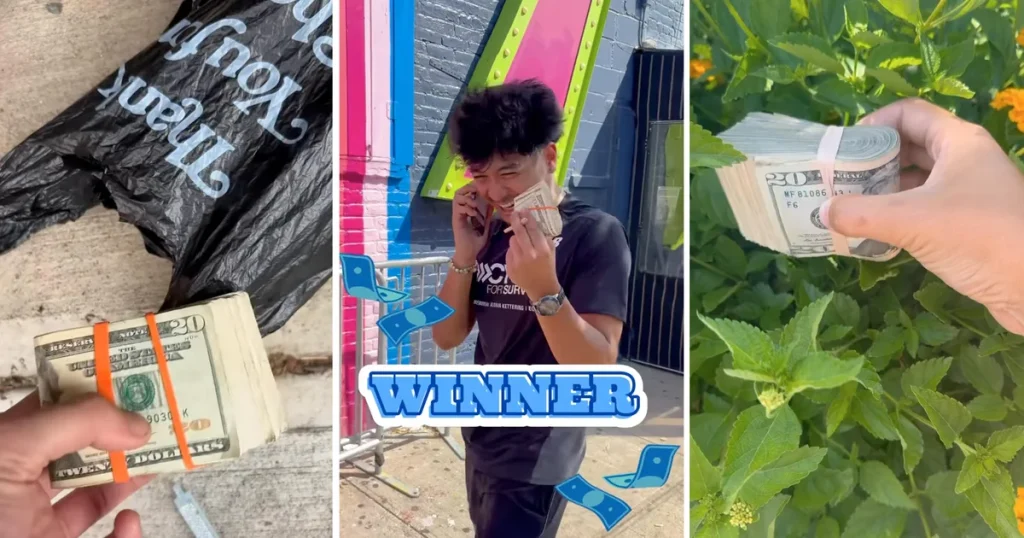
Hidden Cash, Real Chasers: The Social Media Phenomenon Sending Thousands Sprinting Through City Streets
Bizeconanalysis.com – A roll of bills thick enough to make any mob boss pause mid-sentence gets slipped into an empty Doritos bag. White-gloved fingers toss the package beneath a tree. The camera drifts across a park where unsuspecting picnickers sit chatting, oblivious to the fortune resting in the dirt a few yards away. Within minutes, the clip goes live on Instagram, captioned with a simple dare: find it, and it’s yours.
That scenario, repeated hundreds of times across American cities, has become one of the most addictive loops on social media. Cash drop accounts now operate in roughly two dozen metropolitan areas, collectively commanding more than seven million followers. The hidden currency hides inside candy wrappers, envelopes, key locks, takeout containers, paint cans, and even beneath the covers of basketballs and footballs — items the successful hunter walks away with alongside the bills. Locations range from taped-to-a-wall spots on high-traffic avenues to tree hollows, storm drains, trash bins, and the edges of leafy park paths.
How the Hunt Unfolds
The mechanics are deceptively simple. An anonymous or branded account posts a short video showing the deposit being made. Followers who spot the clip rush to the location, often arriving in whatever they were wearing moments before — gym sweats, office suits, thin layers in winter, or heavy coats in summer heat. Some sprint on foot. Others pedal bikes, kick scooters, or floor it in cars. One video even caught a police officer inspecting a garden bed, later revealed to be hoping to snag the cash himself.
Winners typically claim the money within minutes of the post going live. Those arriving seconds later watch from the periphery, empty-handed. The thrill of near-misses fuels the next round of engagement, and the cycle repeats.
A National Network Behind the Drops
While a handful of accounts operate independently, most are anchored to large national operations. Some remain deliberately anonymous — what the industry calls “faceless” accounts. Kristopher Groves, president of PassPass, a company running cash drops in multiple cities, explained that the underlying economics lean heavily on local business sponsorships. Personal injury attorneys, neighborhood restaurants, and youth soccer clubs have all funded drops in exchange for marketing exposure and first-party data: names and email addresses of participants who opt in for sponsored giveaways.
Platform revenue compounds the model. Videos pulling millions of views on Facebook, YouTube, and other networks generate ad-share income. Groves described the opportunity bluntly:
“There are a lot of ways this content can make money through other channels if they’re really savvy.”
For PassPass, that savvy has taken the form of a dedicated mobile app. Free-tier users play arcade-style games with the possibility of winning small cash prizes. Paid subscribers unlock bonus entries into giveaways, travel deals, and — critically — advance hints about where the next drop will land. The app currently lists approximately 200,000 registered users, while the company’s portfolio of city-specific social accounts (such as @PassPassChicago) draws between 100 and 150 million views per month.
Why Now: Inflation, Uncertainty, and the Pull of Free Money
The timing of the phenomenon’s explosion is not accidental. Jessica Rauchberg, a creator-studies scholar at the University of Leeds School of Media and Communication, framed the trend as a symptom of broader economic anxiety:
“This is tied to a larger cultural moment. It says a lot about where we are right now, where there’s growing inflation, a lot of economic uncertainty.”
In a climate where grocery prices climb monthly and job security feels thinner, a $200 bill taped to a fire hydrant carries an emotional weight that transcends its face value. The drop becomes a small, tangible act of generosity in an otherwise impersonal urban landscape — and the chase itself, brief and adrenaline-laced, offers a micro-escape from routine.
The Staten Island Puddle and the Lamborghini
One recent NYC Money Hunt deposit illustrated both the spectacle and the chaos. A massive stack of cash, sealed in a Ziploc bag, was placed in a puddle beneath a shopping-center pylon on Staten Island. The follow-up video showed a stampede of vehicles and pedestrians converging on the lot, carefully stepping around the water while scanning for the package. The money was claimed quickly. Asked about the operation’s goals, the account replied only: “We’re incredibly passionate about both the brand and the business.”
Groves and his brother Edgel, who serves as CEO, have debated internally whether the whole enterprise is merely a fad riding a weak economy. Their conclusion, delivered with a grin, was a rhetorical question:
“When in the history of humanity have people been tired of free money?”
He recalled one particular drop where a man in a Lamborghini gunned his engine toward the location, found the cash, turned to his girlfriend in the passenger seat, and asked when the next one would happen before peeling out of the scene. The image — luxury car, girlfriend, wad of bills, open road — encapsulates why the format keeps working. It is low-stakes, high-dopamine, and universally legible. No explanation needed. Just a bag under a tree, and the city holding its breath.
Related Reading
Frequently Asked Questions
What is People are scrambling to find wads?
People are scrambling to find wads is the main topic of this guide. The article explains the context, practical details, and next steps readers should understand.
Why does People are scrambling to find wads matter?
People are scrambling to find wads matters because readers are looking for a useful answer, not just a short summary. Good content should match search intent and help them decide what to do next.