
Pilot reports possible burn injuries after passenger’s laptop catches fire on American Airlines flight
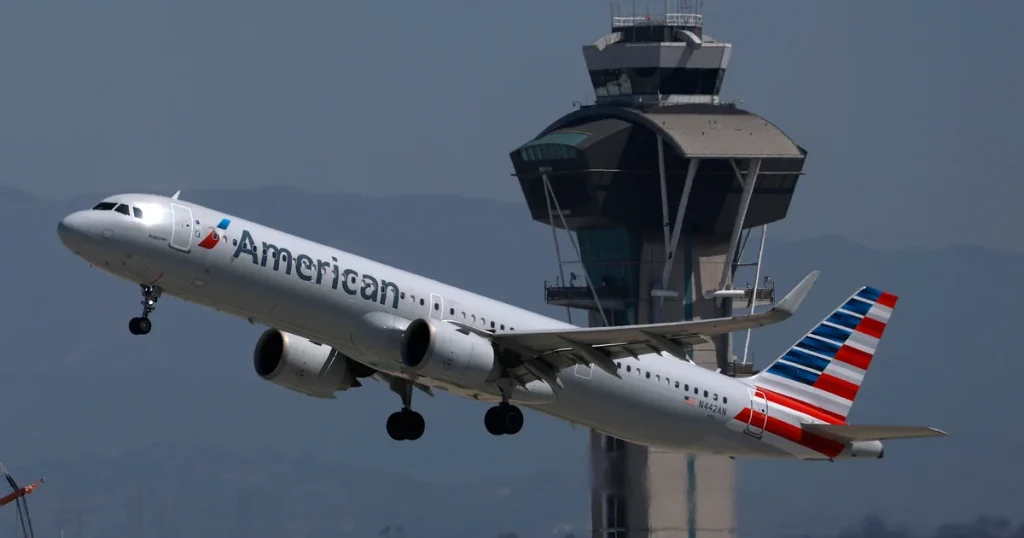
Laptop Ignition on American Airlines Flight Leaves Passengers with Suspected Burns
Bizeconanalysis.com – A fire broke out in the cabin of an American Airlines jetliner Friday when a passenger’s laptop ignited mid-flight, prompting the pilot to report that several travelers may have sustained burn injuries. The aircraft, Flight 2398, touched down at Dallas Fort Worth International Airport after departing Atlanta, and airport officials confirmed that one passenger received medical treatment before being discharged.
What the Pilot Told Air Traffic Control
Audio captured from air traffic control communications gives a real-time account of the chaos unfolding in the rear cabin. The pilot’s voice, tense but controlled, described the situation as it developed:
“Cabin fire in the back of the airplane. The flight attendants are trying to put it out now.”
The pilot went on to estimate the human toll, speaking to controllers as the aircraft prepared for an emergency landing:
“I think we have about four to five passengers that were burned by the laptop. The laptop is contained about mid-aircraft.”
A total of 133 people were aboard when the device caught fire. Flight attendants moved quickly to suppress the flames, and the plane made its way to DFW without further escalation. Airport authorities later confirmed that only one passenger required treatment, and that individual was released after evaluation.
Airline Response
American Airlines issued a brief statement acknowledging the event and praising its crew. The carrier described the landing as safe and credited its staff for acting decisively:
“American Airlines flight 2398 landed safely at DFW after reports of smoke from a customer’s device during landing. We thank our crew for their professionalism and swift response to quickly contain the device.”
The airline did not specify the make or model of the laptop, nor did it indicate whether the device was in use, charging, or stored in overhead bin at the moment of ignition. The Federal Aviation Administration was contacted for additional comment but had not issued a formal statement at the time of reporting.
Why Lithium Batteries Remain a Persistent Hazard in the Air
The incident underscores a risk that aviation regulators have tracked for years: lithium-ion batteries, the power source in virtually every modern laptop, tablet, and smartphone, can fail catastrophically under certain conditions. The FAA has long warned that these cells are susceptible to a phenomenon called thermal runaway, in which internal chemical reactions accelerate uncontrollably, generating heat that further accelerates the reaction in a self-reinforcing loop.
“Thermal runaway can occur without warning as a result of various factors, including if the battery is damaged, overheated, exposed to water, overcharged, or improperly packed,”
the agency explains in a public advisory. Once the cycle begins, temperatures inside the cell can spike rapidly, producing smoke, flames, and toxic fumes. In the confined, pressurized environment of an aircraft cabin, even a small fire can spread quickly through seat upholstery, carpeting, and overhead compartments before crew members reach it.
Because of these dangers, the FAA enforces strict size and quantity limits on lithium batteries carried by passengers and crew. Devices above a certain watt-hour rating generally must be checked as baggage rather than carried in the cabin, and spare batteries must be individually protected against short circuits. Airlines are required to carry fire-extinguishing equipment rated for lithium fires, and crew members receive periodic training on containment procedures.
A Pattern That Keeps Growing
The Dallas incident is not an isolated anomaly. FAA data show that at least 56 lithium-battery-related events involving smoke, fire, or overheating have been logged on commercial flights so far this year. Each event ranges from minor smoke in a lavatory to full-blown cabin fires requiring emergency landings, and the trend has drawn renewed scrutiny from safety advocates and congressional oversight committees.
Just weeks earlier, in February, an Alaska Airlines jet headed for Wichita, Kansas, made an unplanned return to Seattle, Washington, after a passenger’s portable power bank overheated and ignited. That episode, like the American Airlines event, highlighted how a single consumer device can disrupt an entire flight and expose dozens of travelers to injury risk.
Aviation safety experts note that while modern aircraft are engineered to withstand cabin fires for a limited period, the speed at which lithium flames produce heat and toxic gases means that every second of delay in containment increases the danger to nearby passengers. The fact that flight attendants on Flight 2398 were able to suppress the fire before landing likely prevented a far worse outcome.
For travelers, the practical takeaway is straightforward: keep devices in good condition, avoid carrying swollen or damaged batteries, and follow airline instructions about where electronics may be used or stored during takeoff and landing. The technology that powers modern air travel also powers the devices that, in rare but increasingly frequent cases, threaten it.
Related Reading
Frequently Asked Questions
What is Pilot reports possible burn injuries after?
Pilot reports possible burn injuries after is the main topic of this guide. The article explains the context, practical details, and next steps readers should understand.
Why does Pilot reports possible burn injuries after matter?
Pilot reports possible burn injuries after matters because readers are looking for a useful answer, not just a short summary. Good content should match search intent and help them decide what to do next.