
Trump to honor Artemis II crew with nation’s top space medal
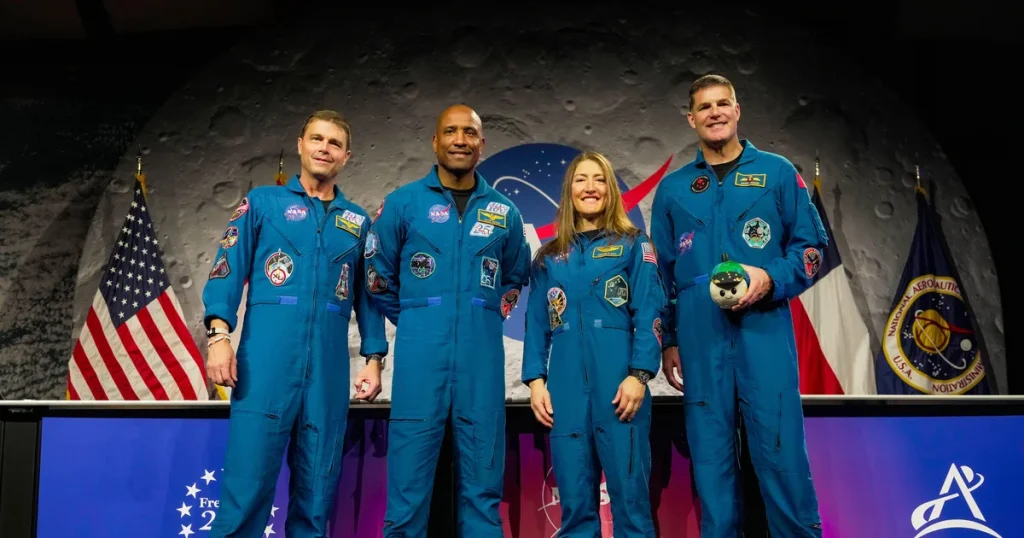
Artemis II Crew Set to Receive America’s Highest Space Honor
Bizeconanalysis.com – The four astronauts who completed humanity’s first lunar flyby in over fifty years will be formally recognized with the Congressional Space Medal of Honor when President Donald Trump presents the award at NASA’s Johnson Space Center in Houston on Friday, August 28. A White House official confirmed the ceremony schedule, marking a rare public moment of national recognition for a crew whose ten-day voyage around the Moon concluded with a safe splashdown on April 10.
The distinction carries extraordinary weight. In the entire history of American spaceflight, only thirty astronauts have ever been bestowed this particular medal. The Artemis II crew — NASA’s Reid Wiseman, Victor Glover, and Christina Koch, together with Canadian Space Agency astronaut Jeremy Hansen — will join an extremely short list that includes Neil Armstrong, John Glenn, and the astronauts who perished in the Apollo 1 fire of 1967, the Space Shuttle Challenger disaster of 1986, and the Space Shuttle Columbia disaster of 2003, all of whom received the honor posthumously.
A Medal Reserved for Extraordinary Achievement
Despite its formal name, the Congressional Space Medal of Honor is not voted on by legislators. Congress authorized the president to present the decoration “in the name of Congress” to any astronaut who has met a specific standard of distinction. The statutory language, as maintained by NASA, requires that the recipient have
“distinguished himself by exceptionally meritorious efforts and contributions to the welfare of the Nation and of mankind.”
In practice, the NASA administrator recommends candidates, and the president makes the final decision. This two-step process keeps the medal deliberately scarce. The most recent recipients before the Artemis II crew were Doug Hurley and Bob Behnken, who in 2020 became the first astronauts to launch into orbit aboard a commercial spacecraft — SpaceX’s Crew Dragon. President Joe Biden presented them the medal in 2023, making the interval between consecutive awards roughly two years.
Why Artemis II Earned the Distinction
The Artemis II mission represented a milestone that had eluded the international space community since the Apollo era. For the first time since December 1972, when Apollo 17’s crew looped behind the Moon, human beings traveled beyond low Earth orbit and completed a full lunar flyby. The four-person crew spent ten days in space, navigating the far side of the Moon, testing life-support systems, and validating procedures that will underpin future crewed landings under NASA’s broader Artemis program.
The mission’s safe conclusion — a splashdown in the Pacific Ocean on April 10 — confirmed that modern spacecraft can carry humans on deep-space trajectories and return them intact. That operational success is precisely the kind of contribution the medal’s enabling language contemplates: efforts that advance not merely one agency’s mission but the welfare of the nation and of humanity’s capacity to explore beyond Earth.
Context and Implications
The timing of the ceremony, set for late August, places the recognition well after the mission’s completion and after the crew has returned to civilian life. Awarding the medal at Johnson Space Center — the very facility where the astronauts trained, where mission control operated during the flight, and where splashdown recovery was coordinated — underscores the institutional continuity between the mission’s execution and its national acknowledgment.
For the broader space community, the award signals that the Artemis program’s first crewed milestone has been absorbed into the official narrative of American spaceflight. It also sets a precedent: if future Artemis missions achieve lunar landing or sustained surface operations, their crews will enter a medal lineage that stretches back to Armstrong and Glenn, linking the current generation of explorers to the pioneers of the 1960s.
The inclusion of Jeremy Hansen, a Canadian astronaut, in the recipient group reflects the increasingly multinational character of deep-space exploration. While the medal is an American decoration, its presentation to a crew member from a partner agency acknowledges that the capabilities required for lunar flyby now depend on international collaboration, a reality that distinguishes the Artemis era from the Cold War competition that produced the original Apollo missions.
With only thirty recipients in more than six decades of crewed spaceflight, the Congressional Space Medal of Honor remains one of the rarest honors in the American system. Adding four names to that list in a single ceremony is itself a statement about the scale of what the Artemis II crew accomplished — and about the threshold Congress set when it reserved the decoration for contributions measured against the welfare of the entire species.
Related Reading
Frequently Asked Questions
What is Trump to honor Artemis II crew?
Trump to honor Artemis II crew is the main topic of this guide. The article explains the context, practical details, and next steps readers should understand.
Why does Trump to honor Artemis II crew matter?
Trump to honor Artemis II crew matters because readers are looking for a useful answer, not just a short summary. Good content should match search intent and help them decide what to do next.