
NASA images show 60-foot-wide crater on moon after SpaceX rocket booster crash
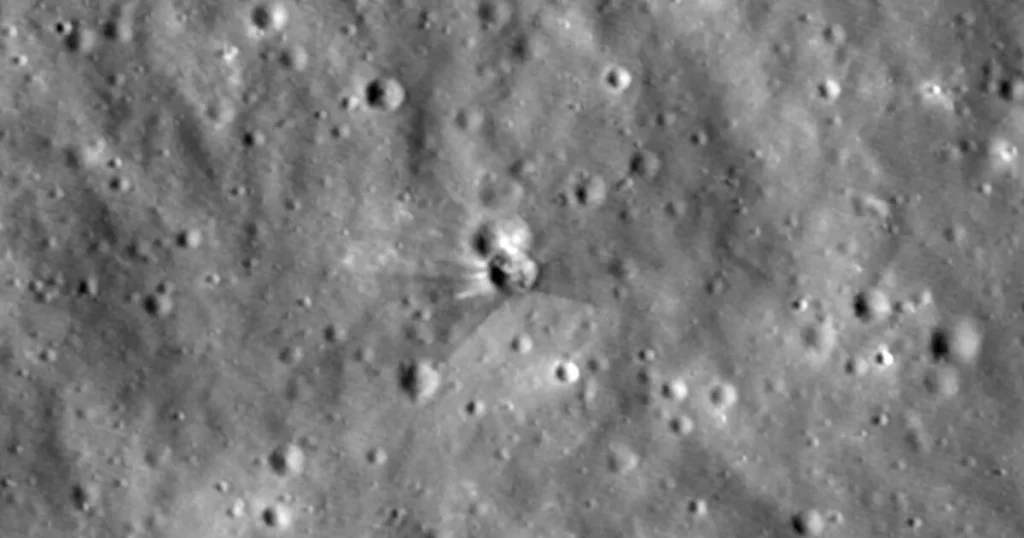
Moon’s Surface Bears New Scar: NASA Orbiter Captures First Close-Up of SpaceX Booster Impact Crater
Bizeconanalysis.com – For over a year, a spent rocket stage tumbled silently through the void between Earth and the Moon, an 8,800-pound aluminum cylinder that had long since finished its job. On August 5, that drift ended abruptly when the SpaceX Falcon 9 upper stage slammed into the lunar surface at roughly 5,400 miles per hour, delivering an impact equivalent to nearly three tons of TNT. Now, fresh imagery from NASA’s Lunar Reconnaissance Orbiter reveals the aftermath: a roughly 60-foot-wide crater, less than 10 feet deep, ringed by radiating streaks of excavated material that scientists describe as resembling the wings of a butterfly.
The Collision and Its Scale
The booster measured approximately 45 feet in length and 12 feet in diameter at its widest point. When it struck the Moon’s Earth-facing hemisphere, the kinetic energy released was comparable to detonating a small conventional explosive charge on the surface. While the Moon is routinely bombarded by natural objects — meteoroids, dust grains, occasional asteroids — deliberate or semi-deliberate artificial impacts remain comparatively rare events. This particular strike represents one of the larger human-made objects ever to collide with a celestial body outside Earth orbit, and its aftermath offers researchers a natural experiment in impact mechanics at velocities far exceeding anything achievable in terrestrial laboratories.
The upper stage had been separated from its parent vehicle in January 2025, when the Falcon 9 carried two privately built lunar landers equipped with scientific payloads and a miniature rover. That mission was part of NASA’s ongoing effort to shift routine lunar surface operations to commercial partners. After completing its propulsive work, the spent stage entered a long, uncontrolled trajectory through cislunar space before gravity eventually guided it back toward the Moon.
What the Orbiter Images Reveal
The photographs, released by NASA on Tuesday, show a clearly defined bowl-shaped depression with dark and bright linear features fanning outward from the rim. Scientists explain the darker streaks as material that had resided near the surface for geological ages, its composition and texture altered by billions of years of solar wind bombardment, cosmic-ray irradiation, and countless micrometeorite strikes. The brighter rays, by contrast, expose fresher rock and regolith that was ejected from deeper layers during the impact event. Together, the two-tone pattern provides a snapshot of how lunar regolith stratification responds to a high-velocity strike.
The crater’s dimensions — sixty feet across and under ten feet deep — place it in a size range that engineers and mission planners will want to catalog carefully. As more commercial and governmental spacecraft operate in cislunar space, the probability of uncontrolled re-entries onto the lunar surface rises. Understanding how such impacts modify the terrain helps inform siting decisions for future landers, rovers, and surface infrastructure.
Capturing the Scene from Orbit
The Lunar Reconnaissance Orbiter, which has circled the Moon continuously since 2009, photographed the impact site approximately one week after the collision. At the time of imaging, the spacecraft was traveling at one mile per second from an altitude of about 60 miles. Because the orbiter follows a polar orbit that completes each revolution roughly every two hours while the Moon rotates beneath it, the crash site did not fall within the camera’s field of view until six days after the event. Flight controllers had to tilt the spacecraft’s attitude so the imaging instruments could be pointed at the fresh scar during the narrow window of opportunity.
South Korea’s Danuri (KPLO) lunar orbiter actually reached the scene first, transmitting its own set of photographs before the American spacecraft completed its observation pass. The near-simultaneous coverage by two independent orbiters from different national programs underscores how crowded the lunar orbital environment has become in just a few years.
A Precedent Set in 2009
This is not the first time a rocket stage has been used as a lunar impact probe. In October 2009, NASA deliberately fired a spent Centaur upper stage into a permanently shadowed crater near the Moon’s south pole. The resulting plume of vaporized material confirmed the presence of water ice in that region — a discovery that immediately elevated the south-polar terrain to a top priority for both American and Chinese lunar-base planning. That mission, known as LCROSS, demonstrated that a controlled impact could answer scientific questions no lander or orbiter alone could resolve.
The August 2025 Falcon 9 strike, by contrast, was unplanned. Yet the data it generated — crater morphology, ejecta patterns, depth-to-diameter ratios — still carries value for planetary scientists modeling impact processes and for engineers assessing the cumulative modification of the lunar surface by human activity.
Why It Matters for the Coming Decade
NASA’s Artemis program and a growing cohort of commercial operators aim to establish sustained human presence at the lunar surface within the next several years. Every additional kilogram of hardware launched toward the Moon increases the statistical chance of another uncontrolled impact. The new imagery from the Lunar Reconnaissance Orbiter, combined with the earlier Danuri observations, gives the community a concrete reference point: what a Falcon-class stage does to the terrain, how far ejecta travels, and how quickly the fresh crater integrates into the surrounding regolith. As the pace of lunar traffic accelerates, such reference data will become essential for collision-avoidance planning, site selection, and long-term stewardship of the Moon’s surface.
Related Reading
Frequently Asked Questions
What is NASA images show 60 foot wide?
NASA images show 60 foot wide is the main topic of this guide. The article explains the context, practical details, and next steps readers should understand.
Why does NASA images show 60 foot wide matter?
NASA images show 60 foot wide matters because readers are looking for a useful answer, not just a short summary. Good content should match search intent and help them decide what to do next.