
Justice Department asks court to reinstate criminal charges against Kilmar Abrego Garcia
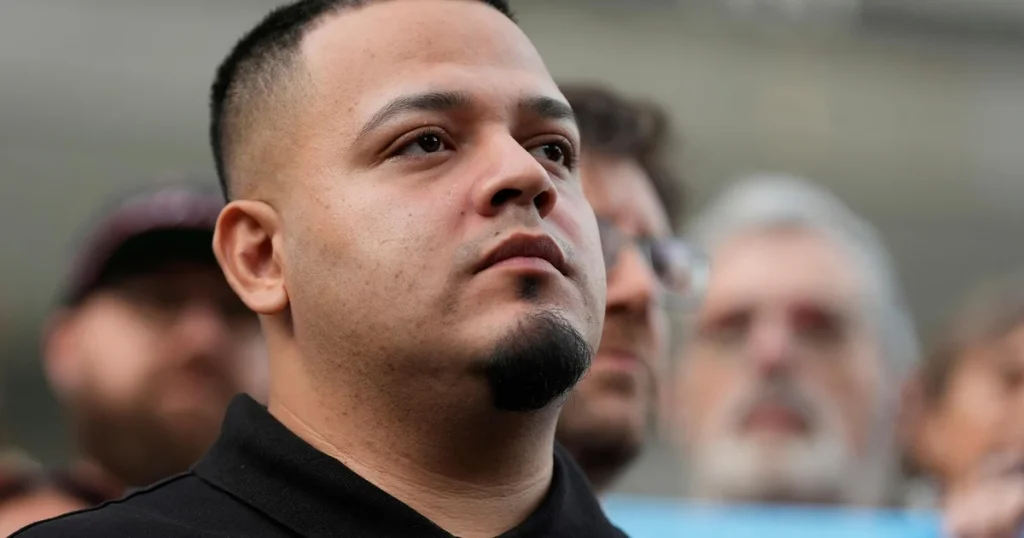
Federal Prosecutors Seek to Revive Smuggling Indictment Against Salvadoran Man at Center of Deportation Dispute
Bizeconanalysis.com – The U.S. Department of Justice filed a brief Monday urging the Sixth Circuit Court of Appeals to overturn a Tennessee district court ruling that threw out a criminal indictment against Kilmar Abrego Garcia, a Salvadoran national who became the face of a bitter legal battle over the Trump administration’s deportation practices. The government’s filing asks the appellate panel to restore two counts of human smuggling that a lower-court judge had dismissed in May, concluding that the prosecution was brought in retaliation for Abrego Garcia’s successful challenge to his forced removal from the country.
The Retaliation Finding That Triggered the Appeal
In May, a federal judge in Tennessee ruled that the Justice Department had prosecuted Abrego Garcia not because of genuine evidence of wrongdoing, but because he had dared to contest his wrongful deportation to El Salvador the previous year. The judge characterized the indictment as vindictive — a legal term describing a prosecution launched or intensified to punish a defendant for exercising a right, such as filing a lawsuit or appealing a government action. That finding effectively nullified the criminal case at the trial level and sent the matter upward on appeal.
The original charges trace back to a November 2022 traffic stop in Tennessee. State Highway Patrol officers pulled Abrego Garcia over and discovered multiple passengers in his vehicle. Federal prosecutors later converted that encounter into two counts of human smuggling, alleging he had transported immigrants into the United States without proper authorization. Abrego Garcia entered a not-guilty plea and has maintained his innocence throughout the proceedings.
DOJ’s Argument: Legitimate Prosecutorial Judgment
In its Monday filing before the Sixth Circuit, the Justice Department pushed back firmly against the retaliation characterization. The department contended it possessed “multiple legitimate bases to prosecute” Abrego Garcia and that the decision to seek an indictment rested on ordinary evidentiary and legal analysis rather than any animus toward his immigration litigation.
“The decision to seek an indictment against Abrego Garcia for human smuggling was made by career prosecutors based on the evidence, the law, and their firm belief that there is proof beyond a reasonable doubt that Abrego Garcia had committed the offenses charged,” the Justice Department said in a news release.
The department went further, framing the district judge’s May ruling as a broad judicial overreach. It argued that the order “marks a dramatic expansion of the power of courts to dismiss serious criminal charges based on subjective assessments of a prosecutor’s motivations.” In the government’s telling, allowing such dismissals would let defendants escape accountability simply by suing the state first and then claiming the subsequent prosecution was motivated by spite.
Defense: The White House Drove the Case
Abrego Garcia’s attorneys told CBS News they considered the department’s public statement “flat wrong.” They maintained that the district court record itself demonstrated vindictive intent and that the proof was unambiguous, notwithstanding what they described as the DOJ’s refusal to place the actual decision-makers on the stand under oath — specifically naming Attorney General Todd Blanche as someone who should have testified.
“This case was initiated vindictively and on instructions from the White House after our client successfully won his Supreme Court case,” his defense team added.
That Supreme Court victory is central to understanding why the prosecution drew such sharp criticism. Abrego Garcia had been deported to El Salvador in what his lawyers and several civil-liberties groups characterized as a gross miscarriage of process. He ultimately prevailed at the nation’s highest court, which ordered his return to the United States. The timing of the smuggling charges — filed after that win — fueled the perception that the government was punishing him for litigating successfully.
A Parallel Deportation Fight in Maryland
The criminal case is not the only legal front on which Abrego Garcia is engaged. A separate federal proceeding in Maryland addresses the administration’s continuing attempts to remove him from the country. Immigration and Customs Enforcement has publicly stated its intention to deport him to Liberia, an African nation with which he has no known familial or residential ties. A federal judge has, for now, blocked that deportation order, keeping the question of his status unresolved while the criminal appeal winds through the Sixth Circuit.
Why the Sixth Circuit Decision Will Matter
The outcome of this appeal carries implications well beyond one man’s traffic stop. If the Sixth Circuit affirms the district judge’s retaliation finding, it would hand lower courts a tool to scrutinize prosecutorial motives in cases where defendants have previously challenged government action. If it reverses, it would reinforce the long-standing principle that courts generally do not second-guess a prosecutor’s charging decisions absent extraordinary circumstances. Either way, the ruling will shape how future defendants navigate the intersection of immigration litigation and criminal exposure — a question that has grown more urgent as the administration has expanded its deportation apparatus and faced a wave of challenges from those it has targeted.
Abrego Garcia’s case has drawn attention from immigration advocates, civil-liberties organizations, and members of Congress who have questioned whether the timing and scope of the smuggling charges were consistent with ordinary prosecutorial norms. The Sixth Circuit has not yet indicated when it will rule on the government’s motion to reinstate the indictment.
Related Reading
Frequently Asked Questions
What is Justice Department asks court to reinstate?
Justice Department asks court to reinstate is the main topic of this guide. The article explains the context, practical details, and next steps readers should understand.
Why does Justice Department asks court to reinstate matter?
Justice Department asks court to reinstate matters because readers are looking for a useful answer, not just a short summary. Good content should match search intent and help them decide what to do next.