
A summer of extremes: Weathering a hotter world
When the Season Turns Against You: America’s Record-Breaking Summer of Fire, Flood, and Furnace Heat
Bizeconanalysis.com – The fireworks over the National Mall were supposed to mark America’s 250th birthday. Instead, the celebration opened with an evacuation. An incoming summer storm swept through Washington, D.C., this July, scattering crowds from the park and shoving them indoors before the show could resume. Hours later the rockets finally launched, but the sky had already delivered its message: the summer that was meant to be a season of escape has become, for tens of millions of Americans, a season of endurance.
A July That Broke Every Thermometer
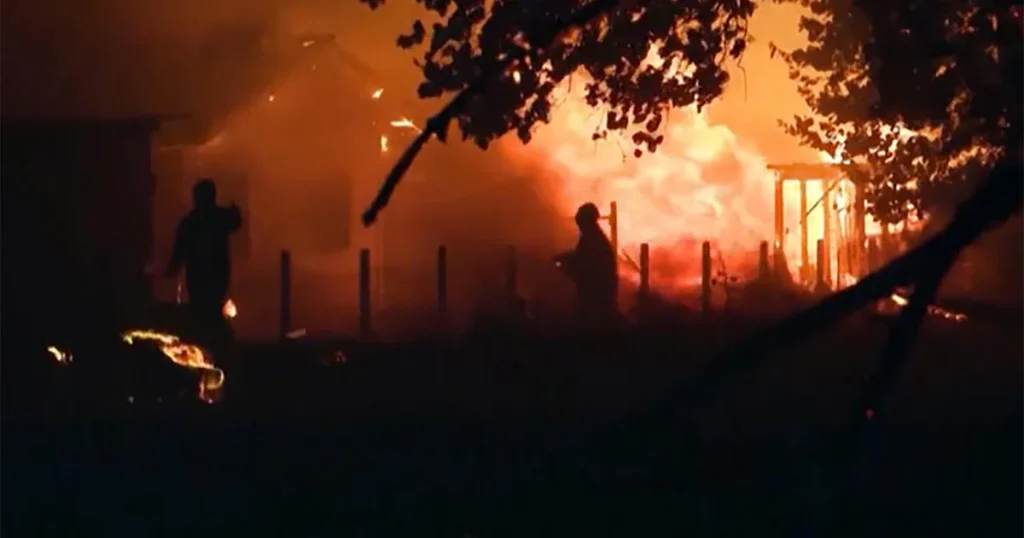
The numbers behind this summer’s violence are staggering. July registered as the hottest month ever recorded across the Lower 48 states, shattering a benchmark that had stood since the Dust Bowl era of the 1930s. That heat did not arrive in isolation. Months of drought and sustained high winds created conditions that turned a small brush fire in Spokane, Washington — allegedly ignited by an arsonist — into a neighborhood-level catastrophe within hours.
Ted Chauvin watched flames leap from the surrounding forest into his street. He had minutes to act.
“We just got the dogs, the cat, the kid, and we just got out,” he recalled.
Standing amid the charred remains of the home where he was diagnosed with cancer, where he recovered, where his daughter grew up, Chauvin described what the loss truly meant.
“I see where I was diagnosed with cancer, where I beat cancer. Where we had our child, and the memories we gave her in growing up in this place. That honestly has been the hardest part, is the memories, and hearing our kiddo go, ‘I miss my house. I miss my house.'”
Spokane’s blaze was not an outlier. It was part of what has become Washington State’s most destructive wildfire season on record — yet another threshold crossed in a single year.
“Something’s changing,” Chauvin said. “And what we need to do is really ask the questions to figure out what to do about it.”
Floods, Twisters, and the Geography of Surprise
The extremes did not stop at one state or one disaster type. Texas endured a second once-in-a-thousand-year flood within twelve months, a statistical impossibility that now reads as routine. Indiana, a state sitting well outside the traditional Tornado Alley corridor, logged a record 77 tornadoes in a single season. Each event, taken alone, invites the reflexive shrug: bad luck, freak occurrence, anomaly. Taken together, they form a pattern that climate scientists have flagged for decades.
The Boiling Pot, Slowly
Climate journalist Jeff Goodell, author of The Heat Will Kill You First and The Water Will Come — titles that now read less like literary choices and more like wire copy — frames the current summer as another escalation step in a trajectory that researchers have documented since the early 2000s.
“Summer of 2026 is another step in the escalation of our world into a sort of hotter, more dangerous planet that we have been told about for decades,” Goodell said. “Oh, they’re absolutely all connected. We’re creating a different world. And we need to think about that and adapt to that world.”
Goodell’s central warning is not about any single storm or fire. It is about the normalization reflex — the instinct to file each event under “abnormal year” and move on. He invokes the old parable of the frog lowered into a pot of water that warms by degrees.
“I think that’s a very appropriate analogy, for sure. I do think that it captures this idea of these slow changes that, you know, we don’t recognize until it’s too late.”
The data behind his analogy is unambiguous. According to figures compiled by the EPA and NOAA, heat waves now strike roughly three times as frequently as they did in the 1960s. Annual wildfire acreage has doubled compared with the 1990s. These are not projections; they are measurements already in the ledger.
Across the Atlantic, the Same Furnace
The pattern is not confined to North America. Europe endured deadly wildfires and record-breaking heat this summer, in a continent where air conditioning remains uncommon precisely because sustained extreme heat was, until recently, a rarity. Heat-related deaths across the continent are estimated to have exceeded 10,000. Infrastructure designed for a milder thermal envelope simply was not built to cope.
“All of human civilization, all of life that we know, has thrived in this sort of Goldilocks Zone,” Goodell observed. “Human civilization has evolved in the last, you know, 10,000 years, and we’ve evolved in this certain range of temperatures. And what’s happening now is that we’re moving out of that range.”
Asked how much of American life — its building codes, its agricultural calendars, its public-health assumptions — rests on a climate that no longer exists, Goodell’s answer was a single word:
“All of it.”
Policy Reversal at the Federal Level
The scientific consensus on warming is not in dispute among working atmospheric scientists. What is in flux is the institutional architecture meant to respond. This year, the Trump administration’s EPA moved to revoke the “endangerment finding” on greenhouse gases — the 2009 determination that formally opened the door to federal regulation of carbon emissions. Separately, the administration loosened a federal rule that had placed limits on greenhouse gas output. For Goodell, the timing is not accidental.
“It’s particularly difficult to do here in the United States, even when you have cities with the best intention, if you don’t have a federal government that is really, you know, helping.”
Modeling What Comes Next
At the University of Maryland, atmospheric scientist Maria Molina is applying artificial intelligence to decades of historical weather records to generate probabilistic forecasts for coming seasons. Her work does not predict a single storm; it maps how the statistical envelope of extremes is shifting against a warming background.
“There have always been extreme events,” she said. “There will always be extreme events, aside from the climate perspective. The question is, how are these extremes potentially evolving due to that background climate gradually warming? That is what could be concerning, because that could be a very small signal, like a slightly”
The sentence trails off, but the implication does not. A small statistical shift in the frequency or intensity of extremes, compounded year over year, is precisely the mechanism by which a once-in-a-thousand-year flood becomes a once-in-twelve-months event. It is the mechanism by which a summer of fireworks becomes a summer of evacuation, and the season of escape becomes the season of endurance.
Related Reading
Frequently Asked Questions
What is A summer of extremes?
A summer of extremes is the main topic of this guide. The article explains the context, practical details, and next steps readers should understand.
Why does A summer of extremes matter?
A summer of extremes matters because readers are looking for a useful answer, not just a short summary. Good content should match search intent and help them decide what to do next.