
Rahm Emanuel on Trump, the left, and what’s right for America
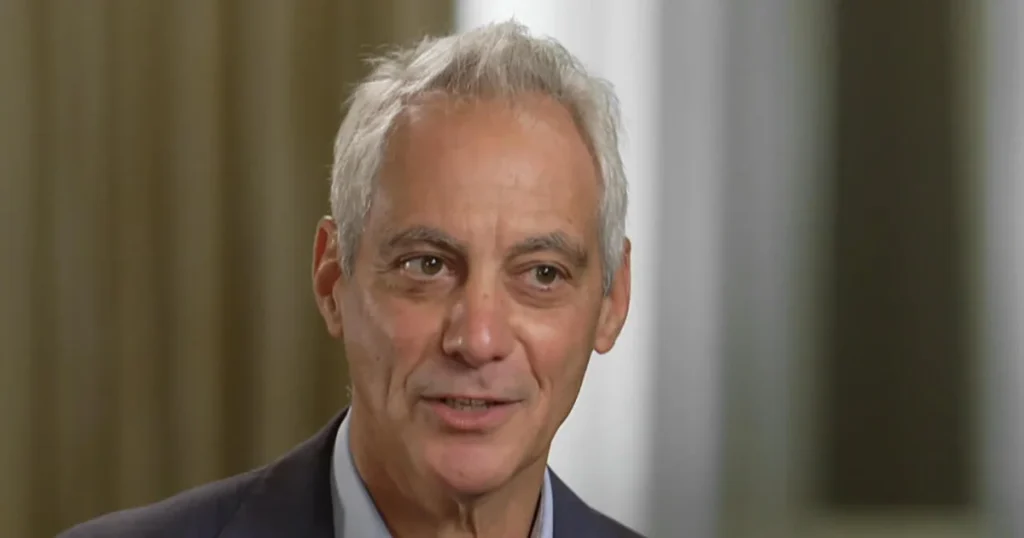
The Moderate’s Counterpunch: Rahm Emanuel Takes Aim at Both Flanks
Bizeconanalysis.com – Former Chicago Mayor Rahm Emanuel has spent decades occupying the narrow corridor between Democratic centrism and the party’s progressive wing, and lately that corridor has become a battlefield. Speaking from a sunlit stretch of the Chicago Riverwalk — a waterfront promenade he championed during his eight-year tenure as mayor — Emanuel laid out a political philosophy built on what he calls “grit” and “no-nonsense” toughness. His message, delivered with the bluntness of a man who once ran a city of nearly three million residents, is that Democrats must stop courting their own base and start winning over voters in red districts.
“I’m about flipping red districts to blue; I’m not about taking blue districts and making them midnight blue.”
The remark lands against a backdrop of escalating intra-party friction. Senator Bernie Sanders and his progressive allies have reshaped primary contests across multiple states, and Emanuel sees that momentum as a threat to the party’s electoral viability. In a Wall Street Journal op-ed published this week under the pointed headline “How to Lose Friends and Alienate Allies,” he warned that what he called “‘Bernie bros’ could spoil the midterms.” The framing is deliberately combative, echoing the title of a well-known social-skills guide, and it signals that Emanuel views the progressive surge not as a natural evolution of the party but as a self-inflicted wound.
Pushback as Method
Emanuel has long been known for pressing back on interviewers, and his willingness to do so extends to fellow Democrats. Sanders, a self-described Democratic Socialist, has made no secret of his disdain for the establishment figure. On the PBS program “Face the Nation” on July 26, Sanders declared:
“People are sick and tired of the Rahm Emanuels and the Democratic establishment and the Republican establishment.”
Emanuel’s response to such critiques is not conciliation. When asked how he would demonstrate genuine passion for working-class economic grievances — the very grievances progressives say centrists fail to grasp — he laughed and fired back:
“You don’t think I bring any passion to what I do?”
He then pivoted to a practical argument: raising the minimum wage, in his view, requires expanding the party’s coalition outward, not deepening its ideological commitments inward. “Winning over Democratic districts is not the way to get it there,” he said, dismissing the notion that progressive policy wins require progressive constituencies.
The Hypothetical Phone Call
Asked what he would tell a Democratic Socialist who phoned him seeking advice on appealing to centrist voters, Emanuel’s answer was characteristically dismissive:
“First of all, it’s a hypothetical. And let me break the news to you – the calls haven’t come in. And everybody knows the number! So, I don’t see that happening.”
He went further, drawing a hard line between his own politics and the progressive platform. Progressives, in his telling, constitute effectively a separate party. He also stated plainly that he does not believe in defunding police departments and does not support open borders — positions that place him squarely against the most visible policy demands of the Sanders wing.
Trump as the Indictment
While Emanuel spends considerable energy policing the left, his sharpest rhetoric is reserved for President Donald Trump. Should Democrats reclaim Congress, Emanuel has argued that impeachment should be pursued, and he has accused the president and his administration of corruption he described as “worse than Castro.” The comparison to Cuba’s longtime leader is hyperbolic, but it underscores the depth of his contempt.
“He’d make an alderman in Chicago blush for the kind of corruption he’s doing.”
He then offered a series of pointed contrasts linking presidential enrichment to household economic pain:
“The president of the United States is $4 billion richer, and you’re $4 trillion poorer. And I think that this is a travesty of his Constitutional responsibilities, let alone the responsibilities of what he’s done. He wants a ballroom, you’re gonna get the bill. He wants his $450 million Qatari plane, you get $4.50 a gallon. He’s building an arch, and your family can’t afford a meal at the Golden Arches.”
The “Golden Arches” reference — a nod to the McDonald’s logo and, by extension, to Chicago’s own fast-food economy — ties his critique back to the city he once governed. For Emanuel, the indictment is not abstract; it is written in the price of gasoline and the cost of a hamburger.
Israel, Peace, and Antisemitism
Emanuel’s political engagement extends beyond domestic politics. Speaking in Tel Aviv last month, he offered pointed criticism of Prime Minister Benjamin Netanyahu while calling for a peace framework built on what he termed “Palestinian dignity” and “Israeli security.”
“You cannot fight indefinitely against a world that has stopped believing you have a right to fight. You must instead find a new sustainable path to peace, security and prosperity.”
As a Jewish American who has served as mayor, congressman, ambassador, and chief of staff in the Obama White House, Emanuel occupies a particular vantage point in the Israeli-Palestinian debate. He has expressed deep concern over the rise of antisemitism in the United States, particularly its recent manifestation in violence and killing.
“You don’t have to agree with the Israeli government to be concerned with the rise of antisemitism in America, and more than the antisemitism which always existed, the way it’s being manifested with violence and killing.”
His position attempts to hold two truths simultaneously: that Israeli policy deserves robust criticism and that Jewish Americans deserve protection from hatred. In a party increasingly divided over both issues, that dual commitment marks him as a figure who refuses to let either conversation dominate the other.
The Career Behind the Rhetoric
Emanuel’s political résumé spans more than three decades: eight years as mayor of Chicago, service as a U.S. congressman representing Illinois’s 7th district, a stint as ambassador to Japan, and top advisory roles under two presidents, culminating in his tenure as White House chief of staff under Barack Obama. That breadth of experience informs his insistence that policy must be judged by electoral consequences, not ideological purity. Whether Democrats heed that counsel in the coming midterm cycle remains the central question his public interventions are designed to force.
Related Reading
Frequently Asked Questions
What is Rahm Emanuel on Trump the left?
Rahm Emanuel on Trump the left is the main topic of this guide. The article explains the context, practical details, and next steps readers should understand.
Why does Rahm Emanuel on Trump the left matter?
Rahm Emanuel on Trump the left matters because readers are looking for a useful answer, not just a short summary. Good content should match search intent and help them decide what to do next.