
Indonesia earthquake death toll nears 70 as thousands wait for help on country’s Independence Day
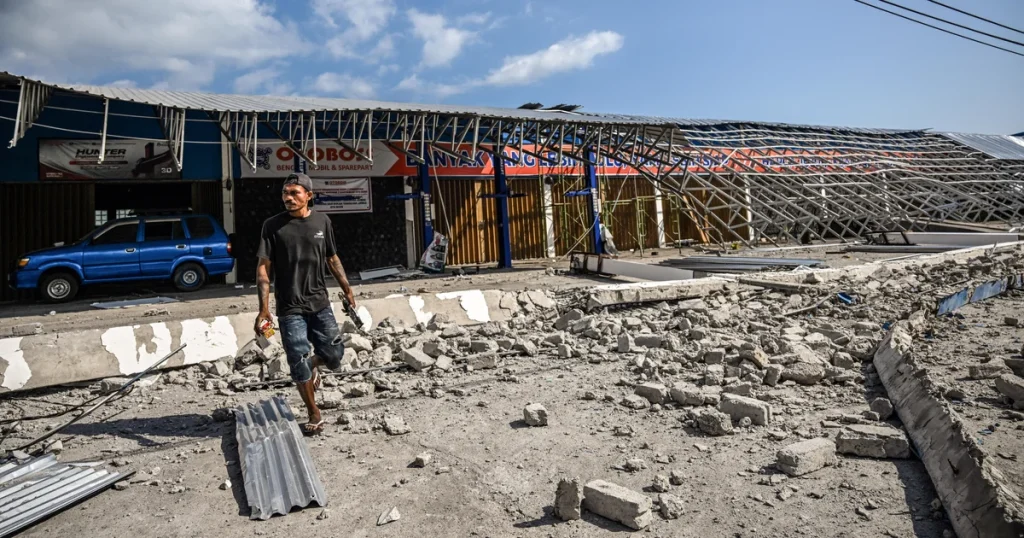
Indonesia Earthquake Death Toll Nears 70
Bizeconanalysis.com – As Indonesia marked its 81st Independence Day, the death toll from Saturday’s magnitude-6.2 quake on Flores island stood at at least 68, with more than 200 injured and thousands sheltering under tarpaulins amid the wreckage of their homes. The tremor struck just before 6 a.m. local time in East Nusa Tenggara province, severing roads, collapsing bridges, and isolating entire villages for days. For residents still waiting for rescue, the national holiday in Jakarta felt like a world apart.
In the capital, President Prabowo Subianto interrupted the Independence Day ceremony to observe a moment of silence for the nation’s founding heroes, then called on all attendees to pray for communities battered by the disaster. The gesture highlighted how the quake had intruded on the country’s most solemn civic observance.
Damage Assessment and Emergency Response
The National Disaster Management Agency (BNPB) reported that more than 1,300 residential structures across the province sustained damage, with nearly 250 on Flores itself flattened entirely. Roughly 5,000 residents were displaced into temporary shelters, and 213 people were treated for injuries. On Sunday, the provincial governor declared a 14-day state of emergency to accelerate search-and-rescue and medical deployments.
The U.S. Geological Survey located the hypocenter at a depth of 10 kilometers. Tsunami advisories went out within minutes of the shaking and were withdrawn shortly after, though the brief alert was sufficient to send coastal residents scrambling uphill. By Monday, seismologists had logged 1,576 aftershocks, most too small to register beyond instrument readings.
Abdul Muhari, BNPB deputy chief, detailed the relief operation in a video briefing: approximately 1,500 military and police personnel were deployed across the zone, supported by 10 aircraft airlifting 275 tons of food, medicine, and shelter materials. Landslides, washed-out bridges, and scarce landing strips created severe bottlenecks, leaving some communities without their first supply drop for days.
Isolated Communities and Lasting Trauma
Palue Island, sitting close to the epicenter, received its first aid workers only late Sunday after a combined sea-and-land transit through landslide-choked terrain. Marselus Yugo Amboro, deputy police chief of Sikka regency, called the approach a “near-death journey” and was among the first to deliver emergency supplies. Initial surveys found one villager killed, two seriously injured, and close to 150 homes destroyed, with thousands still lacking food, clean water, and medical care.
In Ruteng, the hardest-hit town, structural damage to local hospitals prompted authorities to stand up two emergency field hospitals and assign two crisis-management teams to a dedicated health-emergency operations center. Muhari noted that no families had come forward reporting missing relatives, suggesting the toll—while still climbing—may be nearing its final count.
For many Flores residents, Saturday’s shaking reopened a wound never fully closed. In 1992, a powerful earthquake and accompanying tsunami struck the same island and claimed roughly 2,500 lives. The memory of collapsed walls and surging water colored every conversation in the weeks since.
“My house is just rubble now,” said Rasyid Jafar, a clothing trader in the village of Reo within Manggarai regency. “We need food, medicine and clean water urgently.”
Photographic documentation from the island captured fallen trees sealing roadways, massive boulders dragged down hillsides, and homes flattened onto parked vehicles—the unmistakable signature of shallow, high-intensity seismic shaking.
Frequently Asked Questions
How many people were killed in the Flores earthquake? At least 68 deaths had been confirmed as of the Independence Day reporting, with authorities indicating the figure could still rise. More than 200 were injured.
When did the earthquake occur and how strong was it? The magnitude-6.2 quake struck just before 6 a.m. local time on Saturday. Its hypocenter was at a depth of 10 kilometers, making surface shaking particularly intense.
What emergency measures were put in place? The East Nusa Tenggara governor declared a 14-day state of emergency on Sunday. Approximately 1,500 military and police personnel, along with 10 aircraft carrying 275 tons of relief supplies, were deployed to the affected areas.
Were there tsunami warnings? Yes. Tsunami advisories were issued within minutes of the quake but withdrawn shortly afterward. The brief alert nonetheless prompted residents in coastal settlements to move to higher ground.
How many aftershocks were recorded? By Monday, authorities had logged 1,576 aftershocks, though most registered at magnitudes too small to be felt by the general population.