
Ukraine launches hundreds of drones into Russia in one of the largest aerial attacks of the war
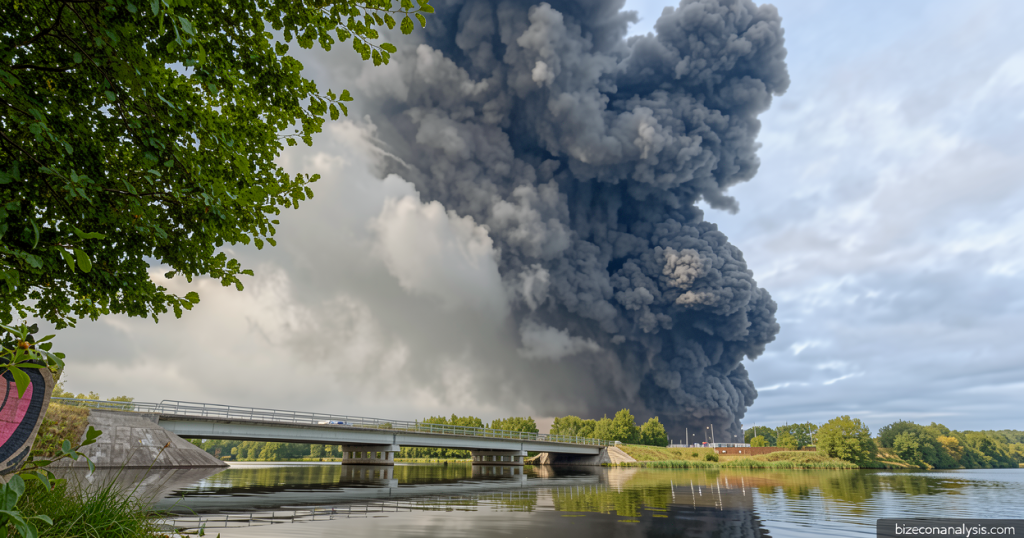
Ukraine Launches Hundreds of Drones at Russia
Bizeconanalysis.com – In one of the largest aerial operations since Moscow’s invasion began in February 2022, Ukraine launches hundreds of drones deep into Russian territory on a single Sunday night, killing at least six civilians and setting ablaze commercial facilities far from any active front. The simultaneous multi-region barrage marks a decisive escalation in Kyiv’s long-range strike doctrine — a shift from reactive counterattacks to sustained campaigns designed to erode Russia’s industrial output and domestic economic confidence.
Moscow Region Absorbs the Largest Share of the Barrage
Russia’s defense ministry tallied 822 intercepted drones across the overnight operation. Mayor Sergei Sobyanin said roughly 600 were tracked on approach vectors aimed at the capital, with about one-third destroyed over the Moscow region before reaching the city limits.
The human toll extended well past military installations. Regional Governor Andrey Vorobyov confirmed that an 83-year-old resident died when a drone struck his private home in the Moscow suburbs. In nearby Podolsk, another impact ignited a blaze at a Wildberries distribution warehouse — a target Kyiv has repeatedly singled out for its outsized role in Russian consumer commerce.
Rostov Region: Five Dead Across Three Towns
A second wave swept southwestern Russia. Governor Yury Slyusar reported that more than 150 drones were aimed at three separate towns within Rostov region, killing five people. Residential buildings and a railway station sustained damage, and the strikes also sparked a forest fire in surrounding countryside. Coordinating simultaneous hits on multiple populated centers appears calculated to overstretch Russian air-defense coverage across a broad geographic arc.
Why Wildberries Warehouses Keep Drawing Fire
The recurring targeting of Wildberries depots is deliberate economic warfare. As Russia’s largest online retail platform, the company stores billions of dollars in consumer goods inside sprawling distribution centers nationwide. Setting those facilities ablaze inflicts direct financial damage on a major domestic corporation while sending an unmistakable signal to ordinary Russians that the conflict has reached their own neighborhoods — through destroyed merchandise, disrupted supply chains, and visible smoke over suburban rooftops.
Kyiv’s long-range tempo has intensified markedly this year. Drone swarms now routinely pair with cruise and ballistic missiles aimed at military-industrial plants, energy infrastructure, and logistics hubs deep inside Russian territory. The operational pattern reflects both expanded Ukrainian drone production and a strategic bet that sustained attrition of rear-area assets will compound pressure already applied along the front.
Russian Retaliation Hits Ukrainian Cities
The exchange ran in both directions. President Volodymyr Zelenskyy posted on social media that a Russian missile strike on Kryvyi Rih killed two people and wounded fourteen, while a separate individual died in Sumy. In Zaporizhzhia region, military-administration head Ivan Fedorov confirmed that a man and a woman were killed when their home was struck. Across Kyiv, additional impacts set multiple fires and injured six more.
“Wherever the Russians can reach with their ballistic missiles, they strike civilian infrastructure,” Zelenskyy said. “Since this morning, air raid alerts have continued in many regions — the Russians launched another wave of drones.”
The pattern Zelenskyy described mirrors a broader Russian operational choice: expending expensive ballistic and cruise missiles against population centers to generate political pressure while reserving shorter-range systems for front-line tasks. For Ukrainian civilians, the consequence is a near-constant state of alert now woven into daily life across dozens of oblasts.
Moscow’s defense ministry framed its own strikes differently, claiming hits on a metallurgical plant in Kryvyi Rih and several military-industrial sites within Kyiv, including a manufacturing facility tied to Ukraine’s domestically produced Flamingo cruise missiles — positioning the attacks as aimed at industrial capacity rather than civilian targets.
Frequently Asked Questions
How many drones did Ukraine send in this operation?
Russia’s defense ministry reported intercepting 822 drones overnight. Ukrainian officials have not published a separate launch count, but the scale places this among the largest single-night aerial operations of the war.
Why does Kyiv repeatedly target Wildberries warehouses?
Wildberries is Russia’s largest online retail platform. Striking its distribution centers inflicts direct financial losses on a major domestic corporation and disrupts consumer supply chains, delivering both economic damage and a visible message that the war affects everyday life far from the front.
Were any civilians killed in Russia during this attack?
Yes. At least six civilians died: one 83-year-old man in the Moscow region and five people across three towns in Rostov region, according to regional governors’ statements.
What did Russia strike back at Ukraine on the same day?
Russian missiles hit Kryvyi Rih (two killed, fourteen wounded), Sumy (one killed), a home in Zaporizhzhia region (a man and a woman killed), and multiple locations across Kyiv (six injured). Moscow’s defense ministry claimed the targets included a metallurgical plant and facilities linked to Flamingo cruise-missile production.