
Top drug trafficker “Macho Coca” and cartel member “Compadre” extradited to U.S. from Costa Rica
Costa Rica Sends Two Major Drug Traffickers to Face U.S. Justice
Bizeconanalysis.com – Costa Rica has strengthened its position as a key player in international law enforcement by extraditing two prominent figures in the drug trade to the United States. The operation, completed on Thursday, involves Gilbert Bell Fernandez and Gabriel Lozano Bonilla, both of whom will now face federal charges in American courts for their roles in transnational narcotics trafficking.
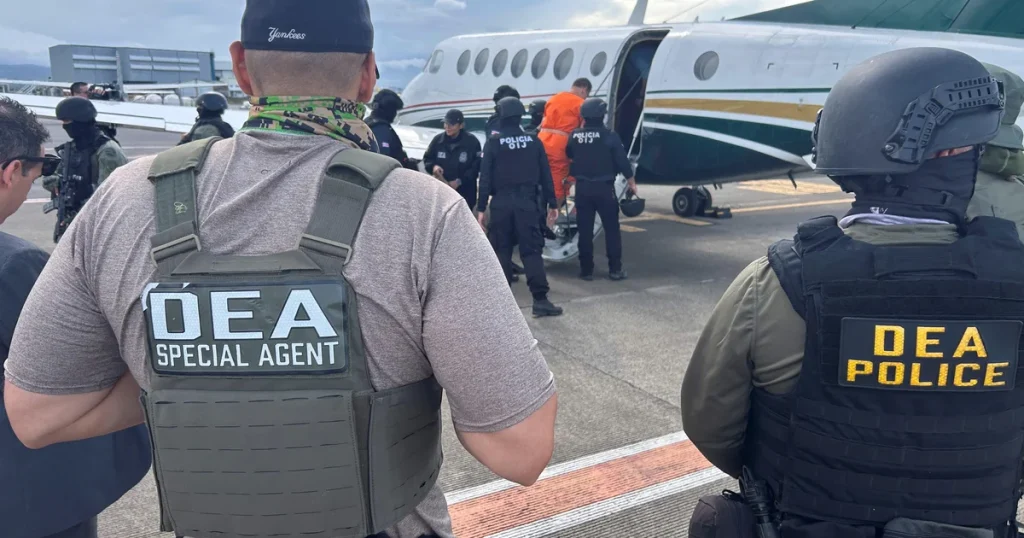
The two men departed from Juan Santa Maria International Airport, located northwest of the capital city of San Jose, and were transported to New York where they will begin their legal proceedings. The extradition marks a significant moment for Costa Rica’s justice system, which has undergone substantial reforms in recent years to better handle international criminal cases.
The Principal Defendants
Gilbert Bell Fernandez, 63, is a Costa Rican businessman who has earned the nickname “Macho Coca” within criminal circles. The U.S. Treasury Department has recognized him as one of the most influential drug traffickers operating in Costa Rica. According to Treasury officials, Bell Fernandez is distinguished not merely by the sheer volume of narcotics he transports but by the aggressive methods he employs in his operations.
Bell Fernandez was formally added to the U.S. Treasury’s sanctions list in 2023, a designation that freezes his assets within American jurisdiction and prohibits U.S. citizens from conducting financial transactions with him. His inclusion on this list signaled Washington’s growing concern over his expanding influence in Central American drug routes.
Gabriel Lozano Bonilla, known as “Compadre,” is a Colombian national who has become a naturalized Costa Rican citizen. Beyond his connections to the United States, Lozano Bonilla is also allegedly involved in shipments of liquid cocaine destined for markets in Europe and Asia, demonstrating the global reach of his operations.
Cartel Connections and Criminal Activities
Costa Rican Attorney General Carlo Diaz provided crucial details about the defendants’ organizational affiliations during a press conference. Diaz confirmed that the U.S. Drug Enforcement Administration has linked both men to the Gulf Clan, a powerful Colombian criminal organization. This cartel has been designated by the United States as a Foreign Terrorist Organization, reflecting the severity of its activities and the threat it poses to international security.
Both Bell Fernandez and Lozano Bonilla are accused of participating in the systematic trafficking of cocaine from Costa Rica to the United States on behalf of the Gulf Clan. Their operations have contributed significantly to the flow of narcotics through Central America, a region that has become increasingly important in the global drug trade.
Bell Fernandez expressed relief at the prospect of being removed from Costa Rica. “I thank the United States for taking me out of this country. They are saving my life,” he stated, adding that he had experienced mistreatment while imprisoned in Costa Rica.
Security and Political Context
The extradition operation was conducted with considerable security measures. Local media documented that both men were transported to the airport wearing bulletproof vests and helmets, accompanied by a tight security detail. This level of protection underscores the potential danger posed by these high-profile criminals and their associates.
The political environment in Costa Rica has been particularly receptive to aggressive anti-drug measures. President Laura Fernandez, a right-wing leader and close ally of President Trump, took office in May with a commitment to confronting organized crime. During her inauguration, she pledged a “firm hand” against drug trafficking, declaring that her “hand will not tremble when confronting organized crime.”
Costa Rica, home to approximately 5.2 million people, has traditionally been celebrated as an oasis of stability and democracy in Central America. The nation is renowned for its pristine white-sand beaches and commitment to environmental conservation. However, the country has experienced a transformation in recent years, evolving into a critical logistical hub for the regional drug trade.
This evolution has not been without consequences. The influx of drug-related activities has fueled local turf wars among competing criminal organizations, contributing to a dramatic increase in the country’s murder rate. The security challenges have become increasingly visible to both domestic and international observers.
Constitutional Reforms and Extradition History
A pivotal development in Costa Rica’s approach to international justice was the constitutional reform enacted in 2025. Promoted by former President Rodrigo Chaves, who preceded Laura Fernandez, this reform enabled the country to extradite its own citizens to foreign nations for prosecution. Prior to this change, Costa Rica had limited ability to send its nationals abroad to face criminal charges.
Since the implementation of this reform, Costa Rica has extradited several notable figures to the United States. Among them are Celso Gamboa, a former security minister and judge accused of drug trafficking, and his alleged associate Edwin Lopez Vega, known by the alias “Pecho de Rata.” These cases demonstrate the country’s growing willingness to cooperate with international law enforcement agencies.
Celso Gamboa was formally indicted by the U.S. Justice Department on July 9, 2025. The indictment charges him with conspiring alongside other international drug traffickers to manufacture and transport substantial quantities of cocaine. His case, along with those of Bell Fernandez and Lozano Bonilla, highlights the increasing coordination between Costa Rican and American authorities in combating organized crime.
The extradition of these two major traffickers comes shortly after Costa Rica captured its most-wanted fugitive, known as “Diablo.” This criminal had been sought by the United States for alleged drug trafficking activities and carried a $500,000 bounty on his head. The successful capture of “Diablo” further demonstrates Costa Rica’s enhanced capabilities in apprehending high-profile criminals.
As Costa Rica continues to develop its role in international drug enforcement, the outcomes of these cases will likely influence both domestic policy and regional cooperation efforts. The nation’s commitment to confronting organized crime, combined with its strategic geographic position, positions it as an increasingly important partner in the global fight against narcotics trafficking.
Related Reading
Frequently Asked Questions
What is Top drug trafficker Macho Coca and cartel?
Top drug trafficker Macho Coca and cartel is the main topic of this guide. The article explains the context, practical details, and next steps readers should understand.
Why does Top drug trafficker Macho Coca and cartel matter?
Top drug trafficker Macho Coca and cartel matters because readers are looking for a useful answer, not just a short summary. Good content should match search intent and help them decide what to do next.