
SpaceX rocket booster slams into moon, creating crater that could be 16 feet deep
Spacecraft Debris Creates New Scar on Lunar Surface in Rare Man-Made Collision
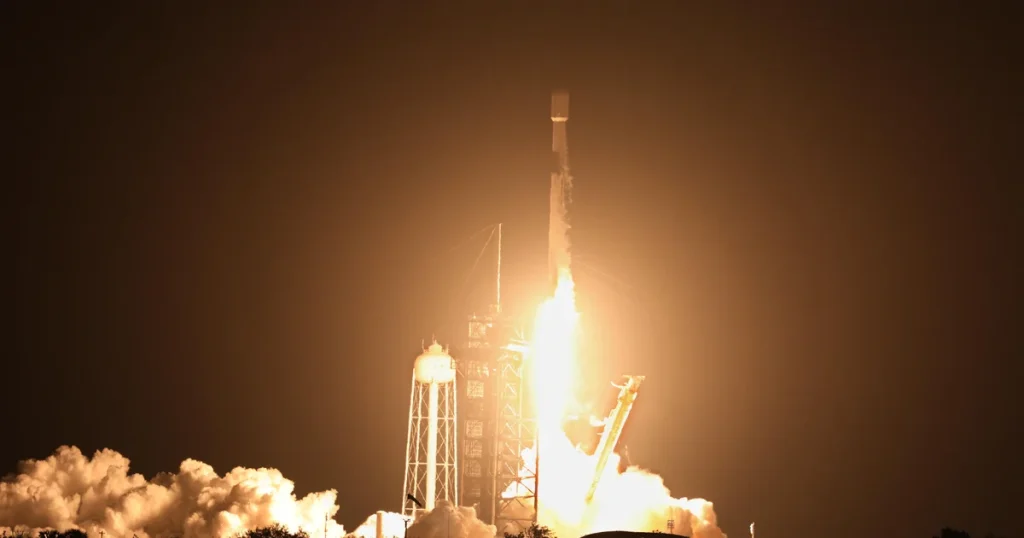
Bizeconanalysis.com – A massive piece of human-made space hardware has carved a fresh wound into the moon’s ancient face, marking one of the most significant artificial impacts on the lunar surface in recent decades. The 8,800-pound upper stage of a SpaceX Falcon 9 rocket struck the moon’s surface in the early hours of Wednesday, creating a crater that scientists estimate could reach depths of 16 feet and span 100 feet across.
The collision occurred at an astonishing velocity of 5,400 miles per hour, generating an impact force equivalent to nearly three tons of TNT. This tremendous energy release sent debris flying across the lunar landscape, creating a plume of gas that astronomers were able to detect from Earth.
Scientific Observations Reveal New Details
Carl Schmidt, a planetary scientist at Boston University’s Center for Space Physics, noted the rarity of such events. “There’s only so many times where events like this will occur, and it gives us a chance to understand how the atmosphere of the moon works,” Schmidt explained. “It’s happened twice in my lifetime.”
There’s only so many times where events like this will occur, and it gives us a chance to understand how the atmosphere of the moon works. It’s happened twice in my lifetime.
The detection of the impact relied on sophisticated spectroscopy techniques. The Very Large Telescope in Chile captured a plume of sodium and lithium gas rising from the collision site. Simultaneously, another researcher monitoring from Sudbury, Massachusetts, recorded a sodium emission that corroborated the event.
What makes this particular impact scientifically valuable is its location on the illuminated side of the moon. Researchers had previously noted that no natural or artificial impact flash had ever been successfully observed on the lit portion of the lunar surface. The challenging conditions—bright sunlight washing out the faint flash of impact—meant that even observers equipped with powerful telescopes were not expected to witness the collision directly.
How a Rocket Stage Found Its Way to the Moon
The wayward booster had a complex journey before its final descent. Originally launched in January of last year, this upper stage had served a critical mission: propelling two lunar landers toward their destination. Firefly Aerospace’s Blue Ghost-1 achieved a successful landing on the moon’s surface, while Japan’s ispace Hakuto-R experienced a more dramatic crash-landing.
After releasing its cargo, the Falcon 9’s second stage continued drifting through space. Julianna Scheiman, SpaceX’s director of NASA Science and Dragon Programs, clarified that the company had followed all appropriate regulations for proper disposal of the rocket stage. However, a combination of solar activity and gravitational forces gradually altered its trajectory, eventually placing it on a collision course with the moon.
As a scientist, I also am very excited to see the observation.
NASA’s Center for Near Earth Object Studies at the Jet Propulsion Laboratory in Southern California independently tracked the booster’s path using publicly available orbital data. Their calculations confirmed that the second stage had a 100 percent probability of striking the lunar surface.
Historical Context of Man-Made Lunar Impacts
While the moon experiences constant bombardment from natural objects like meteoroids, artificial impacts remain relatively uncommon. The first human-made object to strike the moon was an intentional collision launched by the Soviet Union in 1959. During the Apollo program between 1969 and 1972, several U.S.-built spacecraft components were deliberately crashed into the lunar surface.
More recent artificial impacts include a Japanese robotic probe in 1993 and a European Space Agency satellite in 2006. Perhaps most notably, NASA intentionally crashed a rocket upper stage into a permanently shadowed crater at the moon’s south pole in 2009. That impact revealed a plume of material that had never been exposed to direct sunlight for billions of years, ultimately confirming the presence of water ice at the lunar south pole.
Implications for Future Lunar Exploration
The recent SpaceX booster collision offers scientists valuable opportunities to study how ejecta plumes behave during impacts. Understanding these dynamics helps refine geological models that will guide future lunar missions and exploration efforts.
NASA scientists plan to collect comprehensive data from this event, using it to improve techniques for tracking objects in space. The Lunar Reconnaissance Orbiter, a satellite that continuously orbits the moon, captured before-and-after photographs of the impact site. These images are expected to be available within one to two weeks, allowing researchers to analyze the crater’s dimensions and composition in detail.
The booster’s mass distinguished it from most natural lunar impactors, even though it traveled at considerably slower speeds than typical meteoroids. NASA noted that a meteoroid carrying equivalent energy strikes the moon approximately every six days, meaning the lunar surface constantly absorbs impacts of similar force. This particular event, however, provides a unique opportunity to study an artificial impact under controlled conditions with known parameters.
As humanity prepares for increased lunar activity, including potential crewed missions and permanent settlements, understanding how the moon responds to impacts becomes increasingly important. Each collision, whether natural or man-made, contributes to our growing knowledge of this celestial neighbor and helps ensure the safety of future explorers who will walk on its surface.
Related Reading
Frequently Asked Questions
What is SpaceX rocket booster slams into moon?
SpaceX rocket booster slams into moon is the main topic of this guide. The article explains the context, practical details, and next steps readers should understand.
Why does SpaceX rocket booster slams into moon matter?
SpaceX rocket booster slams into moon matters because readers are looking for a useful answer, not just a short summary. Good content should match search intent and help them decide what to do next.