
Did a Louisiana father use his 6-year-old son as an alibi for murder?
A Louisiana Father’s Guilt: A 6-Year-Old Son’s Alibi in a Cold Case Murder
Did a Louisiana father use his 6 – For over two decades, Reginald Reed Jr., affectionately called Reggie, lived with the haunting uncertainty of his mother’s death. Selonia Reed, a bank teller, was 26 years old when her body was discovered in her car near Hammond, Louisiana, in August 1987. The day of the tragedy remains a shadowy memory for Reggie, who recalls only fragments: his mother purchasing a chocolate chip cookie at the Hammond Square Mall and a final kiss before she vanished. Everything else is a blur, but the emotional toll of those missing years has shaped his life.
The Discovery and the Missing Report
A sweltering August afternoon marked the moment Selonia’s body was found inside her blue Chevrolet Sprint, parked in a secluded lot just over a mile from the Reed family home. Authorities concluded she had been brutally beaten, stabbed multiple times, and stripped naked before being sexually assaulted. The crime scene hinted at a deliberate act, yet the exact sequence of events remained elusive. Selonia’s husband, Reginald Reed Sr., had reported her missing just an hour prior to the discovery. His account, however, would become central to the investigation that followed.
Reginald told police that Selonia had informed him the night before she was going out with a girlfriend. The girlfriend, later interviewed by authorities, contradicted this claim, stating the pair had no prior plans to meet. Despite the inconsistency, Reginald’s story held firm. His account painted a picture of a mother who had left for a routine outing, unaware of the danger awaiting her. The details of that evening, however, would soon be challenged by the truth.
The Alibi That Shaped a Child’s Memory
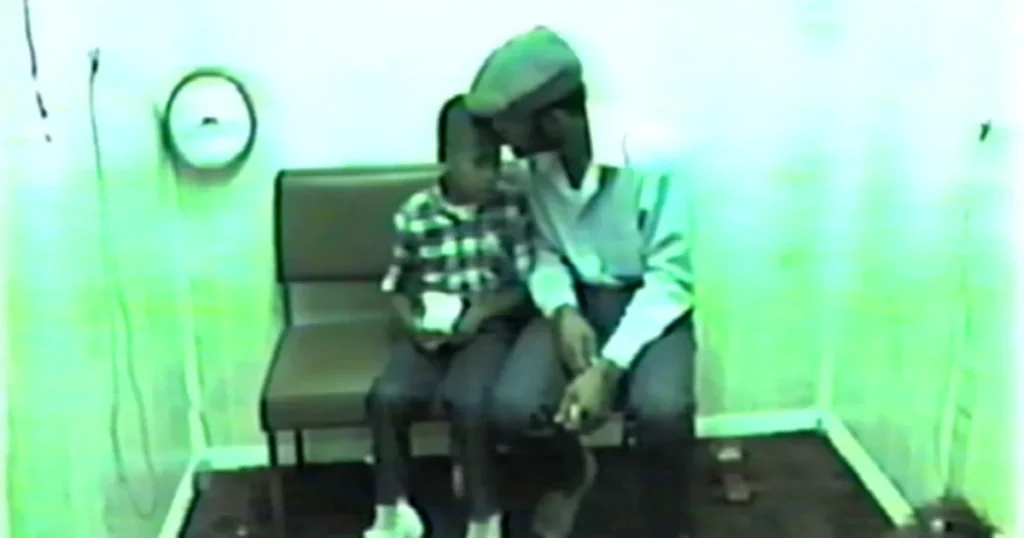
As the investigation progressed, police uncovered troubling information about Reginald’s relationship with Selonia. She had confided in relatives that her husband was physically abusive and discussed her desire to divorce. These revelations made Reginald a prime suspect, yet his son Reggie, then just six years old, remained unaware of the accusations. Police questioned Reggie after securing permission from his father, and the interview was recorded on video. Reggie, under the impression that his parents were together, claimed they had spent the evening playing video games and sleeping on the same sofa bed. His testimony effectively served as an alibi for Reginald.
Years later, watching the video of his childhood self, Reggie was struck by the emotional weight of his words. He recalled the moment he had cried, begging for his “mommy” and “daddy” as he described the events of that night. “I just can’t imagine what it’s like as a 6-year-old to have to sit there,”
said Vladimir Duthiers, a contributor to the “48 Hours” investigation. “Looking at that, it’s still hard to believe that that’s me,” Reggie added, his voice trembling. “Watching that video just brings back so … so many questions and — and pain because … I see me crying.”
From Memory to Revelation
Reggie’s account, once a simple childhood recollection, would later become a pivotal piece of evidence. His memoir, titled “The Day My Mother Never Came Home,” delves into the emotional journey of a boy forced to testify against his father. For years, he struggled to reconcile the loving parent he knew with the man who might have been responsible for his mother’s death. That tension came to a head in 2012 when a Texas Ranger visited his home with a startling revelation: Reginald was the prime suspect in Selonia’s murder.
At 31 years old, Reggie had graduated college and was working for a pharmaceutical company near San Antonio. “I was like, where’s this coming from?” he told “48 Hours.” “I remember asking, is there any new evidence that was surfaced?” The question lingered as he processed the possibility that the man who had raised him could have been a killer. Over the next few years, new evidence would emerge, leading to a breakthrough in the case. Lieutenant Barry Ward of the Louisiana State Police, the lead investigator, pieced together details that pointed to Reginald’s guilt.
The Trial and Its Aftermath
In November 2022, Reginald Reed Sr. was found guilty of second-degree murder for Selonia’s death. The trial revealed a chilling scenario: police believed he had murdered his wife in their bedroom while Reggie slept, then transported her body to the car and placed it in the parking lot. His alleged accomplice, Jimmy Ray Barnes—a close friend—testified that he had met Reginald at the crime scene and seen him beside Selonia’s body in the vehicle. Barnes, in exchange for a five-year prison sentence, provided crucial testimony that sealed Reginald’s fate.
Despite the conviction, Reggie remains torn. “I want justice, but I didn’t think justice was gonna come at the price of my dad going to prison for life,” he told Duthiers. “Do you believe that your father murdered your mother?” Duthiers asked. Reggie’s response was one of uncertainty: “I don’t know … another question — do I think my dad had some involvement? Maybe. I don’t know though. I don’t know. So that’s where I’m just, it’s like a tug-of-war game.”
Reconciling the Past and Present
Reggie’s relationship with his father is now a complex mix of admiration and doubt. He credits Reginald for raising him, funding his private education, and instilling values that have shaped his identity. “Just knowing the type of father he is,” Reggie reflected, “I can’t just turn a page and just look at my father as a complete monster.” This sentiment underscores the emotional struggle of a man who has seen his family’s legacy fractured by the crime.
The case has also prompted Reggie to reexamine the role of his testimony. While his words initially shielded his father, they later became a symbol of the burden placed on children in criminal investigations. The video of his interview, now a stark reminder of his young vulnerability, has haunted him. Yet, the conviction of Reginald offers a measure of closure for the family. For Reggie, it’s a bittersweet victory, balancing justice with the loss of a cherished memory of his father.
As the years pass, Reggie continues to ponder the events of that fateful night. The truth, he admits, is still a puzzle. But the journey from childhood confusion to adult clarity has been transformative. Whether Reginald was the sole perpetrator or part of a conspiracy, the legacy of the crime endures, etched into the lives of those who knew him best. The story of Selonia Reed’s murder is not just about a father and son, but about the enduring power of memory, the weight of truth, and the fragile bonds of family.